





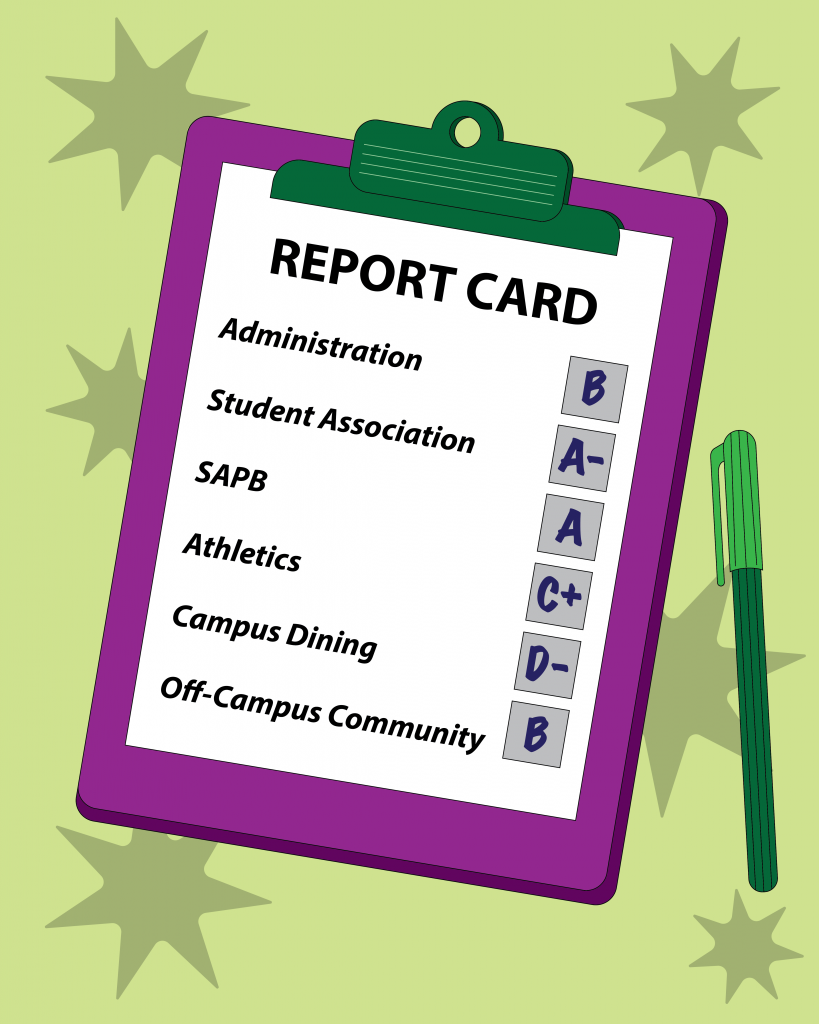
Administration: B
Determining this semester’s grade for the University’s administration was tricky, as leadership transitioned from former President Harvey Stenger to President Anne D’Alleva. The Editorial Board ultimately decided on a B grade based on both administrations, and we hope that any criticisms we have of Stenger’s final weeks as president can be addressed as D’Alleva settles into her role.
To start, the current administration has made great strides in connecting with students and addressing their feedback. In November, D’Alleva began her Listening to Lead Tour, meeting with students, faculty and staff across several schools and organizations. This initiative is a great way to directly connect with students, with stops that have so far included the SA’s Executive Board, multicultural organizations and the Graduate Student Organization. D’Alleva’s ongoing blog also highlights both positive and negative feedback from these groups, which is a good way to increase transparency and signal a willingness to listen to students and address their concerns.
Campus dining will be discussed in greater detail later in this report card, but the administration has also made good progress in addressing student concerns about health and sanitation in dining halls. In response to these issues, the administration announced that it has “implemented a series of comprehensive steps” to promote food safety, which include deploying food safety specialists to monitor food preparation late last month, auditing and reporting internal quality control and encouraging students to report any concerns. While these measures are a good first step to addressing the clear flaws in food safety across campus dining halls, we hope the administration implements other initiatives, such as those outlined in the SA Congress’ recent resolution to improve campus dining.
Additionally, we are concerned about the administration’s response to student protests this semester. In October, a B-Line announcement criticized a protest organized by Students for Justice in Palestine on Oct. 7, which was addressed in a previous editorial. This statement conveyed a confusing message that both affirmed students’ right to protest and suggested some gatherings should be curtailed if they are “insensitive.”
While this statement was issued under Stenger’s tenure, we also believe that the use of a University Police Department drone at a Nov. 21 protest for better campus dining conditions displays a similarly confusing message about student activism. Students should be able to express their opinions and organize without fear of excessive surveillance or punishment for their expressive activity, and using a drone to monitor a peaceful protest signifies a lack of trust and respect for student expression. We hope that future protests are handled with greater respect and consideration for student opinion.
Overall, D’Alleva’s administration has made significant strides toward transparency and addressing student feedback. We hope the administration continues to do so, particularly regarding expressive activity.
Student Association: A-
Compared to last year, the SA E-Board and Congress have effectively prioritized listening to students and addressing their concerns this semester. We were particularly pleased to see the SA Congress actively debate and pass resolutions regarding issues that deeply affect the lives of many at Binghamton University.
With the University’s Sodexo contract set to expire this year, campus dining reform is at the forefront of many students’ minds, particularly after all four dining halls were found to have numerous health code violations over the past five years. Echoing these calls, the SA Congress unanimously passed a resolution in November calling for improvements such as union protections for dining hall workers and greater transparency on food allergens.
A majority of SA Congress representatives also took an important stand in support of campus free speech. After weeks of debate, the congress passed a resolution condemning student doxxing and calling on the University to adopt its own version of the Chicago Statement on Free Speech and Expression. At a time when the federal government is pressuring colleges and universities to exert greater control over student activism, this resolution sends an important message about the value of allowing students to voice their perspectives on highly debated issues and protecting their privacy.
Additional measures were also enacted to promote greater transparency in how the SA functions. A new student feedback survey was released, giving students a direct opportunity to voice concerns with the SA Congress and suggest areas where elected representatives should focus their attention. Meetings are now also live-streamed on the SA website, eliminating the need for students to be physically present for long sessions.
Even though we are encouraged by the SA’s steps to improve student access and representation in its decision-making, some lingering concerns remain. The final version of the “Resolution to Protect the Right to Organize” was significantly revised from its original introduction, which originally denounced the University’s B-Line statement criticizing Students for Justice in Palestine for organizing a protest on Oct. 7, 2025.
While SA Congress representatives extensively discussed the University’s B-Line statement, we would have liked to see the SA address this controversy head-on.
Overall, we are pleased with the SA’s focused direction this semester and hope the organization continues to prioritize feedback from the student body.
Student Association Programming Board: A
This semester, the SAPB brought both viral sensations and nostalgic personalities to the University and the surrounding area. The board has continued to promote student engagement not only through Fall Fest and student flea markets, but also by featuring student performances at its biggest events of the semester.
Starting the semester off strong, the Festivals Committee hosted its annual Fall Fest, themed “Halloweentown.” The event featured live performances from student music and dance groups, including Kickline, MODA, BU Dance Team, Larj and the University Pep Band.
In late October, the board’s Comedy Committee brought iconic American actor and Nickelodeon personality Jerry Trainor to the Anderson Center stage. The event was a nostalgic experience for many students, with some bringing merchandise of Trainor from his iconic roles of Spencer Shay and Crazy Steve.
Perhaps the most anticipated event for students was the annual Fall Concert that brought Flo Milli to the Events Center stage. What was especially notable about this year’s concert, however, was having the student group Black Dance Repertoire featured as the opening act along with student musician DJ AFRANK. In past years, the board has brought other popular artists like Baby Tate and Kallitechnis to open for the headliner. The decision to promote on-campus organizations and artists not only offered a more student-focused experience but also provided a unique opportunity for them to showcase their art.
At the beginning of November, the Insights committee presented “An Evening with John Green” in the Anderson Center. Known for novels “The Fault in Our Stars” and “Paper Towns” and his YouTube presence on Crash Course and Vlogbrothers, the event proved to be a major hit. Tickets sold out, and Green ultimately left the audience with personal stories and inspiring advice. All in all, the show was a highlight for the SAPB this semester.
Consistent with the board’s goal of reaching off-campus students and commuters, the Binghamton Underground Music Presents committee hosted a rave in Downtown Binghamton. Recalling “pop-up raves” that occurred at the University in the early 2010s, the event gave multiple student DJs the opportunity to play their own live sets, with Juliana Huxtable, a popular DJ from New York City, headlining. After last spring semester’s lack of BUMP shows, the off-campus event was an energetic comeback for the committee.
With the past week’s flea market serving as the semester’s final event, we believe the SAPB has truly demonstrated its strength as a student-run organization through its distinct attention to both on and off-campus student engagement and opportunities. We look forward to seeing what the spring 2025 semester has in store.
Athletics: C+
Following a summer in which Binghamton’s Athletic Department announced notable program improvements, such as a new track and field complex and increased funding for athletic scholarships, its 2025 fall season was marked by a significant lack of postseason achievements, despite a handful of teams surpassing expectations.
As a whole, Binghamton Athletics had a mixed bag of performances this fall, but the program’s crowning achievement was the women’s soccer team’s historic 2025 campaign. Its program-best regular season performance culminated in an America East regular season title, but its all-time record 13-game unbeaten streak came to an end during semifinals with a 1-0 overtime loss to Maine.
Meanwhile, men’s soccer floundered, earning its lowest win total since the 2018 season, in a year where the AE contributed two seeded members to the NCAA championship for the first time in conference history.
Despite being selected to finish second-to-last in the AE preseason poll, the volleyball team finished just one game behind regular-season champions UMBC, earning the No. 4 seed before falling to the No. 1-seeded Retrievers in a five-set semifinal thriller.
Women’s cross country replicated its performance at the AE championships from a year ago, finishing in third place, while a historic campaign for the men culminated in a second-place finish, earning them the No. 13 position in the U.S. Track & Field Cross Country Coaches Association’s Northeast Region Cross Country Poll.
The men’s and women’s swimming and diving teams have gotten off to blistering starts to their seasons, tallying 5-0 and 4-2 records, respectively, before their return to competition in January. Similarly, despite not yet competing in any scored duals or Eastern Intercollegiate Wrestling Association events, the wrestling team has started strong under first-year head coach Ryan LeBlanc. Its 2025-26 campaign has been highlighted by the Black Knight open, where the team posted six placewinners.
The golf team saw incremental but notable growth from last year’s fall season, improving its overall placements in the Alex Lagowitz Memorial and The Goat events. Senior Brandon Conner picked up where he left off, willing the Bearcats to top-two finishes in the Blue Hen Intercollegiate and the Binghamton-hosted Matthews Auto Collegiate Golf Invitational.
The injury-addled men’s basketball team has struggled to open its fall campaign, picking up only three wins on the season. Women’s basketball, however, has shown signs of life in head coach Mary Grimes’ second year at the helm, particularly in a thrilling double-overtime victory over Akron.
As a whole, we believe that a grade of C+ properly expresses the performances of BU athletics this fall, with the failure to appear in a single AE championship game overshadowing the program’s achievements.
Campus dining: D-
As previously mentioned, the University’s campus dining has been a point of attention this semester. While the beginning of this year held hopeful promises among the dining halls, multiple recent health code violations have put a halt to students’ excitement. We believe there are many steps the University can take to adjust its dining initiatives before the next semester begins.
When the University Dining Services announced in August that it was partnering with Grubhub, students were elated by the service. With this partnership, students can use a mobile ordering app to order ahead at certain food spots, excluding dining halls. Students can connect their dining dollars to their accounts for free using Grubhub+ Student, making it a convenient option for busy students.
Additionally, BUDS implemented a variety of updates to dining services over the summer. After listening to students’ requests, new improvements included longer hours at the College-in-the-Woods Dining Center, partnerships with local food vendors and adding online nutrition facts for each meal.
However, despite efforts to improve dining and please students, campus dining has remained unsatisfactory. Revealed earlier this semester, several dining locations, including all four dining halls and the MarketPlace, have been discovered to have “critical” health code violations dating back to October 2023, with various “noncritical” violations also uncovered. These breaches range from the inappropriate use of utensils and equipment to the storage of food at inappropriate temperatures and the presence of insects or rodents.
These exposures have sparked outcry, prompting student involvement. In fact, the BU chapter of the Young Democratic Socialists of America recently held a student town hall where they outlined demands in a dining petition. The YDSA also organized a march for campus dining reform on Nov. 21, which gathered dozens of students together to advocate for better health and safety protocols, a new meal plan system and more diverse access to halal and kosher foods.
It is clear that there needs to be improvement within our dining services. With the University’s contract with Sodexo expiring this year, this provides an opportunity for BU to deeply consider the adjustments that can be made to its food services. This is crucial for the safety and happiness of students.
Off-campus community: B
This semester, the Greater Binghamton community has continued to offer students plenty of ways to engage through local events, restaurants and political happenings. Yet while these opportunities have been enjoyable and reliable, few have felt truly remarkable or innovative.
One success was this year’s LUMA festival. Thanks in part to State Sen. Lea Webb ’04, who helped secure a $10,000 grant to expand the festival, LUMA grew substantially this year and generated an estimated $1 million in just two nights. This kind of investment in local arts not only boosts the economy but also strengthens the relationship between students and the broader community. As LUMA continues to expand, we hope it remains a space where Binghamton’s longstanding traditions and the student body can meet, collaborate and build something lasting together.
Another highlight was this season’s Restaurant Week, a Binghamton tradition that allows students and the larger off-campus community to support local businesses each semester. With affordable prices and great selections, it is no surprise that Restaurant Week continues to be a success.
When it comes to delicious food options, the Binghamton area is also due for some exciting new culinary establishments. Qdoba, a Mexican fast-food chain, is set to open soon on Vestal Parkway, along with a highly anticipated Crumbl Cookies. As for local options, Baci and Ianni’s Trattoria, an affordable sit-down restaurant focused on homemade pasta, is anticipated to open on State Street in the near future.
While many off-campus experiences have been positive, this year’s mayoral race was underwhelming. Both candidates offered few new perspectives, and, although a focus of both campaigns, neither seemed prepared to adequately address Binghamton’s most urgent issue — housing. The campaign was further derailed by the resurfacing of a video of Democratic candidate Miles Burnett using the N-word as a teenager, which overshadowed substantive debate and made it difficult for many to support his potentially interesting policies.
Concerns about local accountability were also evident in October when former Binghamton Police Chief Joseph Zikuski resigned amid an investigation into an altercation involving his girlfriend and two teenage boys. Investigators later found he had violated several department policies, including wiping his city-issued devices.
Incidents like this reinforce the sense that local leadership is failing residents. With so many students whose votes could meaningfully shape local elections, we hope to see stronger candidates emerge alongside a renewed push for student engagement in the years ahead.
We are excited to see local businesses and events welcome students, but are disappointed with a lack of engagement from local politicians. Establishing a positive, inclusive off-campus environment is vital for fostering a more meaningful relationship between students and the local community. In large part, this is done by giving students a sense of belonging and by advocating for local issues they care about.