





On Oct. 7, Binghamton University issued an unsigned B-Line statement in response to a protest held on campus. Within the statement, the University affirmed “the right of all community members to express their views peacefully” while also stating that the protest was “viewed by many as deeply insensitive.”
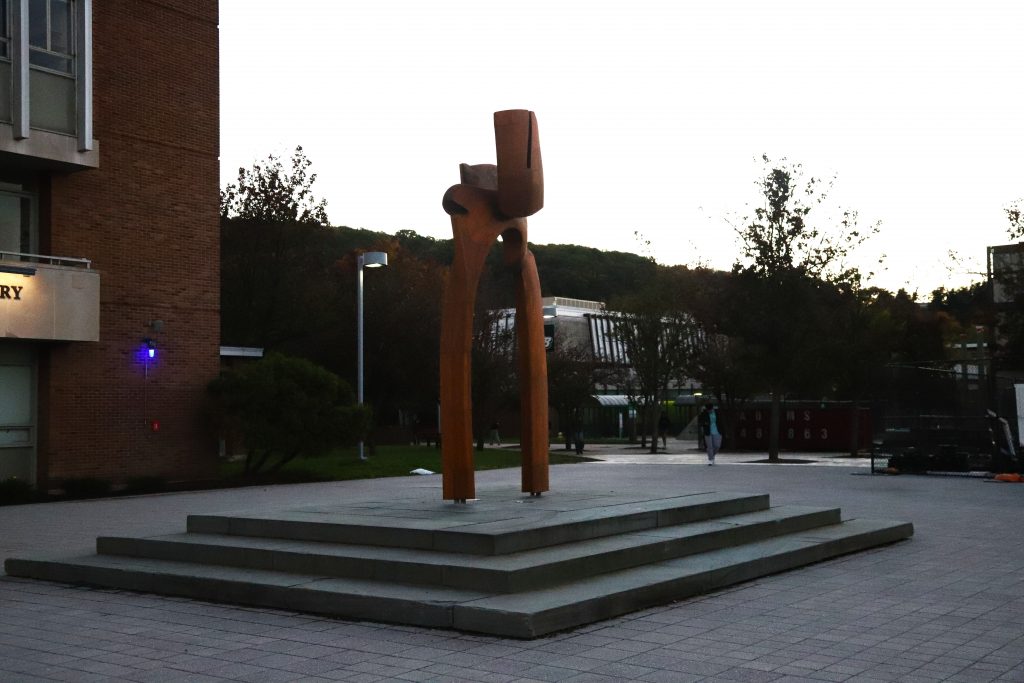
The protest, organized by Students for Justice in Palestine and joined by several allied groups, marched from the library bridge to the Pegasus Statue, where student speakers addressed a crowd. It drew a heavy police presence and a sizable counterprotest.
Although the B-Line described the protest as peaceful, the University nonetheless made an effort to condemn threats and acts of violence in the same statement. We acknowledge that administrators have a duty to condemn violence and harassment. However, doing so in the same statement where a protest is described as peaceful is both contradictory and disingenuous. It sends a message that is both confusing and counterproductive — that student activism is only tolerated when convenient.
While we sympathize with students who felt the timing of the protest was insensitive, especially considering the emotional weight the anniversary of Oct. 7 carries for many Jewish students, our administration bears a clear responsibility to uphold every student’s right to political expression.
Statements like this undermine the University’s supposed commitment to freedom of expression and foster an environment that discourages political demonstrations on campus.
In our current political climate, upholding freedom of expression is crucial. At anti-ICE protests in Chicago and Portland, protesters have been sprayed with tear gas and hit with rubber bullets and pepper pellets. In September, several New York politicians — including Brad Lander, New York City’s comptroller — were arrested for protesting at an ICE processing center in Manhattan. And last week, President Donald Trump claimed that an Aug. 25 executive order “took the freedom of speech away” from protesters who burn American flags, even though the Supreme Court ruled that flag burning can be considered symbolic speech protected by the First Amendment.
At this critical moment, our campus should strive to protect students’ right to peacefully protest, not discourage it.
Peaceful protests can spark meaningful dialogue among a politically engaged student body. Such events embody the very spirit of intellectual exchange that higher education is meant to nurture. Yet by discouraging these protests, the University undermines the very conversations it claimed to value in an August B-Line addressing expressive activity. In fact, in that B-Line, administrators stated they had a responsibility to “encourage faculty, students and staff to ask unexpected questions, foster open dialogue and develop innovative solutions to important problems.”
The administration has repeatedly positioned itself against student protest, and these most recent statements are simply the latest example.
Last fall, for instance, the University issued a B-Line announcement outlining campus protest policies, noting that “no right, however, is absolute” when it comes to freedom of expression. Such language does little to reassure students that their voices are truly welcome on campus.
Preaching accountability to student protesters on an unsigned statement is also blatantly hypocritical. How can our administration expect us to trust that they have our best interests at heart if they won’t hold themselves accountable for their beliefs? By leaving the statement unsigned, our administration ensures that no one can be held accountable for its contradictions.
Our campus is diverse, and with that diversity comes a wide range of beliefs and perspectives.
While the ongoing humanitarian crisis in Gaza is an exceptionally emotional and polarizing issue, treating political protests surrounding it any differently than others is not only unfair but raises serious free speech concerns. Universities should not selectively apply their commitment to free expression based on the popularity or sensitivity of a particular cause.
We firmly believe that the only way to foster genuine understanding across differences is through open dialogue — by engaging directly with those who see the world differently, and exchanging perspectives in an environment of mutual respect. While our administration frequently claims to uphold these values, its contradictory statements suggest otherwise.
Students have every right to feel uncomfortable, offended or deeply hurt by the messages expressed during the Oct. 7 demonstrations. However, students also have the right to express their political beliefs peacefully without fear of administrative reprimand.
Our concern is not rooted in being “pro-Israel” or “pro-Palestine” — it is about being pro-freedom of expression on this campus.
As a student newspaper, our duty is to defend the rights of all members of our community to voice their convictions, regardless of how divisive or unpopular those views may be.
The role of a university is to serve as a marketplace of ideas, not a gatekeeper of acceptable speech. Silencing or discouraging peaceful political expression, no matter the cause, only weakens that mission and undermines the foundation of higher education itself.
The staff editorial solely represents the majority view of the Pipe Dream Editorial Board. It is the product of discussions at regular Editorial Board meetings.