





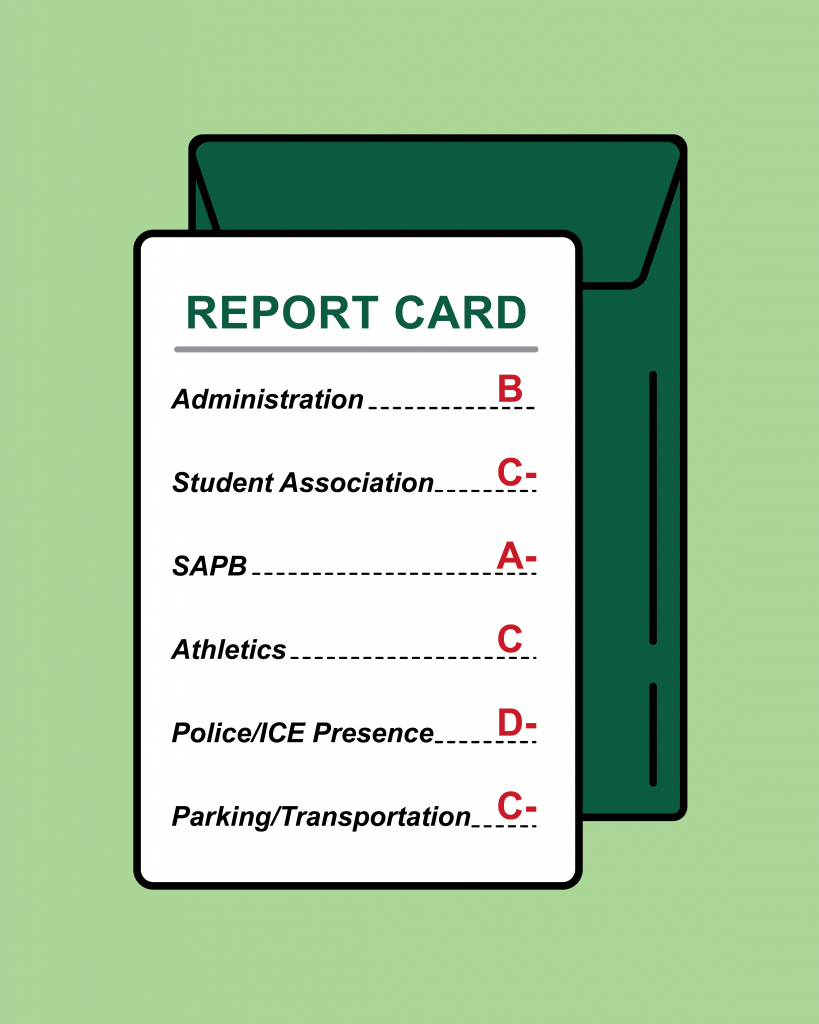
Administration: B
The administration has had a relatively quiet semester, taking no actions that motivate the Editorial Board to grant a higher or lower grade.
In her first five months in office, University President Anne D’Alleva has laid promising groundwork for the future, embarking on a lengthy listening tour and detailing a new “Strategic Plan,” but a lack of open communication over the Flock Safety contract and Immigration and Customs Enforcement on campus creates concern for the Editorial Board.
D’Alleva’s Strategic Plan, presented during her April 21 address to the Student Association, shows a structure for the future of her administration and details specific improvements she hopes to make for the University. Her five goals — to extend research opportunities to every student, transform graduate education, expand commitment to diversity, equity and inclusion, improve the University’s social economic impact and foster relationships to advance the common good — are notable advancements that would create positive change for the University should they be carried out successfully.
D’Alleva also announced a rebranding initiative to make the University more appealing to prospective students and improve its image both globally and nationally. We are optimistic about these changes and think this is a well-timed measure that could bolster and revitalize the University’s reputation.
However, the lack of communication about the University’s contract with Flock Safety, a security company that provides cameras and automated license plate readers, has caused tension. The administration has been uncommunicative and unreceptive to repeated calls from students to end the contract amid concerns with Flock’s history of cooperation with Immigrations and Customs Enforcement.
Additionally, at the April 21 meeting, students brought concerns to D’Alleva over the contract and were directed to the FAQ sheet online. D’Alleva told the students to only ask questions pertinent to the presentation.
According to the University Police’s webpage, the New York Driver’s License Access and Privacy Act of 2019 bars automated license plate reader information from being shared with ICE.
In the future, the Editorial Board hopes to see further care and effort by the administration to address students’ concerns, which pertain to their privacy and safety. Direct and open communication, rather than sidestepping contentious questions, would improve the relationship between the administration and student body.
Overall, it has been an unremarkable semester for the administration, and it has not done enough to warrant a better or worse grade from the Editorial Board. We are eager to see how the rebrand and Strategic Plan play out, but believe there should be greater transparency with students’ concerns about surveillance on campus, particularly over issues related to ICE.
Student Association: C-
The Student Association has passed many effective and productive pieces of legislation this semester. However, constant conflict between the Executive Board and the Congress, as well as unprofessional social media posting, has created dysfunction within the organization and distrust amongst the student body.
The SA notably created an official Department of Public Relations within the SA Congress in March to develop and grow its transparency initiatives. This move was part of a larger transparency campaign, which included initiatives like recording and making Congress meetings public, creating a new TikTok account and consistently posting on the SA Instagram to boost student awareness and trust.
The SA has also taken admirable measures to increase mental health awareness on campus. The Student Life and Academics Committee hosted a mental health town hall in March to create a space for students to share their difficulties with accessing and utilizing mental health resources on campus. The Student Life and Academics Committee also took over “the Noah Project,” an initiative launched last fall to promote campus mental health resources in honor of a student who lost his life in the spring of 2025.
Other important legislation included a resolution passed in March to urge administrative officials to place QR codes by water refill stations on campus so that users can report expired filters and the “Resolution to Bring Back Whimsy,” which aims to “promote a more joyful, spirited, and whimsical campus culture.”
Despite these efforts, the SA has had numerous issues this semester that have been detrimental to their productivity and relationship with the student body.
The E-Board and Congress have not worked in harmony. The E-Board vetoed a resolution to join the U.S. Student Association that was passed by Congress twice, without giving a clear reason as to why. Further, the E-Board ignored Congress’s decision not to release an SA-Line announcement drawing attention to the protest against the University’s collaboration with Flock Safety, posting the announcement despite the majority of Congress members voting against it.
The Congress also brought forth a resolution to impeach Nick Ginsberg, the executive vice president of the SA, for “insinuating and encouraging” the acquittal of an organization accused of violating SA rules, and disclosing confidential information related to the SA presidential race. While the resolution was tabled indefinitely, leaving Ginsberg in his role, the impeachment attempt illustrates a deeply dysfunctional relationship between members of the E-Board and Congress.
Issues over budget transparency fostered a sense of distrust among the student body and pointed to the flawed relationship between members of the SA. There was strong disagreement among members over whether group allocations should be publicly released, leading to the 2026-2027 budget being tabled when it was originally presented and public fighting between Congress and E-Board members. Some took to social media to post insults, making the SA appear unprofessional and unproductive.
Despite important legislation being implemented, the lack of professionalism exhibited by the SA has been deeply troubling. Considering these issues, the SA has much room for improvement next year.
SAPB: A-
While the Student Association Programming Board took a pause in announcing events in the beginning half of the semester, the Board successfully brought celebrated artists to campus events.
This semester’s events kicked off with nine groups competing at the annual Battle of the Bands, where Middle Management was crowned the winner and Spring Fling opener. The show was a collaboration between SAPB, Late Nite Binghamton and the Food Co-op, incorporating new elements at the event such as a pop-up flea market and a photo booth.
A month later, SAPB’s Binghamton Underground Music Presents held a two-act show in the University Undergrounds, showcasing the folk-pop duo @ and songwriter Dan English.
In March, SAPB hosted “An Evening With Debby Ryan.” Best known for her roles in Disney’s “Jessie” and “Radio Rebel,” as well as Netflix’s “Insatiable,” Ryan discussed her early childhood in the performance industry and reflections on growing up in the spotlight. The event included a large Q&A segment with a round of “This or That.”
SAPB brought 2016 to 2026 at the Spring Fling Concert last weekend, hosting rapper Fetty Wap as this year’s headliner. Ending the semester with a bang, Fetty Wap engaged with the crowd, calling audience members to the stage and showing off his vocal range in a capella segments throughout the show.
Ultimately, the gap in events from the SAPB’s Student Flea last December to Battle of the Bands, which occurred in early March, was of note. However, SAPB pulled through with diverse entertainment ranging from smaller artists and student performers to nostalgic figures — packing the middle to end of the semester with talent.
Athletics: C
Following a 2025 fall season where Binghamton’s Athletic Department failed to claim a single conference championship, the winter and spring 2026 seasons have brought more of the same for the Bearcats as Binghamton remains without a title for the 25-26 academic year.
The University announced that a new varsity women’s flag football team is set to begin play in early 2028, the University’s first new varsity program since the addition of the men’s and women’s lacrosse teams and jump to NCAA Division level in 2001.
Despite the postseason shortcomings, both baseball and softball are in prime positions to secure hardware. The softball team, fresh off an appearance in the 2025 NCAA Division I Softball Tournament, has secured the No. 2 seed in the upcoming America East Softball Championship after finishing with a 15-5 record in AE play. Meanwhile, baseball currently sits in first place in the conference as the lone squad to secure a berth in the AE Conference Championship.
In a campaign marked by several season-ending injuries, the men’s basketball team failed to qualify for the postseason for the first time since the 2019-20 season. However, the Bearcats were able to return star guard Jeremiah Quigley to the court, bolstering next year’s roster.
Women’s basketball flourished in its second season with head coach Mary Grimes at the helm, competing in its first playoff game since 2020. The team won its first postseason game in an electric home victory before ultimately closing its season with a loss in the second round of the Women’s National Invitation Tournament.
The men’s swim and dive team and the men’s tennis team both found substantial success in their 2025-26 seasons, each claiming second-place finishes in their respective conference tournaments. Men’s tennis earned the No. 1 seed in the Northeast Conference before falling to Wagner in the final of the NEC Tournament. Men’s swim and dive, coming off consecutive AE Championships, were unable to complete the three-peat, but the squad still earned a second-place finish alongside eight all-conference selections.
While the addition of the new flag football team bolsters our considerations, the Editorial Board feels that a grade of C effectively assesses the accomplishments of Binghamton’s sports teams as they continue to fight for their first conference title of the year.
Police and ICE Presence: D-
The rising national tensions surrounding ICE have become increasingly visible both on campus and within the greater Binghamton community. Arrests have increased as part of a nationwide increase in immigration enforcement by the Trump administration, and as of April 2025, Broome County was receiving $110 per detainee per day in federal compensation, which went to the Broome County General Fund. As of March 25, the Sheriff’s office reported that roughly 20 detainees were being held in the jail, after it stopped accepting those arrested on civilian warrants in February. It is still, however, accepting those arrested on judicial warrants — or those signed by a judge — rather than being issued by ICE itself. These actions illustrate that ICE’s presence is not abstract, but embedded in our local institutions.
At the same time, the city of Binghamton has taken meaningful steps to limit ICE’s presence. In December, the city council passed legislation prohibiting the use of city resources to cooperate with ICE. However, this measure does not apply to the Broome County Sheriff’s Office, whose 287(g) agreement, which “trains, certifies and authorizes [the agency’s] officers to serve and execute administrative warrants on aliens currently in [the] agency’s custody,” remains in effect.
In response to this increased presence, the past semester has seen protesters march both on campus and in the surrounding community. Student organizations — including the Young Democratic Socialists of America, the Latin American Student Union, SHADES, the Mexican American Student Association and Corazoncitos — have organized alongside local groups such as Citizen Action of New York, Indivisible Binghamton, Justice and Unity for the Southern Tier and the Broome County Democratic Party. While collaboration between local and campus communities is important, it is unfortunate that this has to be the issue we unite under.
As a campus with over 2,500 international students from over 100 different countries, this increasingly hostile environment has contributed to an atmosphere of uncertainty and anxiety. Students and community members alike should not feel unsafe or unwelcome in the place they live, study and work.
This semester, we have also seen police crack down on underage drinking, particularly by carrying out a growing number of bar raids. However, this increased presence has done more than just discourage underage drinking — it has also contributed to the broader sense of surveillance already being felt on and off campus due to the presence of ICE. We question whether dedicating significant time and resources to this issue should be a priority of the police department, given the wider concerns facing the community.
Overall, the presence of police and ICE this semester has felt excessive. Rather than making students feel safe, law enforcement has left us feeling on edge and, for some, unwelcome in their own community.
Parking and Transportation: C-
Access to reliable transportation and parking is vital. At the University, however, neither system has kept pace with campus growth and construction. While students are offered bus networks, tracking apps and parking permits, they continuously face inconveniences that can affect their success.
Off Campus College Transport, a bus service that students — especially those living off campus — heavily rely on for free transportation, is inconsistent. Students face delays and unpredictability, with buses often missing their stops or not showing up at all. Tracking tools like the SPOT app are also unreliable, as it is rarely up-to-date with live information, with students needing to go back and forth from SPOT to an online list of schedules and routes to find their bus.
About 7,000 of the University’s students live off campus, and OCCT is a main source of transportation. When an issue arises with their bus, students have to rethink how, or whether, they can make it to class on time.
Additionally, many of the last OCCT buses leave campus before midnight on weekdays, which can make it difficult for students to stay on campus later in the night to complete work or get involved in extracurriculars, particularly considering that Glenn G. Bartle Library and the University Union close at midnight.
While we understand that OCCT drivers are students, we believe that the University needs to work on making transportation more accessible for students by ensuring a consistent and reliable schedule is in place.
However, bus renovations, including new seating and upgraded information displays, demonstrate a commitment to improvement that we hope to see more of. The University must also confront the growing strain on its parking availability, which has increasingly become an issue due to ongoing construction across campus.
As new facilities — including the University’s proposed AI research center on the parking lot across from Bartle Library — take shape, sections of existing lots have been closed or will soon be repurposed. This limits convenient access to academic buildings. While parking is available in outer lots and paid parking spaces, this does little to address the time constraints students face while commuting to class.
For many, driving is necessary, especially when OCCT is known to be unreliable. If the University’s bus system were to improve, students may feel more inclined to use the public transportation offered — freeing up parking spaces and helping the University live up to its commitment to sustainability.
Ultimately, transportation and parking are increasingly interconnected as a result of large construction projects across campus. If the University wants to support student success, it must combat these accessibility problems in a comprehensive way through improving the reliability of OCCT, extending bus service hours and taking the parking situation seriously. Without these changes, a commute to class will consistently feel like an obstacle.