





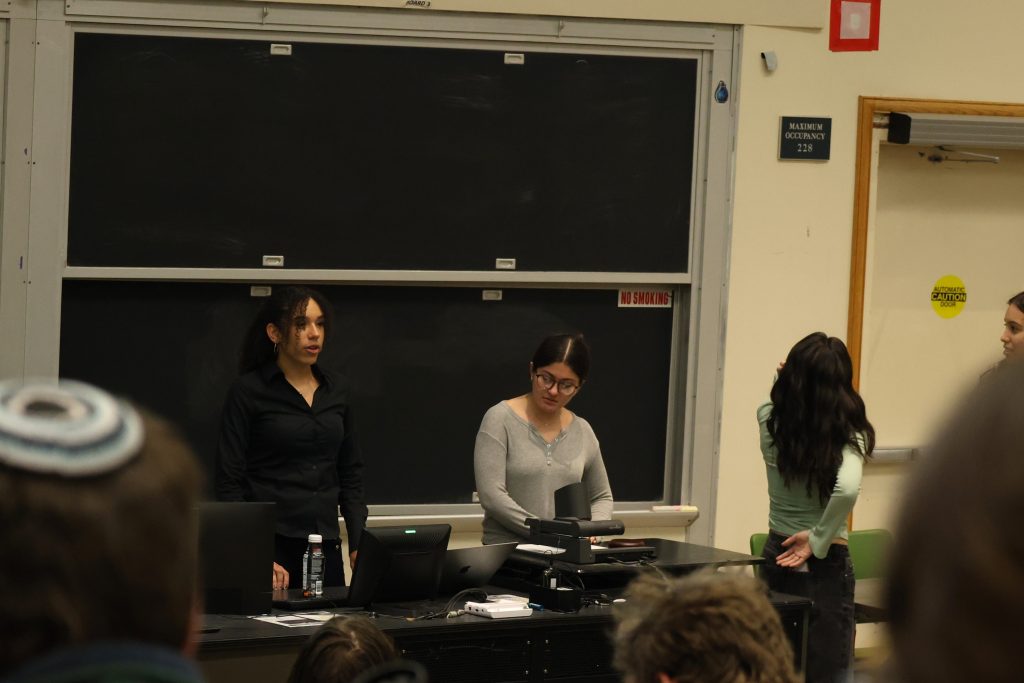
The Student Association Congress passed its 2026-2027 fiscal year budget at Tuesday’s meeting.
The budget process has drawn controversy in recent weeks over whether group allocations, or the amount of money each student organization receives from the SA, should be publicly released. In a survey released in an SA-Line announcement on Monday, 82.3 percent of respondents voted to publicly release group allocation as part of the budget.
“Serving on the Executive Board, I always prioritize the opinions of the student body,” Gabriela Meza, the vice president of finance and a senior majoring in economics, wrote in a statement to Pipe Dream. “Therefore, following the results of the survey, I was happy to share the full breakdown of the SA budget for the 2026-2027 fiscal year, which can now be found on the Financial Resources section of the SA Website. This breakdown is the most transparent budget the SA has ever provided, and I’m glad I had the opportunity to work with members of the SA and Congress to implement this new format.”
The projected budget lists the SA’s total income at $3,429,302.80, with the recent student activity fee increase creating an expected additional $264,530 in income. The SA’s total expenses are listed at $3,687,835.54, putting the SA at a projected $258,532.73 net deficit. The allocated club budget is listed at $715,940.
The SA promised to release this part of the budget if over 50 percent of people voted yes on the survey.
“What stood out most to me was the level of student engagement,” wrote Sasha Chalyavski, a Hinman College representative and a freshman majoring in political science, in a statement to Pipe Dream. “The strong response to the Transparency survey demonstrated that transparency is something the student body genuinely cares about. Regardless of differing perspectives within SA, that level of participation reinforced the importance of listening to student concerns and working toward solutions that reflect their priorities.”
Luke Fehily, a Hinman College representative and a freshman majoring in political science, said that the effort to introduce more transparency to the budget began months ago when he introduced the “Resolution to Establish Categorized Club Budget Transparency,” which made it so the “Group Allocations” portion of the budget had to be split into categories. The resolution was passed unanimously at the March 10 Congress meeting.
However, Fehily said that there was still pushback from “specific individuals” about releasing a complete line-by-line breakdown of the budget. He told Pipe Dream that he attempted to request the information from the SA President and the VPF, but was unsuccessful in attaining it, leading him and other Congress members to table the budget when it was originally presented during the April 21 Congress meeting.
The SA President declined to comment.
Fehily said that during negotiations about Congressional approval of the budget, an agreement to publish the survey was made.
“I hope that we see more transparency within the SA for years to come,” Fehily wrote. “The steps we took in passing a transparent budget will hopefully set the agenda for years to come regarding making the SA a more transparent and open place.”
Other members of Congress, including Chalyavski, Muhammad Bhatti, an off-campus representative and a freshman majoring in biology, and Ryan Eisenstein, a College-in-the-Woods representative and a sophomore majoring in politics, philosophy and law, encouraged students to support publishing group budget allocations in an Instagram reel and subsequent post made last week.
“This semester’s budget process raised a question that mattered: where does the authority over student money actually sit?” Bhatti wrote in a statement to Pipe Dream. “Undergraduate students pay a mandatory student activity fee. They have a right to know how that fee is allocated, and the elected representatives who approve those allocations have a responsibility to make that process visible.”
According to the post, information about $1,269,515 in group allocations and stipends — about 36 percent of the 2025-2026 Fiscal Year budget — was not made publicly available to the student body last year. Eisenstein told Pipe Dream this was a key issue in the push for transparency, especially given that the student activity fee has been raised to $115 per semester.
The video garnered criticism from other members of the SA, including Atticus Fauci, the current vice president of programming and a senior majoring in business administration.
“This nonsense (being pushed by freshmen who have never worked a day in their lives) is preventing actual work being done to help students and clubs,” Fauci wrote in an Instagram story responding to the video. “The budget is already public on the website, a resource these people clearly do not know about. This is nothing more than a classic waste of time from our SA Congress.”
At Tuesday’s meeting, Eisenstein read a statement condemning the comments on the post, saying that “it just makes the SA look bad.”
While the SA budget has always been available to view on the SA’s website, the specific amount allocated to each student organization was not public until the survey results required their release.
“The final, and perhaps the most important, reason we felt it was necessary to create content on this survey was the hesitance of the executive board to release the line-item group allocation budget, and this was clear from the initial conversations we held with SA E-Board,” wrote Eisenstein. “Given that the student activity fee is mandatory, we felt that transparency was necessary and long overdue.”