





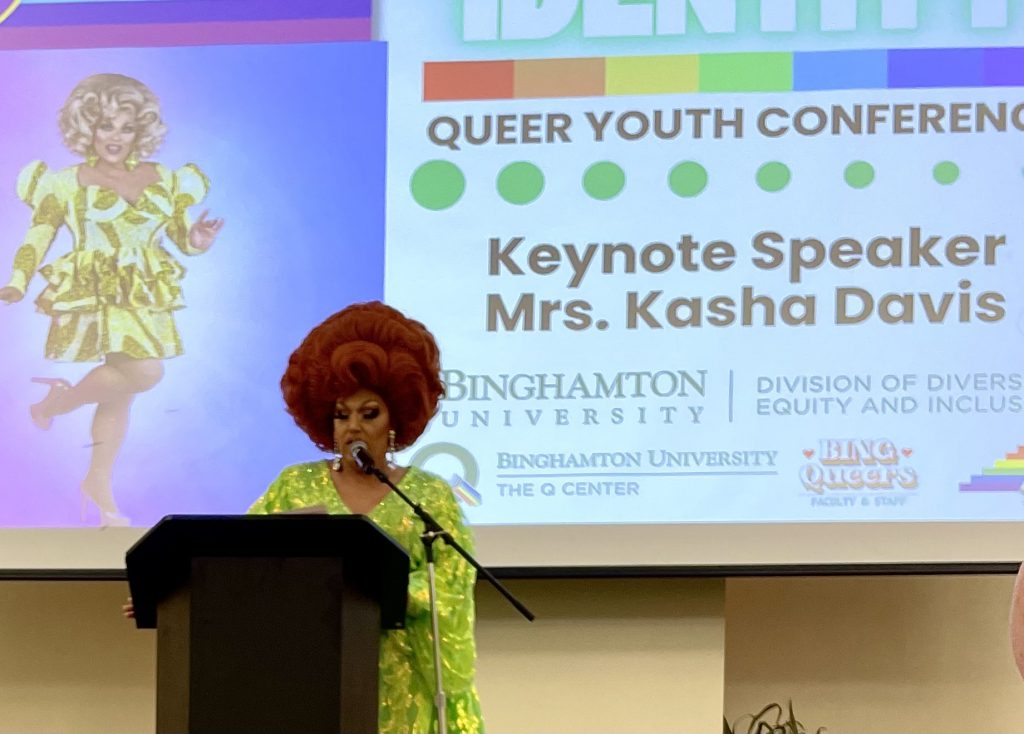
The Q Center invited more than 70 local middle and high school students to Binghamton University for an all-day event last Tuesday aimed at helping LGBTQ+ youth and allies find community.
Mrs. Kasha Davis, a Rochester-based drag queen who competed on the seventh season of “RuPaul’s Drag Race” and the eighth season of “RuPaul’s Drag Race All Stars,” gave the keynote speech at the conference. Held in the Mandela Room, it was hosted in partnership with the University’s Division of Diversity, Equity and Inclusion and the University’s Queer Faculty and Staff Affinity Group.
Since last year, Davis has taught a class at SUNY Brockport called Drag Culture, Theory and Performance. She told attendees on Tuesday that LGBTQ+ people and drag have existed across all time periods and that the community should stand together against attacks.
“Now we are living in a time like I’ve never seen in my 54 years,” Davis said. “Our so-called leaders engage in gross misconduct, constantly whipping up chaos, hate and anger, and they rapidly enact sweeping actions intended to stop progress and silence or eliminate people.”
“We will not be erased,” she continued. “Transgender, gay, gender nonconforming, drag queens, drag kings and every spectrum of people have existed since the beginning of recorded history, and we will continue to exist, no matter what laws are passed by a government or which words are deleted from a website.”
Davis discussed her struggles growing up in Scranton, Pennsylvania in the 1970s and 1980s. When she came out to her parents at the age of 28, they both reacted negatively.
She then moved to Rochester, where she attended her first Pride event and met her “chosen family,” including her husband, Steven Levins.
After competing on “RuPaul’s Drag Race” and traveling the country on tour, Davis said she began drinking alcohol daily and soon “hit rock bottom.” She is now 10 years sober.
“I like to speak about my journey in case anyone out there who you love is struggling with addiction, so they might be able to see and hear what I have to say and witness a person living a life that’s equally thrilling without substances,” Davis said.
Over the past two years, state legislatures across the country have passed or considered implementing laws aimed at targeting drag performances. In 2023, Tennessee enacted a law that bans “adult cabaret” performances at locations where minors are present and classifies “male or female impersonators” as part of adult cabaret. That same year, Montana’s governor signed a law explicitly banning drag artists from reading books to children at public schools or libraries.
In May, a federal appeals court ruled that a Florida law penalizing businesses that allow children to attend “adult live performances,” including drag shows, was likely unconstitutional and upheld an injunction blocking its enforcement.
Davis said these attempts to ban drag performances were an attack on the LGBTQ+ community.
“Drag is an opportunity for me to boldly encourage self-love, challenge gender norms and deliver messages of kindness — kindness toward oneself and to others,” she said.
She closed out her speech by talking about her father’s acceptance of her identity shortly before he passed away in 2018. While she was back in Scranton to perform, Davis’ father attended the show and told her she was “beautiful” while backstage.
Students then asked Davis questions on topics ranging from her favorite looks to the coming out process.
After her speech ended, youth conference attendees moved to Old Union Hall for lunch and a resource tabling event. Representatives from University offices like the Center for Civic Engagement, the Fleishman Center for Career and Professional Development and the Multicultural Resource Center answered student questions and distributed information.
Local LGBTQ+ organizations like the Identity Youth Center and Southern Finger Lakes Pride also tabled at the conference.
Nick Martin, associate director of the Q Center, told Pipe Dream that he thought it was important that Davis attended to show students that “anything’s possible if they would like it to be,” even with all the “external factors that are going on.”
Throughout the day, students and adults were invited to several breakout sessions hosted by student leaders and University offices to discuss issues like constructive dialogue, misgendering and peer education. Mentors and teachers also participated in a restorative circle and a talk about how to support LGBTQ+ students.
Emily Leighton, president of oSTEM at the University and a first-year graduate student studying adolescent education, led a presentation at the conference about the history of queer people in STEM fields.
“I think that queer representation is something that is necessary for today’s youth to see, learn, and enjoy,” Leighton wrote in a statement to Pipe Dream. “Growing up, I didn’t see a lot of people like me in my school, our GSA wasn’t even advertised to students, so I didn’t know it existed. It was awesome to see so many students come with their orgs.”