





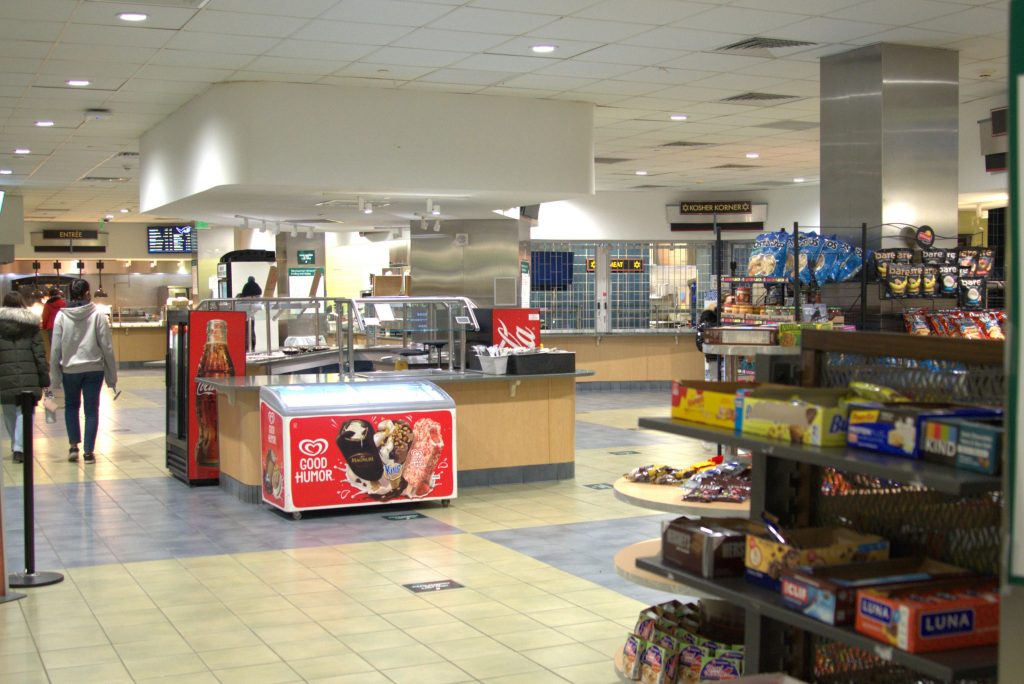
Several campus dining locations at Binghamton University were found to have multiple health code violations. According to data published by the Press & Sun-Bulletin, health inspectors at the Chenango Champlain Collegiate Center have documented numerous violations since Oct. 23, 2020, with the dining hall failing seven out of eight health inspections conducted since that date.
“Critical” violations were reported during five of these inspections, with most involving the improper storage of food at insufficiently cold or hot temperatures.
The six most recent health inspections also uncovered several “noncritical” violations, including the inappropriate use and storage of clean utensils and equipment. The most recent health inspection, completed on Oct. 16, listed “insects, rodents present” as a non-critical violation.
“Last year I saw large mouse traps in C4, I recognized them because I’ve had them outside my own home before, so I texted C4 feedback asking if they were precautionary or if there was a problem in C4,” Ari Ross, a senior majoring in economics, wrote to Pipe Dream. “In the past, the managers have responded to my texts, but this time I was left on delivered. Yet I know that the texts were read because the next day all mouse traps were gone without explanation, which was incredibly concerning to me.”
Hinman Dining Center, Appalachian Collegiate Center and the College-in-the-Woods Dining Center have also consistently failed health inspections. While both critical and noncritical violations have been found in the past five years at all three locations, no critical violations were reported in 2025. An Oct. 30, 2024 inspection found insects or rodents present in Hinman Dining Center.
Noncritical violations were also found at several retail locations in the MarketPlace.
“Every report or inspection finding is addressed immediately through thorough investigation, corrective action, and employee retraining,” Daniel McLain, the district manager of Dining Services, told Pipe Dream in a statement. “Our team follows strict food handling, storage, and sanitation protocols to prevent contamination and ensure compliance with local and federal regulations. When a violation occurs, we identify the root cause, implement corrective measures, and monitor progress to prevent recurrence.”
All food service on campus is run by the BU Dining Services, which partners with Sodexo. This includes dining halls and retail spots like Dunkin’, Starbucks and food outlets in the MarketPlace. BUDS approval is not required for events with food that cost less than $300.
BUDS operates with the Binghamton Auxiliary Services Corporation, formed in 2014 to “support student success and the educational mission” of the University by “devising ways and means of leveraging resources to create superior services and complementary revenue generating opportunities.”
“Regarding health inspections, any violations are completely unacceptable and Auxiliary Services has directed that Sodexo employ a third party to conduct inspections at its own expense,” a University spokesperson told Pipe Dream. “Additionally, we have implemented financial penalties for future violations.”
Sodexo has provided food at BU for the past 40 years. The University’s current contract with Sodexo, signed in 2014, is up for review this year.
All students living in on-campus housing are required to purchase a meal plan, except those living in the Apartments Community.
Student groups have called attention to issues in the dining hall beyond cleanliness. In March, the University’s chapter of the Young Democratic Socialists of America hosted a town hall allowing students to share their grievances against Sodexo and dining hall operations. The Student Association unanimously passed a resolution last year calling for improved dining accessibility and expanded kosher, halal and vegetarian options on campus.
Earlier this year, BUDS announced several updates to dining services, like expanding weekend hours in the College-in-the-Woods Dining Center and publishing nutrition facts for dining hall food on its website. At the time, the YDSA, which spearheaded many of these demands, told Pipe Dream that the response was not enough.
At the Oct. 21 SA Congress meeting, Jeremy Marcus, an off-campus representative for the Student Association Congress and a junior double-majoring in political science and economics, authored a resolution demanding more reforms to campus dining, including greater access to allergen food lists, replacing plastic containers and utensils with sustainable equivalents and longer hours for kosher and halal stations. If the resolution is passed, Marcus plans to discuss it with Sodexo and the University administration.
“It’s one thing when it comes from a typical club — it’s another thing when it comes from the Congress that represents 18,000 students,” Marcus told Pipe Dream. “And that’s what we wanted to do. We wanted to take that next step in hardball and I think this does it and it does it in a way that I don’t think any of these demands are too demanding. I think they’re all relatively feasible.”
Editor’s Note: Jeremy Marcus, who authored the resolution, was a former News contributor for Pipe Dream. He had no part in the writing or editing of this article.