





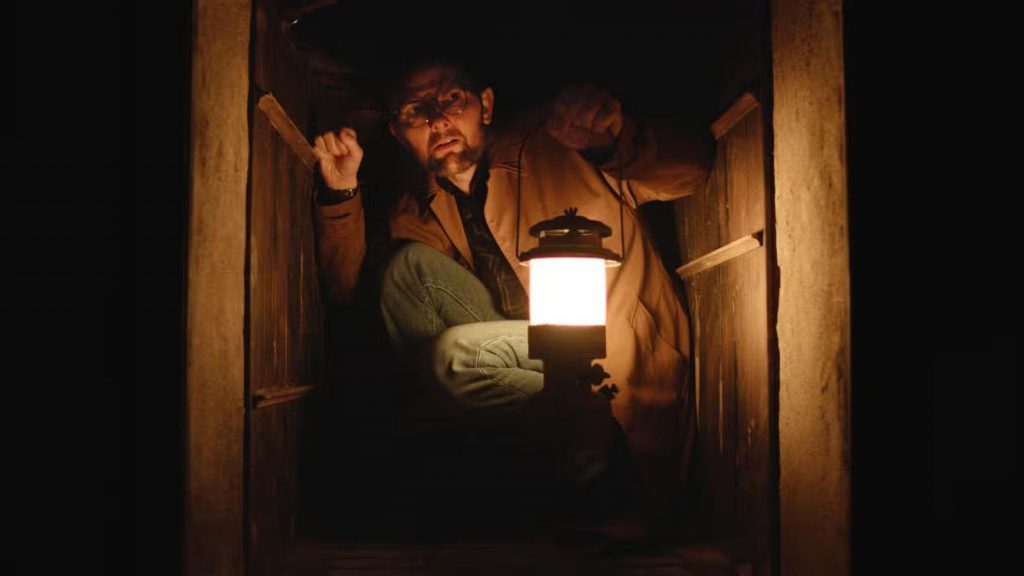
Neon’s newest horror film “Hokum” hit theaters on May 1. Directed by Damian McCarthy, who also directed “Oddity” and “Caveat,” “Hokum” follows Ohm Bauman, played by Adam Scott, a successful novelist who visits an Irish inn to bury his parents’ ashes, and quickly becomes intrigued by the story of the honeymoon suite, which is believed to be haunted by a witch. As he finds out more about the inn and honeymoon suite, his dark past continues to haunt him.
The film opens with Ohm deciding to visit the Bilberry Woods Hotel in rural Ireland, as he struggles to write the ending to his Conquistador novel trilogy. As he meets the hotel staff, he acts very rudely and harshly toward them. This includes Mal, the front desk clerk, whom Ohm is dismissive of when learning that Mal’s son is a fan of his novels, and Alby, a friendly bellhop, whom Ohm acts abrasively toward when told that Alby wants to be a successful writer like him. Though Ohm is established as a rude person, it is quickly revealed that his behavior stems from alcoholism and grief that arose from an accident that killed his mother when he was little, which is explored further throughout the film.
McCarthy’s direction enhances the suspense by creating an eerie atmosphere. He does a good job of producing anxiety-inducing moments in the third act. He takes advantage of the film’s set design, another strength, and creates unsettling imagery using figurines and unsettling faces that Ohm encounters in the hotel. Along with the cinematography and set design, McCarthy is able to effectively create a sense of dread that hangs throughout the film and creates nuance within Ohm’s character.
Scott delivers a great performance, utilizing silence to convey the problems his character experiences. He is able to sell Ohm’s grief and regret to the viewer, using that to build the fear in his character in the third act, elevating the panic of the film. However, his performance is not enough to save the second half, which falls into a range of horror cliches and excessive use of jump scares.
The weakest part of the film is its screenplay. Its main issue stems from its attempt to balance two plotlines: Ohm confronting his dark past in the honeymoon suite, and discovering the truth about the inn. While they are interwoven well at some points in the film, both storylines are fundamentally different. Ohm’s grief is the driving engine of the film. It is what makes him visit the inn, and his regret plagues his attempt to find out what happened to the suite.
However, the main mystery of the honeymoon suite is primarily plot-driven. It does not connect to Ohm’s guilt or grief well, and as a result, both of these story beats are half-baked. We only see Ohm’s relation to his mother through flashbacks or brief appearances of supernatural beings, and there is nothing unique about how the film explores his feelings. Additionally, the central mystery of the film feels very predictable and contrived, using generic story beats.
McCarthy incorporates a variety of jump scares, typically to show how Ohm’s past constantly haunts him. The shock effect works at the beginning of the film, but it feels very excessive by the third act. Not only does it become predictable and redundant, but it takes away from the unsettling atmosphere and slow-burn suspense that the film built up.
“Hokum” has its strengths: its direction and cinematography effectively create a sense of dread that fills Ohm and makes his character interesting to watch. Scott further enhances this with his performance, which uses his character’s silence to convey his guilt and regret. However, its uneven script attempts to dive into many different aspects of Ohm’s feelings and the hotel’s past, leading to the feeling that many ideas were left too shallowly explored. Aside from Ohm, we don’t get to know any of the characters very well, which tends to make them feel like plot devices.
“Hokum” is decently entertaining and contains a compelling character study, but it does have a lot of potential that isn’t reached.
Rating: 3/5