





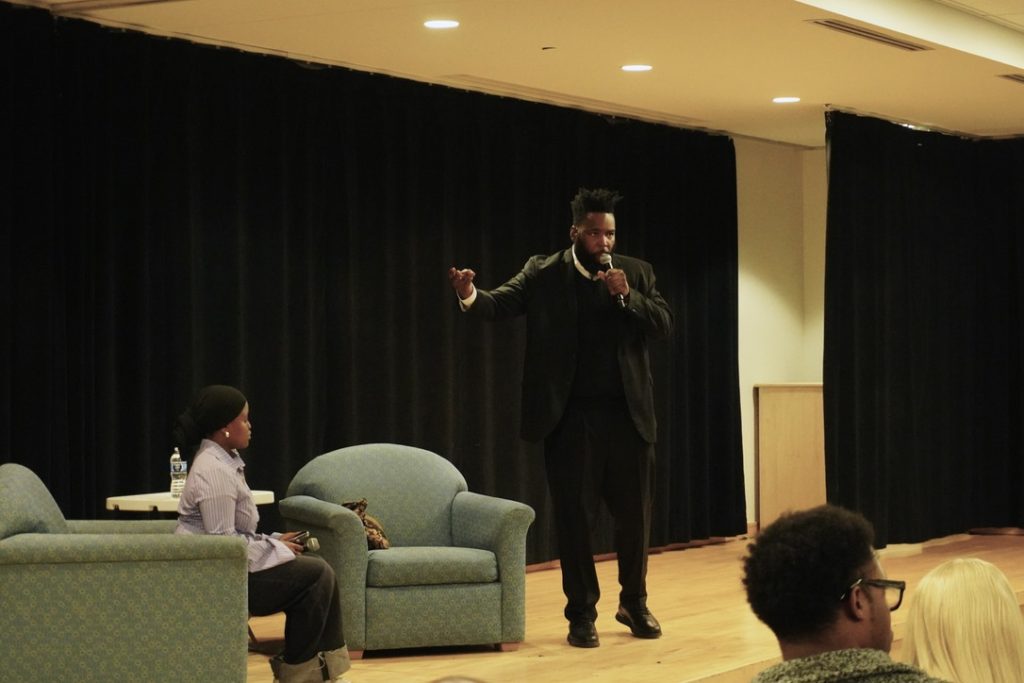
The African Student Organization held its keynote speaker event on April 30 with social media personality Dr. Umar Johnson in the Chenango Champlain Collegiate Center’s Multipurpose Room. The conversation centered around navigating a westernized education system as a Black community, along with broader themes of striving for African interconnectivity.
Lombe Mwambwa, vice president of ASO, moderator of the event and a junior majoring in philosophy, politics and law, decided to host the keynote speaker because of his established voice and platform, which would best facilitate a constructive conversation about race-related topics that are often avoided.
“I’ve been wanting [Johnson] since last academic year, when I was the educational coordinator for the African Student Organization,” Mwambwa said. “But unfortunately, that didn’t happen. So, this year, I made it a mission to get him. So I’ve been the one in contact with him, making sure his contract is signed, texting him.”
Johnson, the self-proclaimed “Prince of Pan-Africanism,” earned his doctorate in clinical psychology from the Philadelphia College of Osteopathic Medicine. He is also an author who has written about ADHD along with other psychological misdiagnoses of young Black boys in both the education system and mental health institutions.
In anticipation of the concern over the controversies relating to Johnson’s previous remarks, including on interracial marriages and the LGBTQ+ community, ASO released a statement regarding the speaker event.
“As part of our mission, ASO creates space for learning and discussion centered on the Black community,” ASO wrote in an Instagram post. “Disagreement with the speaker is expected and welcome — this is a guided conversation meant to encourage reflection, not silence or shutdown.”
The event began with opening remarks from Johnson expressing the utmost importance of staying focused on academics in college.
“Serious business about being a university student,” Johnson said. “No. 1, and this applies to all of you, you came here to get an education. You did not come here for a lifestyle. Don’t come to Binghamton University and get distracted by everything else, except your academics.”
Following this introduction, the main segment of the event took place, which consisted of a Q&A between Johnson and Mwambwa.
Johnson offered an engaging blend of relatable humor, personal anecdotes and passionate claims related to the Pan-African movement. He focused on issues relating to modern-day African economics.
“Africa can’t catch up because the tactics of neo-colonialism prevent African governments from controlling their own economies,” Johnson said. “They are ran from London, they are ran from Paris, they are ran from Amsterdam and they are ran from Washington, D.C. by remote control. Africa is still under colonization, only this time you don’t see the colonizer.”
He then encouraged the audience to read a book related to these principles. He suggested “Neo-colonialism: The Last Stage of Imperialism,” written by then-president of Ghana Kwame Nkrumah in 1966, which led to backlash from the United States and the eventual cancellation of $25 million of aid to Ghana.
Later on in the conversation, Johnson addressed his views on women that may have stirred up some public controversy in the past. He said he wanted to make it explicitly clear that he is not a sexist, nor does he have any animosity against white women. However, he does believe in the importance and impact of happily married Black couples, particularly in their psychological benefit to Black children.
“When you hear Dr. Umar say, ‘I want Black men with Black women,’ it’s not to reject or denigrate you,” Johnson said. “It’s because Black people are in a fight for our survival. Black children need to see healthy examples of Black-on-Black love. As an educator and a school psychologist, I can’t tell you how many times I’ve had little Black girls come up to me in schools — ‘Dr. Umar, what’s wrong with the way I look?’”
“I’m noticing that all the successful Black men only go after white women,” he added. “It’s not a rejection of you. It is an appreciation and an acceptance and an embrace of my Black women.”
The event then concluded with handwritten questions from the audience, as well as the opportunity to get a picture with him onstage.
“This was our second time having a keynote [speaker] since after COVID,” Fatoumata Barry, president of ASO and a junior majoring in philosophy, politics and law, said. “And we really saw how much it impacts students, especially Black students or students of color on campus.”
In her concluding remarks about the event, Mwambwa noted Umar’s ability to blend humor with difficult conversations about race.
“He talks about race in education,” Mwambwa said. “He talks about race in culture. He talks about all of the uncomfortable conversations that people are afraid to have, and then he makes you laugh right after. And I feel like that is very important, because at this specific school, there’s a lot of hard conversations that people try to avoid and people try to censor.”