





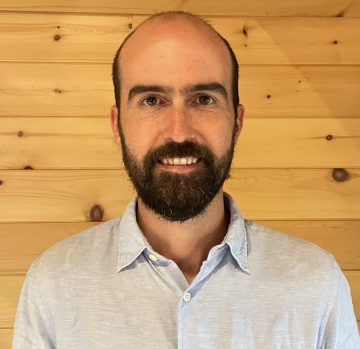
Last Thursday, Binghamton University’s Master of Science in Human Rights program welcomed Dr. Stephen Maher, SUNY Cortland economics professor and editor of The Socialist Register, as part of this year’s Lubna Chaudhry Human Rights Lecture Series.
The event was held at the University Downtown Center and brought together undergraduate students, graduate students and faculty members to hear Maher’s analysis of American economic power and its impact on global democracy.
Named after the late Dr. Lubna Chaudhry, an associate professor of human development at BU who passed away in 2020, the annual speaker series brings together leaders in the field of human rights and aims to complement the scholarship of the advanced studies programs in the College of Community and Public Affairs. This year’s speaker series, titled “Development at a Crossroads,” explored how shifts in strategic and economic development have transformed societies around the world.
Maher describes himself as a political economist. As a speaker for this year’s lecture series, Maher explored the theory of the “American Empire” and analyzed how the rise of investment and free trade since World War II led to a more globalized economy, which was the “structural foundation of the entire American imperial system.”
Maher’s research not only provided a history of the centralization of wealth, but also highlighted how disproportionate financial power can and has hurt poorer nations.
“Thus, imperialism, in the classical sense, was understood as a system in which states of the global core blocked capitalist development on the periphery,” Maher said. “Class struggle was substantially projected onto the world system as a relationship between states as wealthy, core states exploit the states of the periphery through international trade.”
Maher continued by situating President Donald Trump’s second term within historical financial trends, saying that the rise of populism is a reaction by the working class to globalization efforts that he argued did not lead to substantive benefits in their lives.
“The rise of Trump was rooted in the longstanding contradiction between the American state’s obligation to its own social formation, on the one hand, and its responsibility for managing global capitalism on the other hand,” argued Maher.
However, Maher went on to say that Trump’s tariff policy also uses American wealth to control the international order.
“Trump is seeking to restore unipolarity using the substantial power the American state still possesses to bully others, including his own capitalist class, and to redesign an international architecture he believes has come to constrain the U.S. rather than empower it,” Maher said.
Toward the end of his speech, Maher said that collective social rights could stabilize financial democracy. More specifically, he argued that it is important to secure rights to food, water, culture, social provision and access to job opportunities, ensuring societal development. He argued this is especially important given the “ecological crisis now upon us,” which he believes will lead to an even more uneven distribution of resources.
In an interview before the event, Maher told Pipe Dream that he hoped students would leave his lecture understanding that while capitalist development has been beneficial for some people, it has been hurtful to most.
“If we want to move toward genuine self-determination, genuine sovereignty, genuine democracy — that will require breaking the logic of profit maximization and the disciplines of market competition,” he said.
He also remarked that the economy should instead be organized in a way that maintains democratic decision-making in resource production and distribution, instead of focusing on maximizing profits.
Maher also said that it is important for students to collectively organize and advocate to improve their communities.
“[Students] have common interests with their co-workers, common interests with their neighbors,” said Maher. “And those common interests can be fought for.”
Following Thursday evening’s lecture, Maher led a discussion on Friday morning to focus on the international implications of the current war in Iran.
Maher’s visit to the University concluded this year’s Lubna Chaudhry Lecture Series. He prompted students to continue working on improving the global economic landscape.
“This is no longer just a matter of dreaming of a utopian, more just future,” Maher said. “This is now a matter of human survival and the possibility for a livable future for human beings on planet Earth.”