





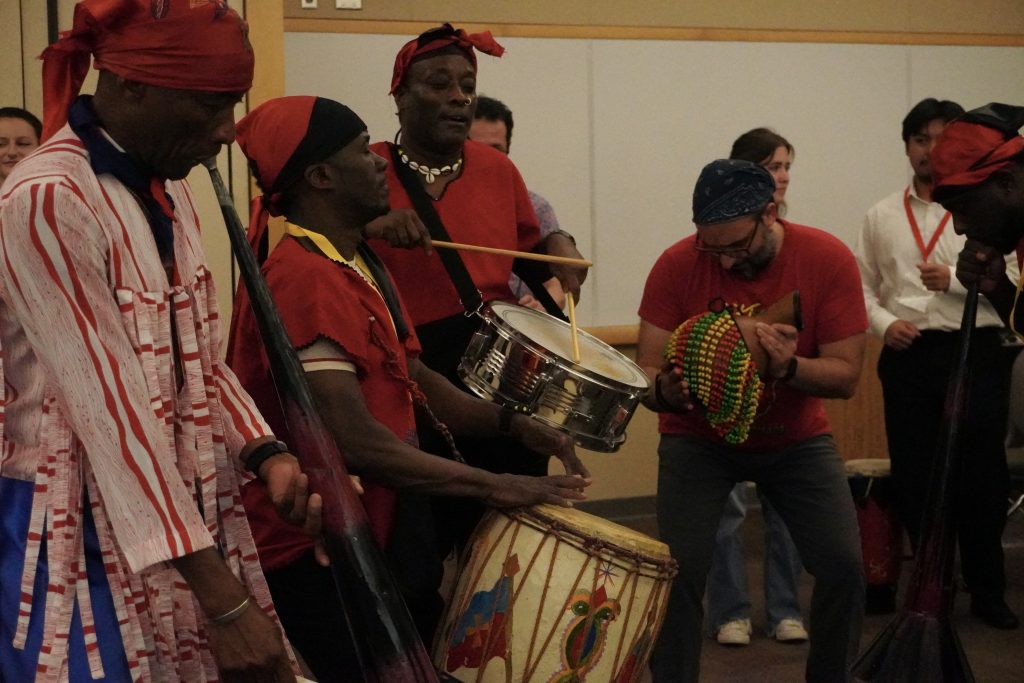
Encouraging students, faculty and community members to dance and embrace Latin culture, the Latin American and Caribbean studies program held its sixth undergraduate research conference, themed “The Body Tells the Story,” at the University Downtown Center on Saturday. Undergraduates from seven different universities worked together to present their research in different panels.
Keynote speaker Peniel Guerrier presented to attendees as they enjoyed lunch, setting the tone for the remaining panel discussions. Guerrier directs two of his own companies and teaches Haitian dance in a one-year course called Kasé Dans. He created the course to help students explore Haitian dance, Vodou and folkloric music, while also expressing the knowledge necessary to perform the dance, music and tradition incorporated into the art.
Guerrier has been recognized five times as a Master Artist in Haitian Dance/Drumming by the New York State Council on the Arts Folk Arts Apprenticeship program. In addition, he was honored with the National Endowment for the Arts in 2025.
Before Guerrier’s keynote address, Robyn Cope, director of LACAS, an associate professor of French and the lead organizer of the event, thanked the faculty mentors and all of the hardworking undergraduate students who presented or had yet to present their research. She introduced Guerrier to the audience and he began a unique and intimate address covering many themes, including the similarity of communication among many cultures despite varying languages, life and death as bodily transitions, the invisible versus visible states of all of the entities around us and our ability to resist and fight.
Guerrier taught the audience different chants, including terms of Haitian Creole such as a greeting, the word meaning “gatekeeper” and an affectionate term used to refer to a child. Next, Guerrier encouraged the audience through movements to honor their mothers and fathers, the earth they stand on and the universe above them. The series of movements ended by bringing their hands to their center and then back out, expressing that they took their foundation — all the things that made them unique — and shared it with others. He connected this to one’s mission here on Earth, establishing that every second counts.
When asked what he hoped students and researchers took away from his performance and address, Guerrier stressed the gift of unity and our ability to speak a universal language — music. He highlighted the misconceptions he feels surround Vodou in Haitian culture, as people often associate negative ideas with the belief.
“They always picture Vodou as a religion, like devils — the crazy things about it,” Guerrier said. “But it’s not. It’s more than that. It’s a way of life. It’s everything.”
Guerrier continued his address by interacting with the audience, asking them to listen to how the different drums, played by his fellow musicians, Jean Mary Brignol, Jude “Yatande” Sanon and Gregory Phanor, communicated. He taught the audience more Haitian songs, often having them sing while the musicians danced and played the drums. He pulled audience members to the front of the room to dance with him, teaching them certain movements, but also letting the audience free dance later on.
Ronae Watson, a freshman majoring in biology, participated in one of the research panels at the conference. She focused her research on the impact of homophobia and violence in the Caribbean, connecting it to the prolonged spread of HIV and AIDS. She explains how she believes that art or performance can help people to better understand the importance of scientific research or knowledge.
“I believe that scientific outcomes are often shaped by history and culture, especially,” Watson said. “And a big part of culture is music and dance and how people express themselves and even just there in the performance, I think that there is a valuable way of communication that is found within the arts and I think that it can also help people foster a sense of community, which they can apply to their scientific ways of thinking.”
Guerrier and the other musicians had one last performance after a short break. Guerrier had a dynamic routine as he danced with intense drumming and chanting. He incorporated the audience into the performance once again, providing opportunities to show off their dancing abilities. He stressed the importance of the unity between Igbo, Kongo and Petwo in Nigeria, Congo and Haiti. The performance came to an end with all of the audience members forming a line as Guerrier led them around the room, continuing to use lively instruments as everyone danced.
The room was filled with an infectious joy as the dancing came to an end and everyone formed a circle, holding hands with their neighbors and applauding one another.
The day was marked by moments of music, dance, communication and movement, both in the body and the mind. Cope highlighted the opportunity that students had to publicize their research in her closing remarks.
“It marks the moment you transition from passive consumer of knowledge to active co-creator of knowledge,” Cope wrote. “It takes courage to share your work for the first time — every time, in my experience. You make yourself vulnerable in order to be open to a meeting of the minds. You put yourself out there. And the reward is fresh perspectives and renewed enthusiasm for moving forward with your ongoing research project or with all new ones. We hope that this conference will be one small part of a lifetime of discovery and work toward social and planetary justice.”