





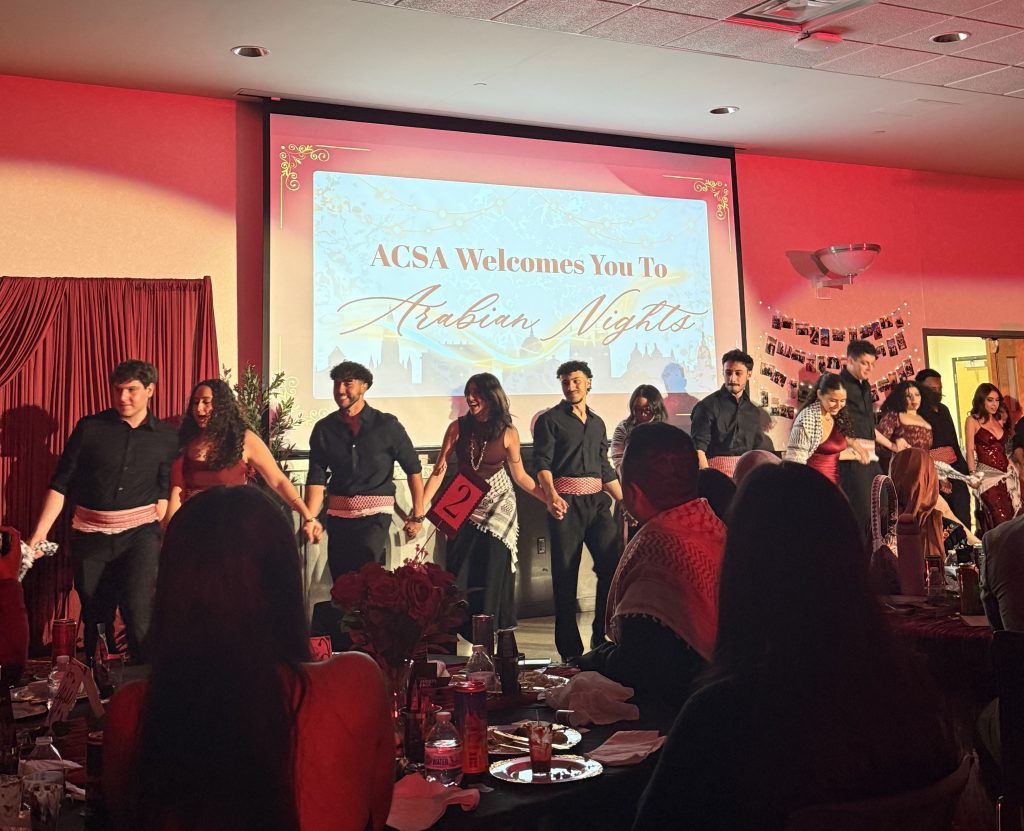
The Arab Cultural Student Association held its first-annual banquet, themed “Arabian Nights,” on Saturday in Old Union Hall. From honoring elements of Arab culture through lively performances and traditional food to highlighting the humanitarian crisis in Gaza and surrounding affected regions, “Arabian Nights” created a space for students and faculty to immerse themselves in the culture while engaging with current events.
Bathed in an atmospheric red lighting, Old Union Hall was transformed by the theme’s central colors of black and burgundy. Each table was adorned in an elegant black cloth with a red runner, LED candles and a bouquet of red roses.
“‘Arabian Nights’ is a chance to bring a little piece of home to Binghamton with us,” Deen Kaakour, president of ACSA and a senior majoring in biomedical engineering, wrote. “Wherever we go we bring our culture, and we want to take this night as an opportunity to share it with the broader Binghamton University community. A lot of the features of Arabian Nights are aspects of our culture that we frequently share and engage with either home in the states or especially when visiting our families’ communities abroad, so bringing a little piece of that for one night is really a great way to show everyone what it means to be Arab.”
A portion of the front of the space was dedicated to a photo backdrop, including a draped red fabric, a rug with traditional patterns and lanterns on either side of the setup.
The night began with an introduction of the E-Board and attending alumni, leading into a set of Arabic pop songs performed by Adel Hamdi ‘24, former president of ACSA, and Mary May Elkass, an intern at ACSA and a freshman double-majoring in theatre and biology.
After an engaging scavenger hunt involving banquet attendees, the audience was given a short history of belly dancing before welcoming a professional belly dancer to the stage.
Audience members clapped along and cheered as the performer made their way between the tables, dancing to traditional songs and incorporating props like Isis wings, pleated fabric connected to dowels that represent the goddess’ wings, a hand drum and the saidi cane, a hooked staff.
Kaakour discussed that ACSA fills a gap in multicultural spaces at BU as the only Arab-centered organization on campus. Hamdi, Kaakour and Georges Karam, a senior majoring in electrical engineering, established the organization in fall 2023 to share Arab culture and traditions and provide a space for students craving a home away from home.
“Our biggest goal was to create a space where people feel seen, comfortable, and proud of their identity,” said Mariam Moussa, co-events coordinator of ACSA and a junior majoring in biology. “When I first came to Binghamton University, I felt really outnumbered. I fully believed there were only a few of us, and it was easy to feel disconnected from that part of myself. Now, being able to help create a space where over 150 people can come together, celebrate openly, and feel at home is something that means so much to me.”
“This is the first time an event like this has existed at this scale here,” she continued. “And it’s more than just a banquet, it’s a moment of belonging. That feeling shaped every choice we made. We wanted to build something intentional, something that makes sure no one else feels that same isolation, and a space where we never feel like we have to shrink or hide our culture.”
A plate of food was distributed to each attendee by the E-Board members and interns, including a selection of falafel, chicken or lamb kebab, rice and an assortment of dips such as hummus and baba ganoush.
Throughout the night, raffle prizes were announced, including the chance to win tickets to the Binghamton Rumble Ponies and gift cards to local establishments.
Transitioning into an educational segment of the event, the E-Board highlighted the ongoing humanitarian crisis in Gaza and brought awareness to the ways in which families across the region endure the insecurity and instability they currently face. A video compilation played in which journalists asked children in Gaza, Syria, Sudan and Yemen what they dream of; responses were as innocent as dreaming of sugar and as hard-hitting as returning home.
Jana Uones, senior advisor of ACSA and a senior majoring in philosophy, politics and law, spotlighted several families she is in communication with through Operation Olive Branch, a grassroots organization connecting donors to Palestinian families seeking aid. She urged attendees to donate and help in any way possible.
The banquet transitioned into intermission, allowing attendees to take photos at the designated backdrop, dance. They perused several tabling stations offering henna designs, hand-drawn portraits and the opportunity to buy keffiyehs from Students with Justice in Palestine, with proceeds going to humanitarian aid in Gaza.
After a short eating contest, an additional performer sang several songs in Arabic that highlighted the beauty of life. A simple flute and piano accompanied the singer, spotlighting vocal technique and lyricism.
The night ended with a lively dabke performance, a traditional Levantine circle dance, performed by the E-Board. The floor was then opened for audience members to dance to both traditional and contemporary music from around the world.
“Being part of ACSA has given me a strong sense of belonging and identity within a predominantly white institution,” Saber Hassan, co-events coordinator of ACSA and a sophomore double-majoring in political science and global public health, wrote. “It’s created a space where I feel seen and understood, while also allowing me to share my culture with a broader audience. Through planning events like ‘Arabian Nights,’ I’ve been able to turn that representation into something visible and impactful on campus. It’s made my college experience feel more grounded and purposeful.”
Editor’s Note: A previous version of this article stated that Deen Kaakour is the vice president of ACSA. He is the president.