





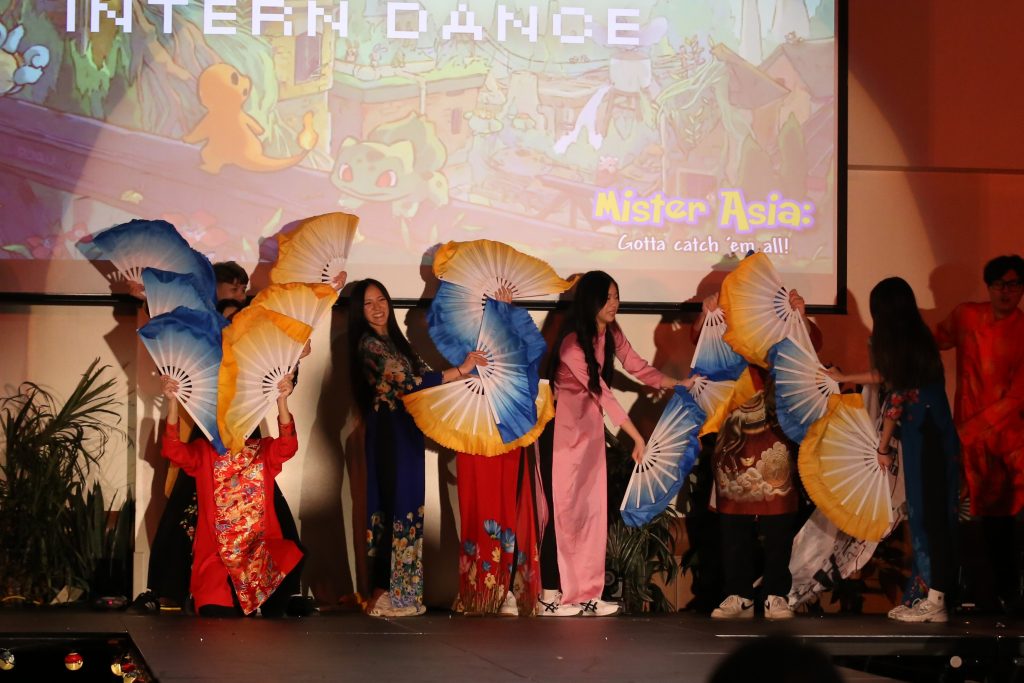
The Vietnamese Student Association hosted its fifth-annual Mister Asia contest, featuring a plethora of cultural and comedic performances to highlight the diversity of their contestants stretching across the Philippines, Vietnam, India and China.
The event’s Pokémon-inspired “Gotta Catch ‘Em All” theme was present in the Mandela Room’s decorations and goody bags. The event opened with an action-packed video of members of VSA’s E-Board venturing across multiple well-known Pokémon locations and gathering all of the night’s contestants. Johnny Pham, president of VSA and a senior double-majoring in biology and Spanish, explained how he hoped the theme brought people together.
“Together, we decided that Pokémon offered a fun, nostalgic, and universally recognizable theme that would bring excitement to Mister Asia 2026,” Pham wrote.
Mister Asia has worked to highlight countries across Asia that are reflected on Binghamton University’s campus. The process of selecting men to compete for the title is important, as they hope to find contestants with pride in their culture and are active members in their community.
“For our pick for Mister Asia, we hope to highlight contestants who bring genuine dedication and passion to the stage,” Pham wrote. “We look for individuals whose performances showcase who they are — their culture, their organizations, and the friends and family who support them.”
This year’s contestants engaged in six rounds of competition to display both their character and country. The winner was decided by a panel of judges, including Mister Asia 2025, Iden Li, a senior double-majoring in global public health and Africana studies, Gabriel Kim, former contestant and a junior double-majoring in biology and philosophy, and Mitchell Yang, president of Asian Student Union and a junior double-majoring in mathematics and economics.
Ultimately, the final four contestants included Pham representing Vietnam; Brandon Singh, a sophomore majoring in biology, representing India; Anderson Li, a senior majoring in business administration, representing China; and Johann Belizario, a junior majoring in industrial and systems engineering, representing the Philippines.
Belizario hoped to showcase what it means to be a Filipino American and all the experiences that come with it.
“Filipinos are also resilient and adaptive, so we never give up and keep fighting for what we believe in, as our principles and religion keep us strong,” Belizario wrote in an email. “I hoped to represent the issues the Filipinos face such as Asian hate and attacks, especially in Queens, as it’s important for people to know and support one another during these times of hardship and struggle.”
His cultural walk included Maglalatik, or “coconuts dance” — a traditional Filipino folk dance that involves wearing coconut shells across the body and striking them to create fast-paced rhythmic beats. The beats didn’t end there, as Belizario opened his talent walk with a short DJ set that led into a performance from PALband. Showcasing a multitude of musical talents, Belizario played the clarinet, guitar and sang in both English and Tagalog.
Stringing together traditional aspects of Filipino culture with modern Filipino stars like Bruno Mars, he showcased his own musical talents and the beauty of the Filipino dance and song.
As Mister India, Singh strived to highlight the dynamic nature of Indian culture through his dancing and martial arts performances.
“I hope to showcase both the high energy and vibrancy of Indian culture,” Singh wrote in an email. “I feel this is what makes India unique so that is what I ultimately wanted to present as Mr. India.”
For his cultural dance, Singh chose to perform bhangra, a Punjabi folk dance, because he felt that the dance’s vibrant costumes and movements best captured what he hoped to share about Indian culture. Following his dancing, he demonstrated his martial arts prowess as he performed a series of Taekwondo moves, highlighting over a decade of experience. By choosing these talents, Singh shared some of his multifaceted identity.
Pham, along with hosting and planning his final Mister Asia, participated as Mister Vietnam. In his two years of planning the event, he had yet to see himself represented.
“Vietnam had never been represented at Mister Asia, and as a graduating senior, I felt it was finally time to give my organization and my friends/family the same opportunity past contestants had,” Pham wrote.
Pham performed a fan dance during his cultural walk, a skill he learned in his time with VSA. He incorporated his own twist by combining traditional fans, long fans and race hats. For his talent, he also showcased his musical prowess with the euphonium, a brass instrument, as a video detailing his journey throughout his four years at the University played in the background.
He hoped to shed light on his experiences with his own Vietnamese identity and the issues that Vietnamese communities face. This included the Vietnam War, which ended only 50 years ago.
Li strived to use his platform as Mister China to discuss the issues facing Asian immigrants in America.
“I would like to use my platform to talk about the recent [U.S. Immigration and Customs Enforcement] raids that’s been happening this year,” Li said. “I personally do know some people that have been affected and this isn’t something that’s just targeting illegal immigrants. They’re targeting you if you have green cards, if you’re renewing, everything. They’re showing up at courts and things like that.”
Li chose to do a fan dance for his cultural walk and continued the dancing theme into the talent portion. With a K-pop-inspired routine, he showcased what he learned in his time with Asian Outlook magazine, a community he cited as helping him connect with his cultural identity.
In the last round of the competition, the panel of judges asked a series of questions to the contestants. These questions centered around their cultural identity, childhood icons and present issues facing their countries. Many of the contestants paid homage to family members as their icons and then highlighted relevant issues affecting diaspora and mainland Asian communities. This included topics of overpopulation, immigration enforcement, civil wars and recent hate crimes.
After these questions were asked, the judges were left to deliberate on who to crown Mister Asia 2026. After a night of great performances and bringing together these cultures and communities, Belizario was crowned Mister Asia 2026. With much applause, the contestants ended the night with their thanks.
Reflecting on the goals of Mister Asia, Pham underscored the importance of bridging these communities together.
“We hope students leave the event with a deeper understanding of its purpose — to celebrate the beauty of Asian identity while also highlighting the incredible diversity within it,” Pham wrote.