





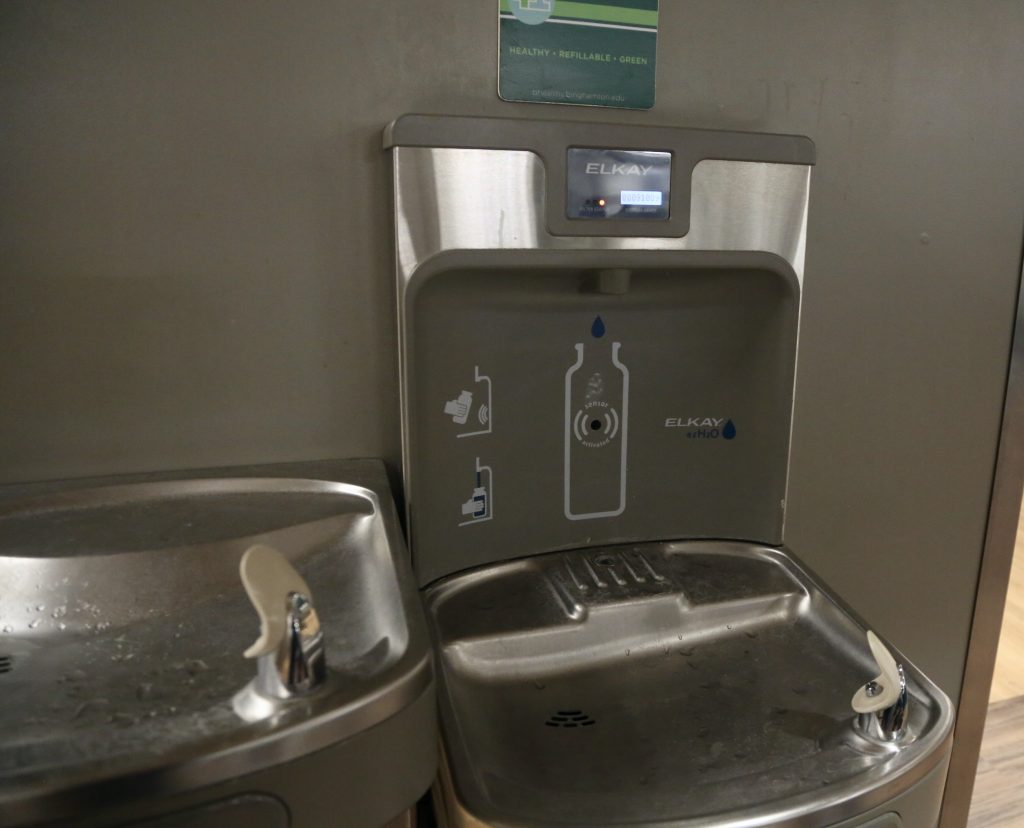
In response to reports that several water refill stations on campus operate with expired filters that need replacement, the Student Association passed a resolution encouraging administrative officials to place QR codes by each station, allowing users to report “red or expired filter indicators.”
The resolution, which passed on March 10 by a vote of 14 in favor, one against and one abstention, urges Facilities Management to expand the QR code reporting system that it currently uses to gauge if handicap-accessible door buttons around campus are functioning. Students and others who notice issues with the automatic door openers can scan the code to automatically send a notification to Facilities Management.
Muhammad Bhatti, an off-campus Student Association Congress representative who authored the resolution and a freshman majoring in biology, told Pipe Dream in a statement that the resolution authorizes the SA to engage in conversations with Binghamton University to implement the expansion.
In a statement forwarded to Pipe Dream, JoAnn Navarro, the vice president of the division of operations, said Facilities Management is “in the process of completing a comprehensive inventory of all bottle filling stations across campus.” However, Navarro added the University does not plan on expanding QR codes to water refill stations “at this time.”
“We truly appreciate the Student Association bringing this to our attention,” Navarro wrote. “Your input helped highlight an opportunity for improvement, and we are confident that the steps we are taking will enhance the overall performance and upkeep of these stations.”
According to Elkay Manufacturing Company, which manufactures some of the drinking fountains and refill stations around campus, a red flashing light indicates that the machine’s filter “has reached end of life and may no longer be effective.”
The SA has not conducted a formal audit on the status of water filters around campus, but Bhatti said he estimates that anywhere from five to 15 refill stations might have expired filters “on a given day,” with the caveat that this number likely depends on “maintenance timing, station location, and how visible particular stations are to the general public.”
The passed resolution would have authorized Bhatti to act as a designated SA liaison to coordinate communication with Facilities Management.
“While I understand their decision not to move forward with QR codes at this time, I am pleased that this resolution helped bring attention to a gap in the current process and contributed to a concrete step toward improvement,” Bhatti told Pipe Dream. “My main goal with this proposal was to help ensure students have reliable access to clean, functional water refill stations across campus, so I am glad to see action being taken in support of that.”