





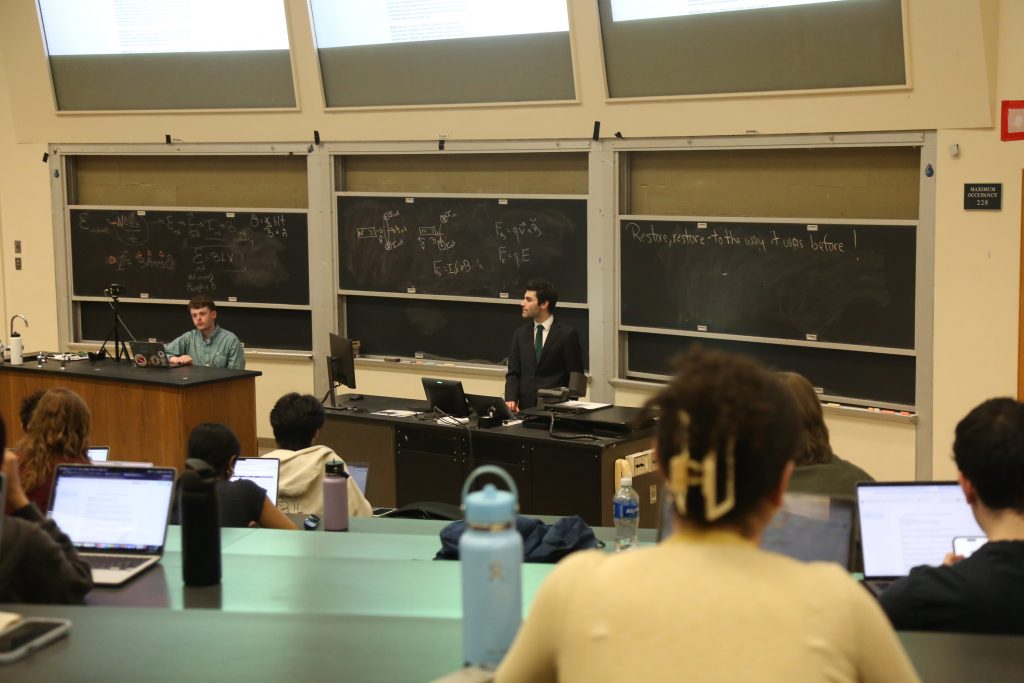
The Student Association Congress passed a bill urging the administration to create a committee ensuring ethical AI research at Binghamton University.
The “Resolution to Ensure Ethical AI Research for the Public Good” passed last Tuesday and was co-authored by Nicholas Washington, the president of the University’s Climate Action Campaign and a junior majoring in mechanical engineering; Sebastian Rivas Alvarez, a sophomore double-majoring in philosophy, politics and law and global public health; and Jayden Cedano, a representative from Mountainview College and an undecided freshman.
Of the 19 votes cast, 11 congress members voted in favor of the bill, four in opposition and four abstained. The resolution aims to ensure the University’s new Center for AI Responsibility and Research, to increase ethical oversight and foster student engagement about the center. The development of the AI center is funded by a $25 million capital investment from SUNY and a $30 million philanthropic donation from Thomas Secunda ’76, MA ’79, the co-founder of Bloomberg L.P.
Under the resolution, the SA will be formally “advocating for an Ethical AI Oversight Committee or Office with Student, Faculty, and Administrative collaboration.”
Washington said at the meeting that he co-authored the bill after learning that the University was building the new AI research center and wanted to ensure students were included in the discussion about what “for the public good” means regarding AI research.
“I would say that the stated objective of the research center is ‘AI for the public good,’” Washington said. “But if you look at the state legislation of [Gov.] Kathy Hochul and the State Assembly, if you look at the state websites that I have cited in the resolution, the definition of public good is never defined and I think that defining it is what is necessary.”
Washington provided a statement to Pipe Dream on the creation, deliberation and ultimate passing of the resolution. At the SA Congress meeting, Yoav Muscal, a freshman majoring in computer science, expressed concern that E-Board candidates for next year were contacted for endorsements of the bill.
Washington told Pipe Dream that he and his co-authors made sure not to exhibit any bias when contacting student candidates to sponsor their resolution.
“With regards to the deliberation, we understand the concern in the inclusion of student candidates in sponsoring the resolution,” wrote Washington. “We see this being a long standing issue and as such saw it necessary to inform the incoming executive board as this would impact them and their work.”
He also said that no candidates were endorsed during their selection process.
Muscal was one of the four SA Congress members to vote against the resolution. He told Pipe Dream he was concerned that the SA Congress may not be able to make meaningful change in the actions of external entities and that the SA should focus instead on internal student affairs.
“Resolutions introduced at SA Congress should focus on what can be changed: services for students, subsidiary organizations, and organizational reforms that improve efficiency,” Muscal wrote. “Resolutions such as S2526-R6 have mission statements that are benevolent and commendable, yet they are purely ideological.”
Washington said that now that the resolution has passed, he hopes there will be increased student involvement in conversations about AI at the University.
“We believe that as AI increases in prominence it’s all the more necessary to begin the proactive conversation of how we can healthily integrate this technology into our lives,” Washington wrote in a statement to Pipe Dream. “CAC doesn’t aim to enforce any vision of this integration, but we do think that by bringing everyone to the table we have the ability to ‘make the road by walking’ collectively.”
Editor’s Note (4/14): This article was updated to clarify Yoav Muscal’s argument against the resolution.