





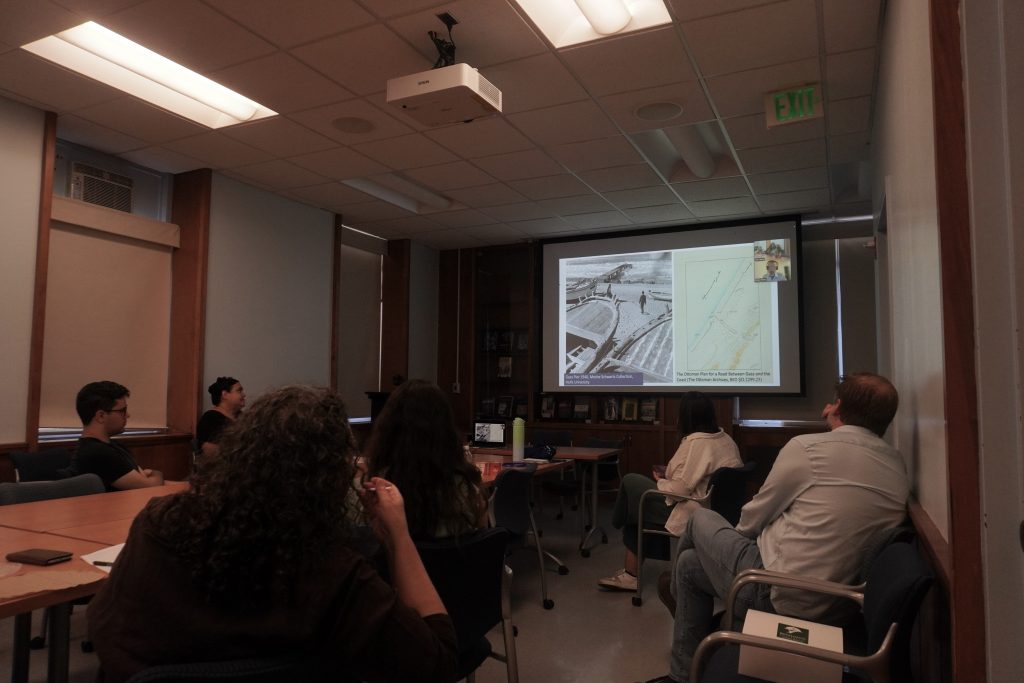
The Center for Israel Studies held a roundtable discussion on Monday to address the current crisis in Gaza.
The talk, titled “Gaza Beyond the Strip: Histories and Possibilities of a Middle East Borderland,” was the first in a planned three-part series to foster dialogue and discuss solutions for the humanitarian crisis in Gaza. The roundtable featured Dotan Halevy, a senior lecturer and assistant professor at Tel Aviv University’s Department of Middle Eastern and African History, who explored the history of Gaza from pre-1948 Mandatory Palestine to the present day.
“What is Gaza anyway, when it is not a strip?” Halevy asked the audience. “A city, a district, a geographical area? What is the natural space, if there is one, to which Gaza belongs?”
“To begin examining this, we must ask, what was Gaza before the Gaza Strip?” he continued. “That is, what was Gaza before the Palestinian Nakba of 1948, when the strip was created as an enclave containing 200,000 Palestinian refugees?
The Nakba refers to the forced displacement of Palestinians in the wake of the 1948 Arab-Israeli War. Following the war, around 750,000 Palestinians were displaced from their homes and thousands were killed. Of those displaced, tens of thousands of Palestinian refugees fled to the area around the Gaza Strip, under Egyptian control at the time.
Halevy said the collective memories shared by Gazans over the past seven decades have cemented a common identity. He added that both Israelis and Palestinians could not imagine a future layout of the region without the Gaza Strip.
“The most crucial question to ask now regarding the future of Palestine and Israel is whether the destruction of Gaza and the genocide of its people will change this perception,” said Halevy. “This is a critical question for any peace-seeking human being, because even if the war stops today, the Gaza Strip on the eve of the seventh of October 2023 no longer exists, and there is no way back to it.”
Halevy highlighted the increased death toll in Gaza and the destruction of political and administrative institutions, residential buildings, agricultural areas, hospitals and water plants. On Tuesday, an independent United Nations commission released a 72-page report that concluded Israel “committed four genocidal acts” in the Gaza Strip since Oct. 7, 2023.
Lior Libman, associate professor of Israeli studies and director of Binghamton University’s CIS, explained the importance of the talk series and the department’s responsibility to educate students on Israeli involvement in the region.
“The motto I picked for this series is a line from Samuel Beckett’s ‘Waiting for Godot’ that resonates with me,” said Libman. “It says, ‘Was I sleeping when others suffered? Am I sleeping now?’ I felt that as a center that deals with Israel studies, we cannot ignore the major events that are going on in the region and what Israel is doing, and being involved in, and we have to teach our students and educate our students about the realities, the histories and the possibilities on the other side of the border.”
Since the Oct. 7 attacks, various student organizations on campus have organized in support of Israel and the Palestinian people. Last year, students set up an encampment on the Peace Quad in solidarity with Palestinians and to call on the University to divest from the defense industry.
The encampment came weeks after the Student Association passed a Boycott, Divestment, Sanctions resolution calling on the University to end partnerships with Israel and divest from defense companies. The SA Congress repealed the resolution last October.
Libman said the second roundtable will feature an aid worker from Doctors Without Borders, allowing students to learn about the humanitarian crisis in the region. The third speaker is expected to feature an eyewitness voice who can provide a firsthand account of what Palestinians are experiencing.
“I wanted students to get to know Gaza,” said Libman. “To learn, to know that it has a history, that it has a story, and that it can have a future that is different than just taking it over, like some nationalists would want. And then recognize the rights, the humanity and needs of everyone between the river and the sea, Jews and Palestinians.”