




The Henna Club transformed the Chenango Champlain Collegiate Center’s multipurpose room into an intimate venue on Saturday for its third-annual fashion show, themed around the four elements — fire, water, earth and air — and drawing inspiration from “Avatar: The Last Airbender.”
The night began with a reference to the animated series, depicting the Fire Nation as creating a disturbance among the balance of the elements.
The room’s atmosphere was dark, with spotlights aimed at the center of the room, where four sections of chairs formed a circle. A yin and yang was placed in the center of the room, representing the balance between the elements.
Joanna Thomas, the secretary and treasurer of Henna Club and a junior majoring in integrative neuroscience, explained some of the substantial aspects that went into planning the event.
“Model managers had to host auditions for models, sort them into themes that fit their walk and presence, and be the bridge of communication between models, costume, and henna artists, so that everyone understood the theme and their role in bringing it to life,” Thomas wrote in an email. “Logistical planning also played a critical role in this event. Lighting and music selection were carefully chosen to match the mood of each elemental segment, in order to enhance the audience’s experience and continue to reinforce the theme.”
The hosts, two alumni who were former members of the Henna Club, explained that models were tasked to embody elemental styles or characters from the beloved show. They introduced the E-Board and gifted flowers to three seniors in the club who are set to graduate this spring.
Each element had the floor for a portion of the night. They started with water, hoping to pay homage to the traditions of the Water Tribe, representing the versatility of water and its overall power as an elemental force.
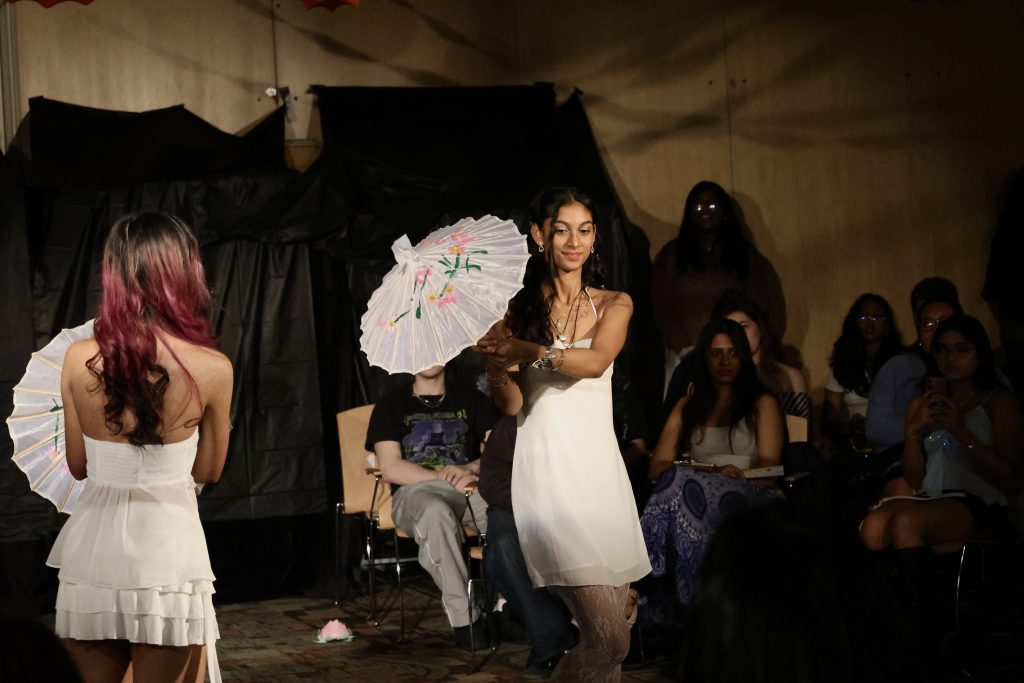
The models walked out in pairs, coming from both sides of the room as they walked down each aisle between the sections of chairs, dancing mesmerizingly. They switched seamlessly between pairs of models — as the first set finished their routine, the next were already walking down the aisles. The models worked opposite each other, mimicking similar or complementary movements and then meeting in the center.
Following the water segment of the show, the hosts asked for a volunteer from each of the four sections to show off their modeling abilities in a light-hearted competition. With a little bit of convincing, they successfully found four volunteers and each candidate walked down an aisle to the center of the room, finishing off their display of talent with a pose. Each section was then asked to cheer for who they thought did the best overall and the volunteer who received the loudest cheering was given a stuffed animal prize.
With inspiration taken from the Earth Kingdom, Thomas said that the model’s styling featured earth tones like greens and browns and heavier materials. The models had henna in various places such as their arms, legs, backs and torsos.
Oishi Dey, the president of the Henna Club and a senior majoring in biology, provided insight on the significance of the henna the models displayed and its embodiment of both long-standing tradition and cultural continuity.
“The henna that the models will be showcasing draws inspiration from the show itself while also mixing in conceptual aspects,” Dey wrote in an email. “Designs are a mix of traditional and nontraditional designs personally sketched out by our members that represent each category of water, fire, earth and air.”
“For example, the flowing wave-like patterns that reflect water and themes of adaptability and healing, while earth would consist of grounded nature like designs representing stability and growth,” Dey continued. “This creative interpretation connects traditional mehndi artistry with a contemporary, narrative driven concept.”
After a 10-minute intermission, models represented the last two elements — fire and air. The fire models depicted the balance between destruction and renewal, with inspiration taken from the Fire Nation. In bold, dramatic outfits with a red, black and gold color palette, they conveyed the power and intensity of the element with far more aggressive routines and movements.
The pairs of models who took the stage often defensively stood off against one another, with one pair even pretending to physically push and punch each other.
Next, the models who represented air, derived from the Air Nomads, showcased lightness and spirituality in warm neutral colors, depicting effortless flow and grace.
Two models, dressed as characters from “Avatar: The Last Airbender,” staged a fighting sequence, throwing punches and kicking one another. Suspenseful music played, and they continued to spar until the fight concluded. Everyone applauded as they posed in the center of the stage.
Two Undivided members performed their own rendition of “Set Fire to the Rain” by Adele as the final treat of the night. The singers went back and forth with one another, harmonizing throughout the song. As the performance came to an end, all models walked out section by section around the circle, surrounding the singers and joining each other on stage.
Shefali Mahapatro, vice president of Henna Club and a junior majoring in psychology, shared her hopes for the audience after they witnessed all the hard work the organization put into the event.
“I hope the audience walks away with not only a deeper appreciation for the multifaceted application of henna, but for the intentionality of the many aspects that went into crafting the event as well,” Mahapatro said. “As a model manager, it was incredibly important for us to highlight the costuming, conceptual detailing, and narratives that span throughout each theme as a reflection of the underlying message of yin and yang and finding the balance within and between the elements.”