





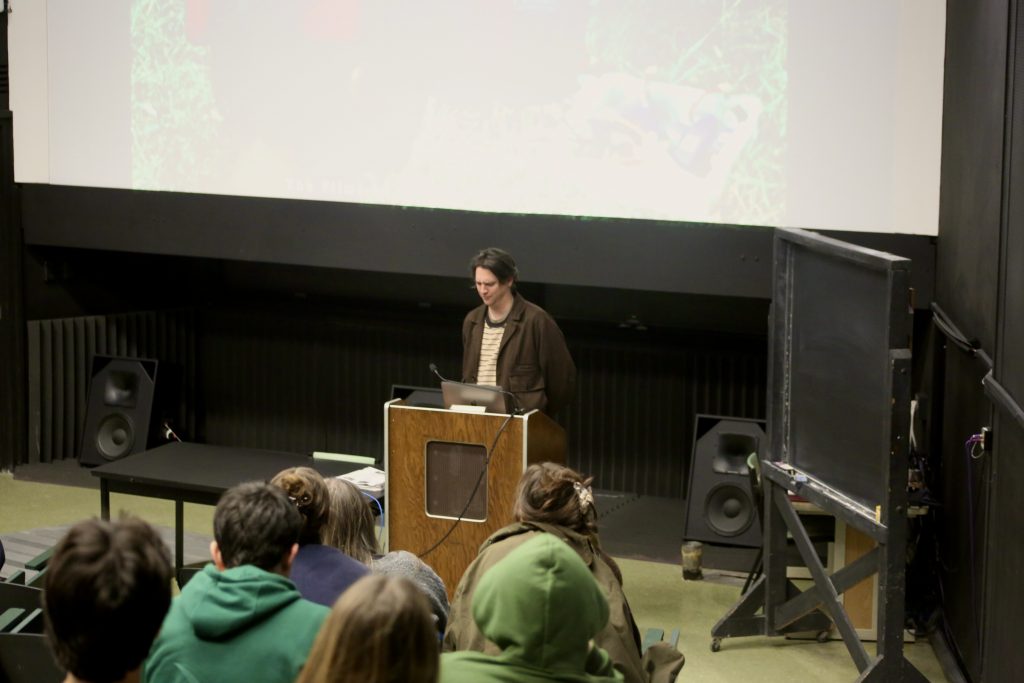
The Cinema Department’s Visiting Artist Series brought a unique perspective to the Binghamton University community on Thursday with a talk from filmmaker Ross Meckfessel. Through his artwork, filmmaker Ross Meckfessel seeks to answer questions like “how is a human mind altered after thousands of hours on the internet?” and “what does an increasingly technology-dependent society look like under a magnifying glass?” among many others.
Meckfessel was invited to exhibit and discuss his works, including “A Century Plant in Bloom” (2017), “The Air of the Earth in Your Lungs” (2018), “Estuary” (2021), “Zero Length Spring” (2021) and “Spark from a Falling Star” (2023). The audience consisted of University cinema faculty, students and community members, all of whom were surrounded by sensations of modernity captured on film.
In Meckfessel’s work, sounds and images of contemporary society, whether bizarre, glamorous, disturbing or mundane, are compiled to build a surreal yet familiar atmosphere. “The Air of the Earth in Your Lungs” displays natural ecosystems through the lenses and filters of technology like drone cameras, while “Estuary” prominently features a 3D digitally modeled Instagram celebrity.
”The major theme that I’m interested in my work is to really make people aware of what time we’re living in and everything around us, what it’s doing to us,” Meckfessel said. “We walk through life, myself included, sort of unaware of all of the effects of everything that’s being pumped at us all the time. A major thing I want to do is to really stop and look at it and question, ‘What is this doing to us? How is this changing the way that we interact with each other? How is it changing the way that we see in general, or interact with nature?’ All of these sorts of ideas.”
“It’s not controversial to say that we’re living in a very interesting time, a very radical time where technology is at an all-time high, and I think we’re just sort of going through it without wondering what exactly that’s doing to us as humanity, as human beings,” he continued.
The complex effects of Meckfessel’s films on viewers extend beyond acute awareness of society. His unique approach subverts the conventional relationship between a film’s subject matter and audience.
“So much of Hollywood cinema or classical narrative cinema is very manipulative and controls the viewer’s emotions and points them in a certain direction, which isn’t to say that I don’t want people viewing my films to feel something,” Meckfessel said. “But I’m really open to the idea of the film letting the viewer come with their subjective experience and having every viewer have their own feelings and bringing their own perceptions to it.”
This aspect of Meckfessel’s work creates a wholly unique experience for each viewer and, to those most open-minded, offers a form of cinematic meditation. As the films introduce stimuli from the collective consciousness of modern society, viewers’ minds drift through their thoughts and memories, revisiting their perceptions of each idea and all that they associated with it.
Perhaps the most distinctive example of this is Meckfessel’s use of modern pop songs in his films. From “Clarity” by Zedd and Foxes, to “Better Off Alone” by Alice Deejay and “Meet Me Halfway” by the Black Eyed Peas, distorted edits and karaoke renditions of famous pop melodies are scattered throughout his body of work.
Meckfessel shared an anecdote revealing the origin of this technique.
”When I first got into filmmaking, I had a teacher who talked about not using very recognizable pop songs because people bring all of their emotions to it, and stories they remember when they first heard it,” Meckfessel said. “And I was fascinated with that, which is one of the reasons that I use pop music a lot in my films, because I’m interested in people bringing those unique experiences to it.”
The event not only celebrated Meckfessel’s works but also provided an opportunity for each attendee to contemplate their perceptions of society and their personal experiences. Through his work, Meckfessel prompted the University community to remain carefully conscious of how our minds can be influenced.