





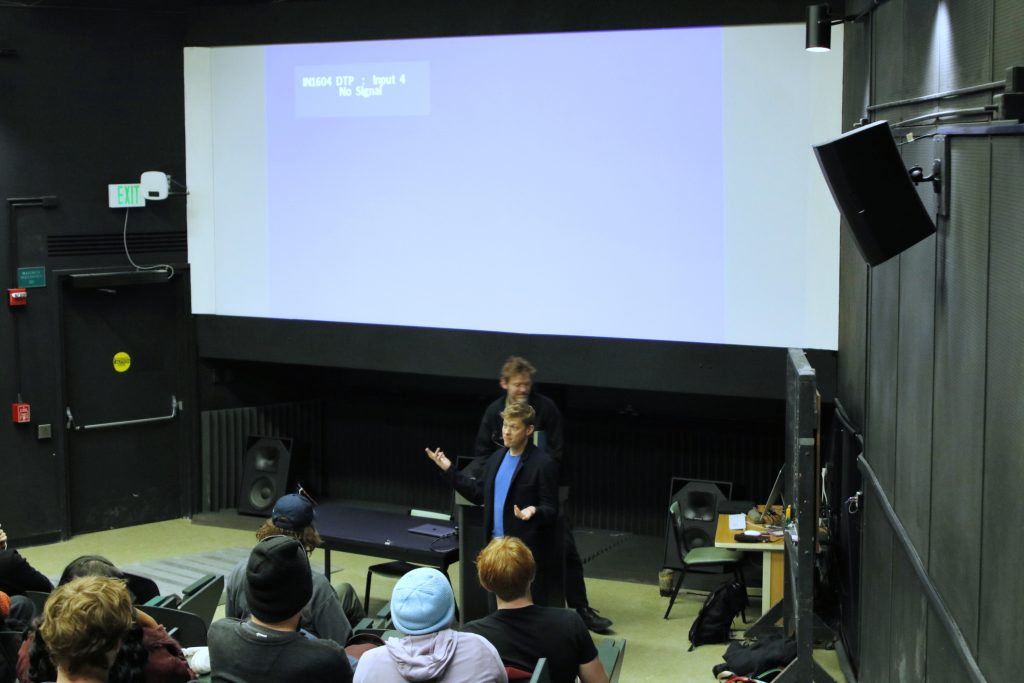
The most recent visiting artist event brought dozens of students, faculty and community members to Lecture Hall 6 for an otherworldly encounter with the digital creations of multidisciplinary artist Peter Burr. Organized by Binghamton University’s Cinema Department, the evening celebrated and reflected on the film career of the Brooklyn-based artist, who uses innovative techniques to craft unique and deeply moving experiences.
After an introduction by Daniel Murphy, a lecturer of cinema, the room fell into darkness and silence, allowing the audience to become completely absorbed by the endless intricacies within five of Burr’s video artworks. An in-depth Q&A segment with the artist followed and the night concluded with a final presentation of Burr’s 2020 film “Black Square.”
Throughout his work, Burr uses digital animation to create surreal, mesmerizing worlds governed by computerized patterns rather than the laws of physics that viewers are accustomed to. The entrancing effects of his films are achieved in part through their labyrinthine level of detail.
“[It’s] definitely easy to get lost in the surfaces and textures and patterns and shifting of colors,” Armand Yervant Tufenkian, a lecturer of cinema, said. “I’m kind of in a daze, almost, throughout the whole thing, in a really good way.”
While each work of Burr’s possesses a hypnotic quality, his 2016 piece “Pattern Language” has a particularly intoxicating effect on viewers. Created with a game engine, this piece features complex, ever-evolving pixelated patterns exploding with kinetic energy. During its showing, audience members sat transfixed as the black-and-white fractal geometry on screen morphed rapidly into structures reminiscent of the paradoxical architecture of M.C. Escher.
At times, Burr’s films are designed with such complexity that they appear sentient. In “Alone with the Moon” (2012) and “The Mess” (2016), shifting surfaces create the illusion that the digital landscapes are alive and breathing. Objects and scenes from the physical world appear repeatedly throughout Burr’s virtual dimensions, always rendered in a distinctly unnatural way — as if seen through the eyes of a computer. Together, these components present digital technology as akin to an alien life form, imbuing audiences with the feeling that they’re in the presence of a being they cannot possibly understand.
Benjamin Stone ‘12, an alumnus of the University cinema department and a second-year graduate student studying cinema who attended the event, described the power of Burr’s approach to filmmaking.
“I loved the way he utilized older computational techniques and systems to create this incredible space inside the screen, and through flicker, patterns, extending beyond, out into the theatre,” Stone wrote. “We were all in this other, ultra-realm together.”
The one-of-a-kind experience that Burr’s artworks create stems from a diverse range of influences that shaped his artistic trajectory. Having explored numerous mediums throughout his career, Burr has discovered new and inventive means of channeling creativity.
Burr told Pipe Dream that when he joined Carnegie Mellon University’s art program, he was interested in traditional mediums such as drawing and painting. However, after being exposed to various disciplines through the school’s curriculum, Burr became increasingly drawn to the computer lab as a tool for artistic experimentation.
“I would say that really planted the seeds for everything, both this compulsion to always complicate a single medium or single workflow,” Burr said. “Let’s complicate painting with animation, let’s complicate animation with game engines.”
Burr’s sources of inspiration have roots much older than his time at art school. He recounted a childhood activity where he pretended to play video games because his parents wouldn’t buy him a Nintendo console. He credited this part of his early life as a formative influence on his imagination and the impact is visible in his reality-bending artworks.
Though the event featured only Burr’s films, his career stretches far beyond any single medium. Many of his more recent creations combine elements of film, game design and installation art.
Using generative algorithms, Burr builds immersive worlds that are “living” beyond the metaphorical sense. For example, the experience of viewing his artwork “BOOM TOWN” or “Dirtscraper” is different for each visitor, as the digitally animated sequence unfolds uniquely and unpredictably each day.
Burr is currently a Ph.D. candidate in critical game design at Rensselaer Polytechnic Institute and plans to use his growing technical knowledge to continue pushing the boundaries of art.
Burr closed his interview with words of advice for anyone pursuing their passion.
“The world is this kind of chaotic morass that we only can make sense of when we apply some sort of filter on it,” Burr said. “And I think that the more you can be obsessed with the thing you wanna do, that that can inform how you engage with the world both as an observer, a consumer and also as a maker.”