





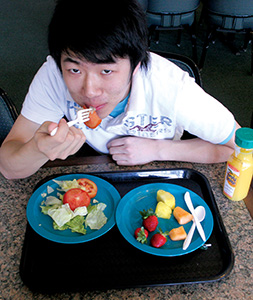
Though students may feel their choices are limited when they eat at campus dining halls, they actually have an abundance of choices, a Binghamton University professor said.
“I do agree that eating in a cafeteria day-in and day-out can get a little monotonous,” said physical education Professor Jennifer Wegmann, who is also a member of the Eating Awareness Committee. “However, Alexa Schmidt [a dietitian for Sodexo Campus Services] and Sodexo have worked really hard to provide a variety of food, including healthy choices to meet many students’ likes.”
Wegmann said many students want food choices that are “easy.”
“As a result students become creatures of habit in choosing the same meals day after day,” she said.
Schmidt said there are healthy options available at each station in the dining hall.
“For example, the grill offers garden burgers, Boca burgers and turkey burgers,” Schmidt said. “The hot line has a wellness entree each day and the deli offers lean meats, low-fat cheese, grilled veggies and hummus.”
ADJUSTING YOUR ATTITUDE ABOUT EATING IN THE DINING HALLS
One way students can adjust their habits in dining halls is to be patient, Wegmann said.
“Don’t walk into a dining hall with the mindset that it’s a fast food restaurant,” she said. “Many students want their food now so they choose the line that is the quickest, which may not be offering the healthiest food options.”
Students can also plan ahead, Wegmann said. She suggested looking at the dining hall menu online before heading to the cafeteria.
Bringing food with you while you are on campus is also a good habit to develop, Wegmann said.
“Snacking will help students avoid getting to the point where they feel like they are starving,” Wegmann said. “That way once you arrive at the dining hall you can make healthier choices and waiting a few minutes won’t seem so bad.”
Eating breakfast is starting the day out right, Wegmann said.
“Breakfast fuels the body and gets the metabolism cooking,” she said.
Anita Vogely, an adjunct in the health and physical education department, agreed.
“The metabolism is like a fire which is better suited to run with small quantities of fuel at the beginning of the day,” she said. “Starting the day off with a huge meal doesn’t give the body adequate time for the body to process the food it is taking in.”
Schmidt said students should fuel their bodies every three to four hours, whether they are eating on campus or off.
“Students should practice eating consistently throughout the day,” Schmidt said.
If there are unhealthy foods that you love you should never eliminate them, Wegmann said.
“Those fun unhealthy foods should be limited, but they do not have to be cut entirely from your diet,” she said. “Figure out how to incorporate the foods that you love fully into a healthy diet.”
CONSEQUENCES OF UNHEALTHY DINING
The selection of unhealthy food choices at dining halls on a regular basis can bring on some negative consequences, Wegmann said.
Diets high in saturated fat are linked to increased rates of cardiovascular disease.
“Cardiovascular disease is the leading cause of death in this country,” Wegmann said.
Many unhealthy foods, Wegmann said, are also loaded with calories.
“When you consume more calories than you burn, you tend to gain weight,” she said.
Many times, Wegmann said, unhealthy food items are also processed and refined.
Making healthy balanced food choices at the dining hall, Schmidt said, will enhance overall health and well-being.
“Making healthy food choices will provide students with increased energy and an improved concentration, among many other things,” Schmidt said.