





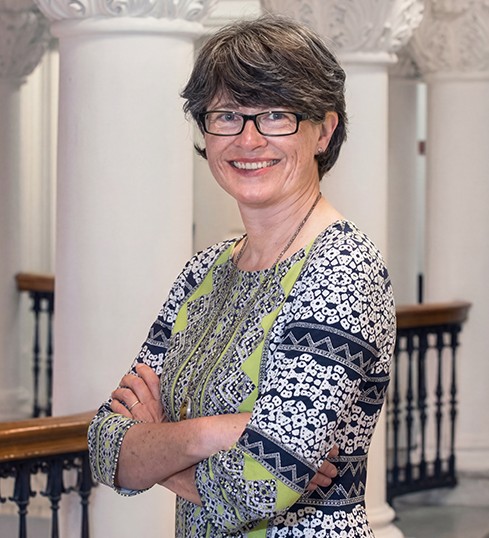
Binghamton University announced that Sheena Murphy, an expert in condensed matter physics and an experienced research administrator, will serve as its new vice president for research.
Murphy is currently the associate vice president for research development at West Virginia University, leading the school’s expansion and diversification of research. This includes overseeing initiatives to strengthen cross-disciplinary collaboration and increasing federal funding and coordination between WVU research initiatives and external organizations.
Murphy is a former executive committee member of the Oklahoma/Arkansas Materials Research Science and Engineering Centers and a National Science Foundation Faculty Early Career Development recipient. She has received more than $20 million in external funding, served on NSF’s task force for the Future of Established Program to Stimulate Competitive Research and is an Association of Public & Land-Grant Universities Council of Research Leadership Fellow.
“I view research broadly, including not only funding, but also scholarly output, creative activity, public scholarship, and community impact,” Murphy said to BingUNews. “My approach to leadership emphasizes collaboration across academic and administrative units, and I’m eager to get to work at Binghamton, which has exciting goals for growing its research capacity.”
Since 2024, Murphy has served as a research liaison to the Resilient Energy Technology and Infrastructure Consortium. The initiative is a finalist for the $160 million NSF Regional Innovation Engines award, the same program that funds the Energy Storage Engine in Upstate New York, led by BU.
The search committee was co-chaired by Donald Hall, provost and executive vice president for academic affairs at BU, and Mark Poliks, SUNY distinguished professor in the School of Systems Science and Industrial Engineering. As a candidate, Murphy stood out in particular because of her experience with the ESF Engines program and building large-scale competitive research initiatives.
Hall explained that these experiences will be crucial to guiding the expansion of BU’s battery initiatives alongside other research initiatives. This year, BU raised $87.3 million in research funding, its best yet.
“Sheena has an understanding of what it will take for Binghamton’s research portfolio to grow,” Hall said to BingUNews. “I also appreciate her commitment to inclusive research environments that benefit researchers at all stages of their careers, and I look forward to working with her to recruit and retain exceptional scholars at Binghamton.”
Murphy also explained the importance of the battery initiative for the University and energy storage technology in general.
“The battery initiative is obviously quite successful and has just cleared into the second phase of NSF Engines funding,” wrote Murphy in an email to Pipe Dream. “Energy storage is going to be vital for the energy transition as manufacturing increasingly relies on electrification. There is a tremendous need to re-develop the national grid infrastructure to support that transition and grid-scale storage is key, so BU and the battery initiative are well placed to make a difference and I’m looking forward to working with that team on additional industrial engagement and partnerships to see those lab-based innovations transition to the marketplace.”
Lisa Gilroy, an experienced research administrator for BU, is the current interim vice president for research. Gilroy was recognized for her service with the Council/Foundation Award in 2014 and the Winifred R. Widmer-Downey Empowerment Award from the Research Foundation in 2019.
Bahgat Sammakia stepped down from the vice president for research position in August 2025. Sammakia continues to serve as a distinguished professor of mechanical engineering and the director of the S3IP Center of Excellence.
In addition to expanding the University’s research initiatives with dialogue between scholars, Murphy plans to integrate research with educational opportunities for career development for researchers at all levels.
“I’m a strong advocate for undergraduate research and scholarship,” Murphy wrote. “I believe what happens between a student and a faculty mentor can really complement what happens in the lecture hall, so I’m looking forward to working with various academic offices to enhance and increase the opportunities for undergraduate engagement in research and scholarship at BU. I’m also aware of President D’Alleva’s charge to increase graduate enrollment.”
“The Research Office has a role to play in all of those stages and I look forward to working with the colleges to add to the existing resources so that researchers, regardless of stage, can maximize their effectiveness,” she continued.