





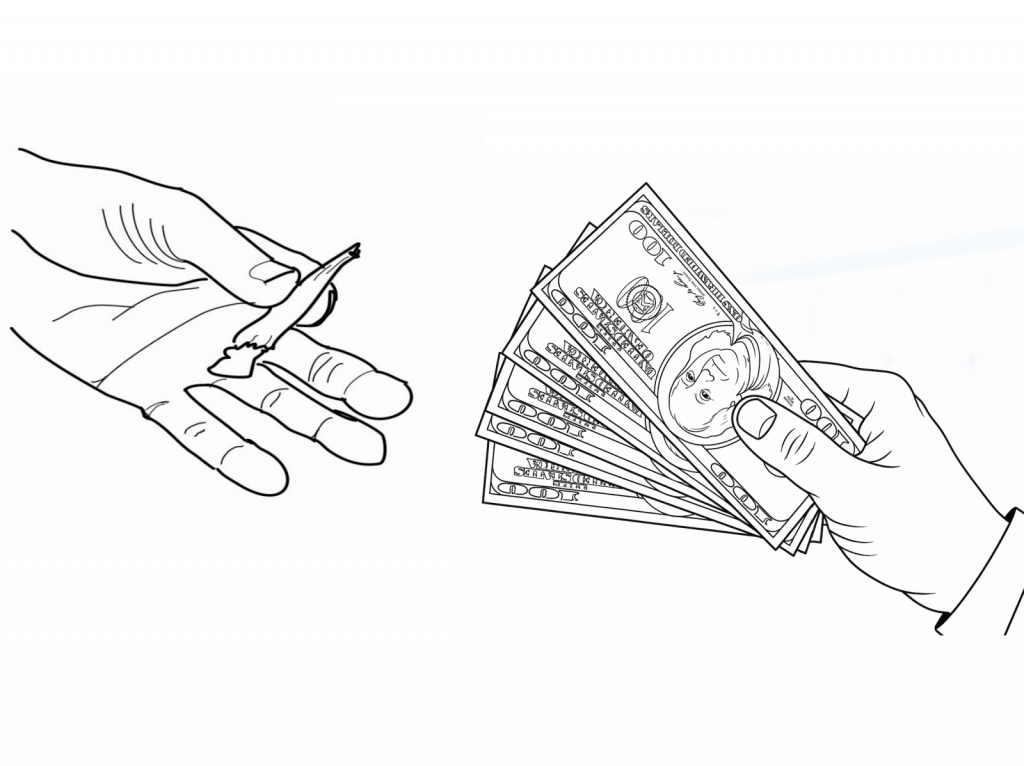
Many students who use recreational drugs go to dealers rather than licensed establishments. Pipe Dream talked with some anonymous Binghamton University students to learn more about drug dealing on campus.
The University’s Code of Student Conduct prohibits the consumption, purchase, personal use and sale of drugs and alcohol. Nevertheless, some students looking for cannabis, magic mushrooms and lysergic acid diethylamide, or LSD, resort to dealers on campus and in the Binghamton community.
This dynamic appears to be global — a 2019 study conducted across nine colleges in Wales found that half of the students who reported using drugs solely obtained them from friends and associates, while one-fifth of users only got drugs from external dealers. One-third of students in that study reported selling drugs.
In response to Pipe Dream’s informal survey, 27 students reported purchasing drugs on campus.
To purchase weed during their junior year, one student used Telegram to connect with a local dealer who would drive to campus and usually deliver a quarter of an ounce of cannabis. The student reported that obtaining drugs from this dealer was “much much cheaper” than visiting a dispensary.
Another student said they both purchased and sold cannabis and shrooms on campus. When asked if they believe more requests come from certain living communities compared to others, the student said the Cayuga Building in College-in-the-Woods was “definitely my #1 building.”
Back when they still dealt, the student usually sold between 3.5 and seven grams at a time. To obtain the drugs, a middleman from Connecticut used to provide them with cannabis, which mainly came from farms in Michigan and Oregon.
Dealers have reported taking cash and mobile payments with Zelle, Venmo and Cash App.
Across the country, some students have faced discipline for selling drugs at colleges and universities. In 2020, the U.S. Department of Justice announced that 21 people were federally charged related to the sale of narcotics in North Carolina. According to an investigation by the U.S. Drug Enforcement Administration, a drug ring collectively funneled “over a thousand pounds of marijuana, several hundred kilograms of cocaine, and significant quantities of other drugs” in the University of North Carolina at Chapel Hill area.
Drug transactions completed as part of this ring exceeded $1.5 million, according to the federal government.
In 2023, investigative journalist Max Marshall published a book detailing widespread drug dealing, excessive drinking and selling fake IDs connected to several fraternities at the College of Charleston in South Carolina.
It is not uncommon to purchase shrooms, LSD and other psychedelics from dealers, and recent federal action has pushed toward greater research of these substances. This month, President Donald Trump signed an executive order to fast-track research into the potential therapeutic benefits of hallucinogenic drugs and allocate $50 million for state research into ibogaine, a psychedelic made from the roots of a shrub.
Most psychedelics are listed as Schedule I drugs under the Controlled Substances Act. While the executive order does not immediately delist any drugs, it creates a process for the federal government to loosen restrictions on certain substances going through the FDA’s approval process.
“We insist on romanticizing the collegiate underground-treating encrypted chats and student ‘plugs’ as mystical psychoactive psychopomps — yet the reality is dreadfully pedestrian: a series of mundane, capitalist transactions compiled entirely by the draconian architecture of prohibition,” one anonymous student wrote to Pipe Dream. “Every botanical sacrament and illicit phenethylamine carries the heavy, unglamorous tax of selective prosecution. We are currently enduring a so-called ‘psychedelic renaissance,’ a reactionary bloom to our modern psychological decay, subsidized by podcast sensationalism and sterile clinical trials.”
“But to strictly medicalize these compounds while aggressively stigmatizing their recreational pursuit is a profound failure of imagination; it is the hypocrisy of a society that permits consciousness alteration only if it is dressed in a hospital gown,” they continued. “The catastrophic fentanyl crisis was never born of a collective consumer desire for synthetic respiratory depression; it is simply the predictable segmentation fault of corporate greed executed within a poisoned, prohibited supply chain.”