





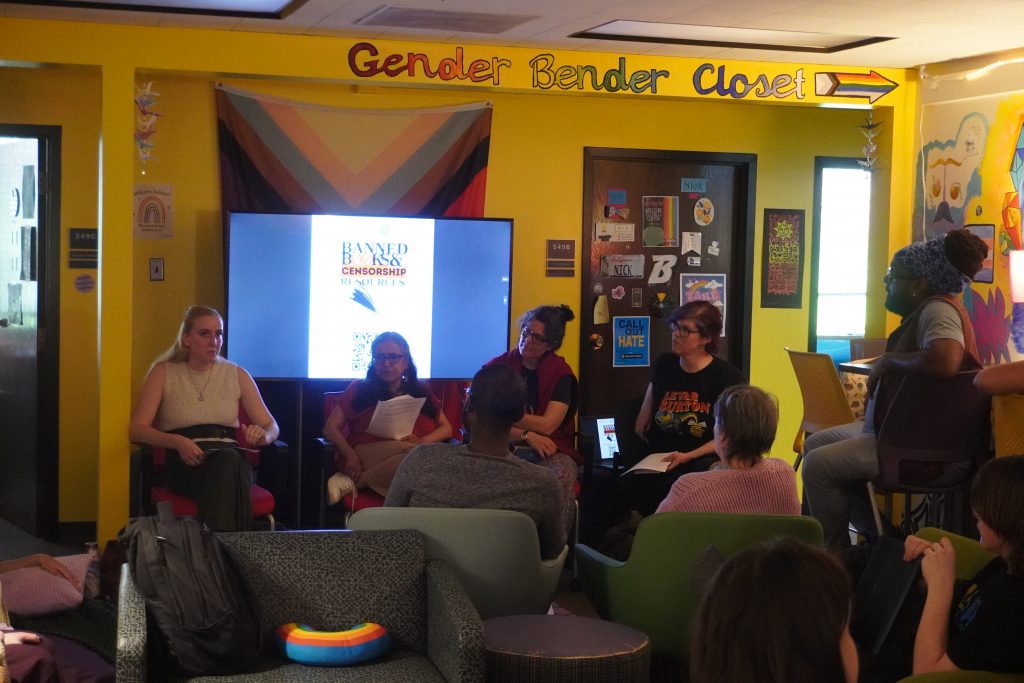
On Tuesday, the Q Center and Binghamton University Libraries collaborated on a “Banned Books and Censorship Panel,” featuring three panelists who discussed censorship through their own distinct lenses.
The three panelists were Alexandria Pollock ‘20 MA ‘21, a Ph.D. candidate studying anthropology who has worked extensively in public libraries, Tina Chronopoulos, an associate professor and chair of Middle Eastern and Ancient Mediterranean studies, and Monika Mehta, an associate professor of English who has authored a book on censorship in Bombay cinema.
“Censorship has been around for a very long time — basically as long as information has existed,” Jillian Sandy, the event’s moderator and an instruction and outreach librarian for the University Libraries, wrote. “There are a lot of misconceptions that we are beyond censorship as people can access whatever information they need online. Unfortunately, this is not true as a great deal of accurate information is behind paywalls, deprioritized by algorithms, and unavailable to many people who don’t have reliable internet access. Having public events like this one recognize censorship both to raise awareness and to reflect our values of information sharing.”
The panel focused on how book banning and censorship can disproportionately impact marginalized communities, typically people of color and the LGBTQ+ community. Pollock discussed the importance of organizations like the American Library Association in tracking which books are banned and why. She stressed the ALA’s vital role in gaining insight into the governmental framework of censorship and fostering public discourse.
“The American Library Association keeps track of what books are banned,” Pollock said. “Because otherwise it would just be happening and sort of going under the radar and people would be like, ‘Okay, I’m sure there are banned books, but I don’t know what they are.’ And so they keep track of that and a lot of other things that are happening in terms of censorship and things with libraries.”
“I think it’s also important to keep the record of that so we know what is being censored and why, because a lot of it has to do with political agendas and things like that,” she added.
Pollock spoke about these technological and financial barriers while addressing the audience. She discussed how the lack of Internet and electricity, particularly in rural areas, makes viewing certain online resources extremely difficult, raising questions about geopolitical equity in access to information.
Mehta brought her film perspective into the conversation, referring to the heavy censorship applied to post-colonial Indian film. The state felt that it was its duty to protect its citizens from what it considered “demoralizing.” Mehta also spoke of the highly erotic nature of Bombay cinema and how its more intimate aspects are being threatened with the rise of the Hindu right.
On a similar note of censorship in history, Chronopoulos discussed how the translation of texts can act as its own distinct censorship. She brought up a poignant example of the sexually explicit content in many ancient Greek and Roman texts, which are often bracketed without translation. This prevents people who do not know the native language from understanding its content.
This tension highlights an important theme from the panel discussion — that censorship takes many forms across various mediums and it need not be overt. The panelists discussed the importance of learning the mechanics of censorship to be best equipped with defenses against it.
Michael Williamson, an attendee and a Ph.D. candidate studying English, described what he appreciated and took away from the discussion.
“The panel was really robust, I really enjoyed it,” Williamson said. “A lot more was covered than just books and that’s what I appreciated. My main takeaway is that the tactic of government that we need to be focused on is the issue of censorship itself and that is not limited to a certain form, whether that’s the book or the novel, but it also applies to print media, to history itself.”
Chronopoulos concluded the panel by underscoring the importance of creating open spaces to facilitate real conversations. The panelists reinforced that while it may be difficult to have these conversations, they are important in ensuring individuals stay informed and learn from history.
Since censorship has historically silenced the voices of marginalized groups, Sandy went on to discuss the value of actually reading books from these sources directly, so people can develop their own perceptions and interpretations of the content.
“I encourage folks who are concerned about censorship to read books and watch media from creators who are part of minority communities, including those based on ability, gender identity, race, and sexuality,” Sandy wrote. “Reading books and viewing media for yourself can help you determine whether you actually find its content objectionable.”