





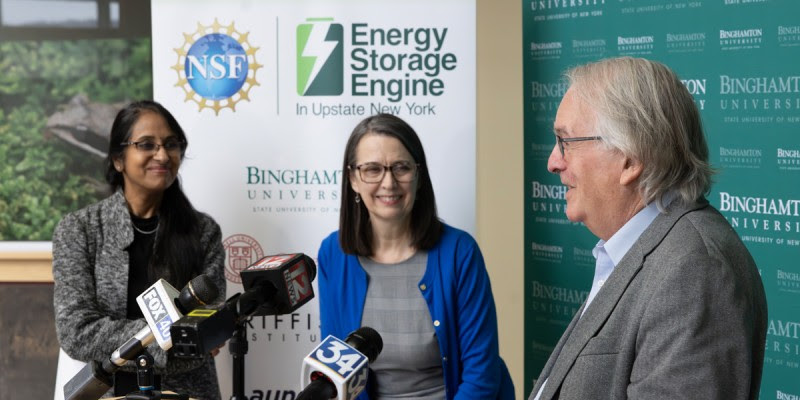
With renewed funding, an initiative led by Binghamton University plans to cement the Southern Tier as the premier battery technology hub in the country.
The University and Sen. Chuck Schumer announced on March 23 that the New Energy New York project will receive up to $45 million in funding over the next three years as part of phase two of the National Science Foundation’s Regional Innovation Engines program.
“I’ve fought to secure tens of millions to grow the battery industry in Upstate NY, helping the region to be designated a prestigious federal Tech Hub and be named one of the NSF’s Innovation Engines,” Schumer said in a press release. “Today’s investment keeps that momentum going and will help ensure the next breakthroughs in battery technology are made here in the U.S.A. The Southern Tier is charging ahead, and we’re just getting started.”
Schumer helped create the NSF Regional Innovation Engines program through the CHIPS & Science Act, enacted in 2022. The hope in creating this program, according to Schumer, was to strengthen Binghamton’s capacity to commercialize, create and accelerate technology growth in batteries.
One of nine engines within this program, the Energy Storage Engine, part of the broader NENY initiative, launched and received its first round of federal funding in 2024, totaling $15 million. Over the next decade, funding could potentially reach up to $160 million. BU leads the regional initiative with help from partners like Cornell University, Rochester Institute of Technology, Syracuse University, the Griffiss Institute, Launch NY and New York Battery and Energy Storage Technology Consortium.
“This renewal acknowledges the Engine’s remarkable progress and early impact, the collective strength of its extensive partner ecosystem, and the bold vision guiding its future,” University President Anne D’Alleva said in a press release. “The NSF Energy Storage Engine is already successfully advancing an ambitious plan to establish upstate New York as America’s battery tech capital, building on our region’s strong legacy of innovation and manufacturing excellence. We thank the National Science Foundation for its support and unwavering commitment to this program.”
According to Meera Sampath, the CEO of the Energy Storage Engine, the initial phase focused on launching programs and networking with all of these collaborators. In contrast, the second phase will concentrate on upgrading and expanding these programs and partnerships, with a particular focus on next-generation battery systems and solutions that not only promote safety and efficiency but also incorporate artificial intelligence and tackle common energy storage application challenges.
“Batteries for America by America is our goal,” M. Stanley Whittingham — a distinguished professor of chemistry at BU, the director of the NorthEast Center for Chemical Energy Storage and the chief innovation officer of the Upstate NY Energy Storage Engine, who in 2019 won a Nobel Prize in chemistry for his contributions to the creation of lithium-ion batteries — told BingUNews. “The Engine, combined with the other key capabilities we are building in upstate New York, including Battery-NY, a peerless battery pilot manufacturing facility, are moving us toward realizing this goal.”
Whittingham is also the chief innovation officer of the NSF Energy Storage Engine. Omar Faruk, a fifth-year doctoral candidate studying materials science and engineering and one of Whittingham’s students, shared his belief in the revolutionary power of using rechargeable batteries with modern technologies.
“I think an award like this one will enable NSF Storage Engine to redefine the next-gen energy storage system by designing high performance batteries with enhanced safety, driving down the cost by integrating AI from materials discovery to battery production, while expanding regional economic growth and domestic battery production,” Faruk wrote in a statement to Pipe Dream.
Over the past two years, the engine helped prop up numerous industry-academia teams, provided funding for over 15 high-tech battery startups and assisted various organizations by giving access to infrastructure, capital and other technologies. Hundreds of young learners in grades K-12 and thousands of constituents across upstate New York have also benefited from the engine’s community outreach efforts.
“It is great news for Binghamton University and the entire NSF energy storage engine in upstate NY,” Sitaram Panta, laboratory technician of Whittingham’s NECCES, wrote in a statement to Pipe Dream. “I am excited to see growth in battery [research and development] activities across the region, among the partners, and beyond.”