





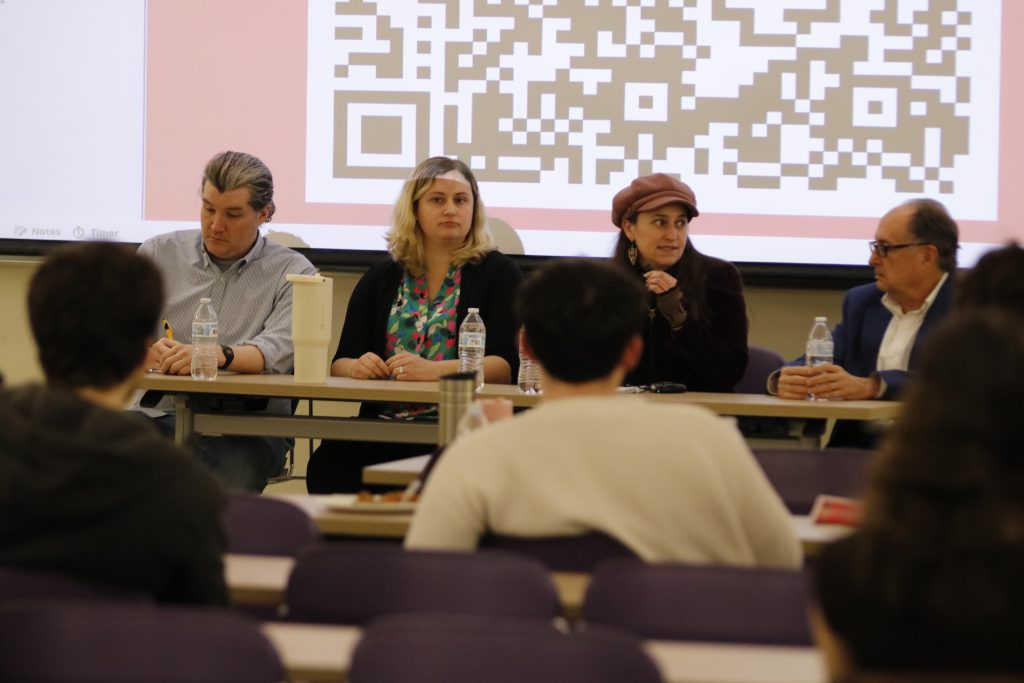
The Young Democratic Socialists of America and SHADES partnered with the Student Association to host a panel discussion featuring local attorneys, faculty, advocates, and politicians to discuss U.S. Immigration and Customs Enforcement activity in the Binghamton area.
The event, held March 25 in the University Union, was moderated by Myles Dansby, the membership co-chair of YDSA and a sophomore double-majoring in political science and history, and August Rey, the political activities chair of SHADES and a sophomore majoring in political science.
“For many students here at Binghamton, ICE sounds like a boogeyman,” the YDSA said in a statement to Pipe Dream. “We constantly hear about ICE raids in Minnesota, NYC, or in border states, but when two of our neighbors were detained by ICE this week, one of whom was taken on Murray Hill Road just off campus, there was no fanfare or news blast. Despite ICE operating in Binghamton for nearly a year and detaining more than 300 of our neighbors, many students are unaware that they’re in our community at all.”
The event featured guest speakers John Perticone, a lawyer at Levene Gouldin & Thompson, LLC; Christina Zawerucha ‘05, a conversation pairs coordinator and lecturer at the English Language Institute at Binghamton University; Emily Capone, the supervising attorney for Journey’s End Refugee Services and Andrew Pragacz, the president of Justice and Unity for the Southern Tier and an adjunct lecturer at the University. Dan Livingston, a former Binghamton City councilman who is currently running for the 123rd District of the New York State Assembly and Matt Ryan, former mayor of Binghamton who is running for Broome County sheriff, were also present at the event.
President Anne D’Alleva was invited to attend and representatives from the International Student and Scholar Services were asked by the YDSA to sit in on the panel and speak directly to student concerns. Both offers were declined, according to a statement from the YDSA.
The panel opened with a question about the documentation ICE officials would need to detain individuals on campus after D’Alleva said that ICE officials can enter campus and detain people with the right paperwork. Zawerucha was the first panelist to answer, explaining that someone cannot be detained or searched, generally speaking, unless the ICE official has a judicial warrant signed by a judge.
According to ICE’s website, agency officials do not need judicial warrants to make arrests. Most often, they use administrative warrants signed by an authorized officer.
“About 11 percent of students here at Binghamton University are international,” said Zawerucha. “Even more might be of mixed status. And so it’s really important for us to have clarity about what the rights and needs are of people with mixed documentation here at Binghamton University.”
Zawerucha also said that most detentions reported in Broome County have happened while people were driving to work or the doctor’s office.
A University spokesperson said that during a meeting with students, D’Alleva said BU would “proceed accordingly depending on what documentation was provided to campus” regarding immigration enforcement. This would align with SUNY Board of Trustees policy requiring “a subpoena, court order, search warrant” or other legal documentation before assisting law enforcement with investigations into students.
Pragacz explained that it seems unlikely ICE officials would step foot on campus to arrest anyone, since the University is part of SUNY, a public university. He also suggested that we demand more from D’Alleva and that the statement regarding ICE was “almost meaningless.”
Perticone added that the Broome County Jail has an agreement with the federal government to house detainees. However, this agreement does not allow local law enforcement to arrest people for violating immigration laws. This differs from other parts of New York, such as Nassau County, where the sheriff’s department has essentially been “deputized” by the federal government to try and find people who are in the country illegally.
The next question asked how students could work to prevent collaboration with ICE. As a coordinator for the conversation pairs program at BU, Zawerucha noted that she has historically observed 30 percent more English learners apply to the program than native English speakers. This year, however, the program’s applications shifted to 3 percent more English speakers than English learners.
“What that tells me is that the Binghamton University community, the Bearcats that are here, are stepping up and seeing what’s happening in the big world and welcoming international students at a time when it’s really challenging to be an international student,” Zawerucha said. “I also think that students have a whole lot of power.”
Zawerucha then listed several pieces of state legislation students could support to help counteract ICE. Among these are the New York for All Act, which would forbid local law enforcement agencies from collaborating with ICE; the MELT ICE Act, which would prohibit ICE officers from wearing face coverings and plainclothes; and the Access to Representation Act, which would establish a right to legal counsel in immigration court proceedings.
Capone added that the Access to Representation Act is particularly important in her view because immigrants seeking asylum in the United States often cannot afford legal counsel, which is not provided to them for free as it is for U.S. citizens.
Pragacz said that the areas where ICE raids are conducted depend on a variety of factors and larger institutions are often not targeted. As an example, he claimed that immigration officers are not going after immigrants who work on dairy farms because farmers usually support Trump and removing the immigrant workforce on farms would cause the price of milk to rise.
Rey then asked another question specifically to Perticone and Capone about their experience representing people who were detained or at risk of being detained by ICE.
Capone explained that her job as a supervising attorney involves determining the options available for detainees or others at risk of being detained. This requires getting background information on them, including whether the person has been trafficked, whether they have relatives that are U.S. citizens and if they are married. These are all possible ways that an individual can gain legal status in the United States.
“What I always tell people is the best thing you can do is ask,” said Capone. “The worst thing someone could tell you is that you don’t have any options, but sometimes there are and so it’s important that someone talks to a lawyer, an immigration lawyer, to get an individual evaluation of their situation and their case to know that for sure.”
According to Pragacz, the Trump administration has “weaponized” the legal system by detaining asylum seekers and forcing their lawyers to navigate the jail system, which they often have had no prior experience doing.
“Political education initiatives like this are an important first step, but they are just that: we in the Young Democratic Socialists of America will not stop organizing until our representatives take tangible steps to end ICE overreach in New York State and our administration ends their contract with Flock Safety, the company which supplies our campus’ [Automated License Plate Readers] then turns around and shares the data they collect across the country to ICE,” YDSA wrote in a statement to Pipe Dream.
“While we are glad the SA President and VPMA have shown solidarity with their fellow students in this fight, their willingness to act makes the University’s silence even more damning.”
SHADES also supports the movement to end the University’s contract with Flock Safety.
“I don’t believe a panel alone will change any of this, but I would like to see Binghamton University end its contract with Flock and remove its license plate scanning cameras from campus,” Rey wrote in an email to Pipe Dream. “I would also like to see more advocacy from the University administration. Too often, it feels like our administrators are there to maintain the status quo rather than to improve it.”
According to the University Police’s webpage, automated license plate reader information cannot be shared with ICE and other immigration authorities pursuant to New York’s Driver’s License Access and Privacy Act of 2019.
When asked what students could do to stay safe and get involved, Perticone noted the importance of voting in the upcoming election and Pragacz spoke about the impact of organizing.
“When students are organized and get together, you can have a big impact, right?” Pragacz said. “But you’re not going to do it alone.”
Editor’s Note (4/13): This article was updated to clarify a panelist’s statement on the Access to Representation Act.