





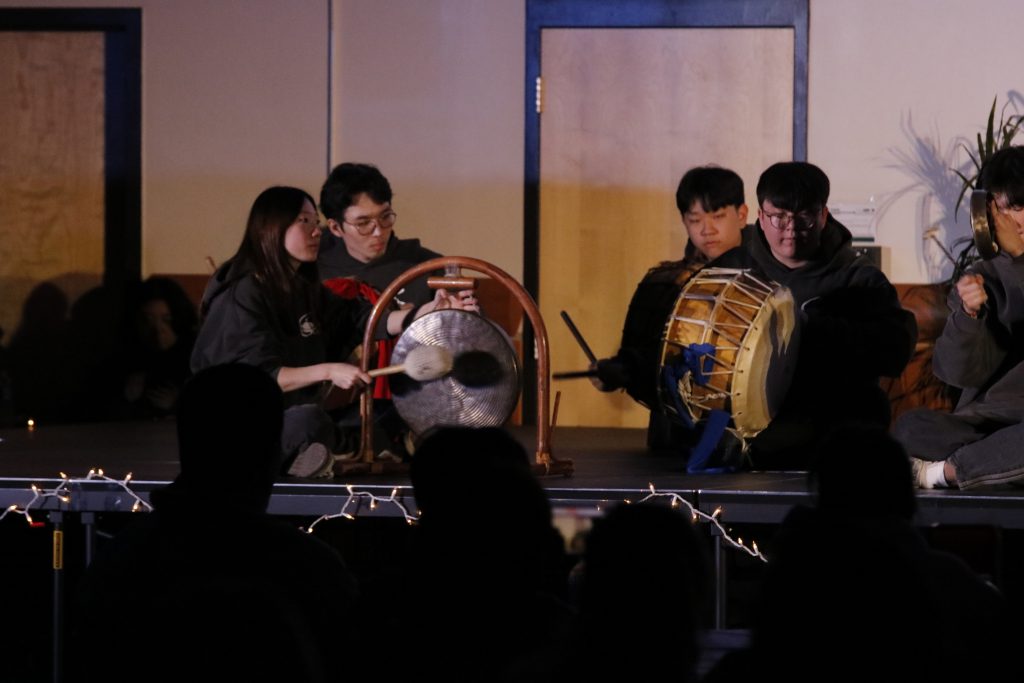
Binghamton University Sulpoong hosted a revival of its annual showcase for the first time in six years. With performances from Cornell University’s Shimtah and University students, guests were treated to a night of traditional Korean culture, rhythmic drumming and energizing choreography.
Sulpoong, founded in 2004, has been a beacon of Korean culture on campus through the tradition of Pungmul. Originating from agricultural traditions, Pungmul has influenced varying drum styles focusing on four instruments: kkwaenggwari, janggu, buk and jing. Each instrument represents its own element of nature, such as thunder, rain, clouds and wind, coming together to make intricate rhythmic music as dynamic as the world around us.
The event’s theme reflects its history and the work the organization has done to bring the showcase back. Nina Malone, vice president of Sulpoong and a senior double-majoring in Korean studies and political science, explained the events theme of hangul lettering, or buak, as both honoring the past and looking toward the future.
“So the inspiration for the event, we looked at past performances, the past annuals that we’ve had before,” Malone said. “Buak was because it means reviving — like, fresh, new start.”
Sunkyung Kim, president of Sulpoong and a senior majoring in business administration, recalled the dreams of past members to revive the showcase. While Sulpoong has performed at events for other organizations, it has been some time since it last performed on a stage of its own.
“Basically, our seniors, they had this whole regret that they weren’t able to have their own stage, because we’re always performing for other people’s stages,” Kim said. “And we wanted our own stage for us and so that became our inspiration to fulfill these seniors’ wishes.”
Edward Son, Sulpoong’s treasurer and a sophomore majoring in business administration, and Abigail Ahn, Sulpoong’s multimedia chair and a sophomore majoring in history, hosted the event. The first half of the evening included multiple percussion performances in different styles, including Yeongnam, Nantah and drum dance. Each style is uniquely influenced by its region with different drum patterns, choreography and lyrics.
Having grown up in Korea, it was the nostalgia surrounding these historical practices that drew Kim to Sulpoong. Learning and reconnecting with her culture, even thousands of miles away, has inspired her to stay.
“It’s just the music itself was so nostalgic and I just welled up when I was seeing them for the first time, and that’s when I was like, ‘This is what I’m gonna do for the rest of the three years,’” Kim said.
Many of the performers wore costumes honoring the traditional samulnori, a music genre coming from pungmul, dressed in colors of red, yellow, white and black. The genre’s name translates to “four objects play,” showing how these colors come together, much in the same way as the instruments, to represent the different aspects of nature.
These performances’ long histories that pay homage to ancient traditions are part of Sulpoong’s mission to educate on and maintain these practices.
“The importance is that we want to spread this music around campus and we want them to be immersed in what we do and what we sing — because we also have lyrics in this — and have this passion, and we channel that passion through our drums and then we want them to see our efforts being made,” Kim said.
The second half of the event included performances in the style of Ahnjeunban, Samul and Utdari. Cornell’s Shimtah closed out the night with Samul performances, encompassing the themes of the night with the traditional instruments coming together to create a powerful melody.
The final style showcased was Utdari, characterized by its lighter and playful beats that brought a fun close to the night’s performances. Once the performances ended, a tribute began for Sulpoong’s departing senior members and a thank you for the work they put into building the club. Malone shared her wish for people to get involved, no matter their cultural background — as she is not Korean herself — and have fun experiencing new and exciting cultures and languages.
Kim also returned to the event’s theme as she expressed hope for new and incoming members to see their hard work showcased. As the club grows, she hopes that more people will become acquainted with traditional Korean music that, as Kim puts it, “just hits different.”
“We also wanted to show our new members that this is also what we have done in the past and that this is something you should look forward to when you’re practicing as well,” Kim said. “Because we do put a lot of commitment and hours into practice and so we want to show them this fulfillment in the academic year.”