





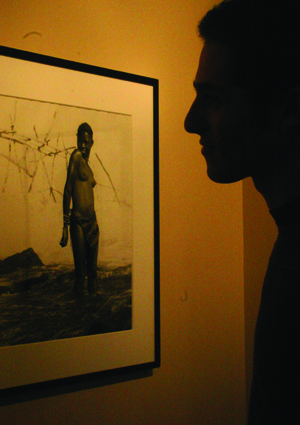
A controversial art exhibit featuring nude African women on display at the Binghamton University Art Gallery has spurred campus debate among faculty and students who are outraged at the content of the exhibit — and who are demanding that it be closed.
The exhibit, “Engaging the Camera: African women, portraits and the photographs of Hector Acebes,” on loan from the Spelman College Museum of Fine Art, features photographs of women in Africa during the 1940s and ’50s — most of them nude. They are part of a collection of thousands of photographs taken during that time by Columbian photographer Hector Acebes. According to Lyn Gamwell, director of the BU Art Gallery, the curators of this exhibit decided to focus on Acebes’ photographs of women because Spelman College is an African-American women’s college.
Gamwell said that the response hasn’t been completely a surprise. “It’s a sensitive topic,” she said, “because scholars differ on the interpretation of history.”
Criticism of the collection has come mainly from faculty of the Africana studies department. James Burns, a professor in that and the music departments, was one of the first to see the exhibit and call for its closing.
Burns, who has lived in West Africa, said the the portrayal of African women in the photographs was a “misrepresentation of Africa.” The impression of Africa that is seen in the West, he said, is mainly of “poverty and nakedness,” and one that he feels is reienforced by the exhibit.
In addition to calling for the dismantling of the exhibit and a formal apology, Burns also voiced his desire for a different collection of photography.
“[The gallery] should eventually have an exhibit that would have a positive representation of Africa in the 21st century — Africa as it really is today,” he said.
But Gamwell, who coordinated the exhibit in conjunction with another exhibition of African artifacts and a concert from the Royal Drummers of Burundi, said that the point of the Acebes exhibit was and remains putting the photographs into a historical context.
“For students, the important thing is to see the material and to be educated about the debate,” she said.
But for Africana studies Professor Isidore Okpewho, the content of the photos is too offensive even for debate.
“… [I]f some foreign photographer, with obviously voyeuristic intentions, went to an unfamiliar society and cornered young girls … into a pose they would hardly have been allowed to give by their parents or their society,” he wrote in a statement, “why would any serious scholar … want to dignify such photographs with an exhibition?” The statement in its entirety — along with a response from Lyn Gamwell — can be found in this issue’s Opinion section.
Amid the criticism, Gamwell has remained firm in her decision.
“Absolutely no,” she said. “That would be the last thing I would do. No matter what we think we don’t want to silence the debate. We don’t want to put the issues in a box and put them away.”
A 1994 exhibit, “Madness in America: Images of mental illness,” which showed medical images that some women and minority groups deemed offensive, also drew a strong reaction, she said.
Gamwell decided not to close that exhibit, she said, for the same reasons she cites now: “It’s important to look at the history,” she said, “and to learn from history.”
Text placards accompanying the photographs prompt the audience to consider the connotations of Acebes’ photography. One such placard asks readers to contemplate: “Why are photographs of naked African women considered socially acceptable ethnographic materials?”
But that explanatory text and Gamwell’s assertions appear to have done little to calm the growing turmoil around the exhibit, and so a discussion with the curators, Andrea D. Barnwell and Isolde Brielmaier, is scheduled for 6 p.m. Nov. 9. And the African Student Organization met last night for a forum on the exhibit. A protest, which is being supported but not organized by the ASO, has been scheduled for this Friday, Oct. 20.
But for now, while the protest gained steam, the ASO put off any call to close the exhibition. Mari Morales-Williams, a senior English major and the group’s educational coordinator, said the group was “imploring everyone to see the exhibit, to look at it with a critical eye, and to encourage the dialogue about what it is.”
The University administration, for its part, has remained conspicuously silent on the issue. At press time, neither BU President Lois B. DeFleur nor Provost Mary Ann Swain had commented on the controversy, but directed all questions to Gamwell.
To Burns, this was “symptomatic of the devaluation of Africa.”