





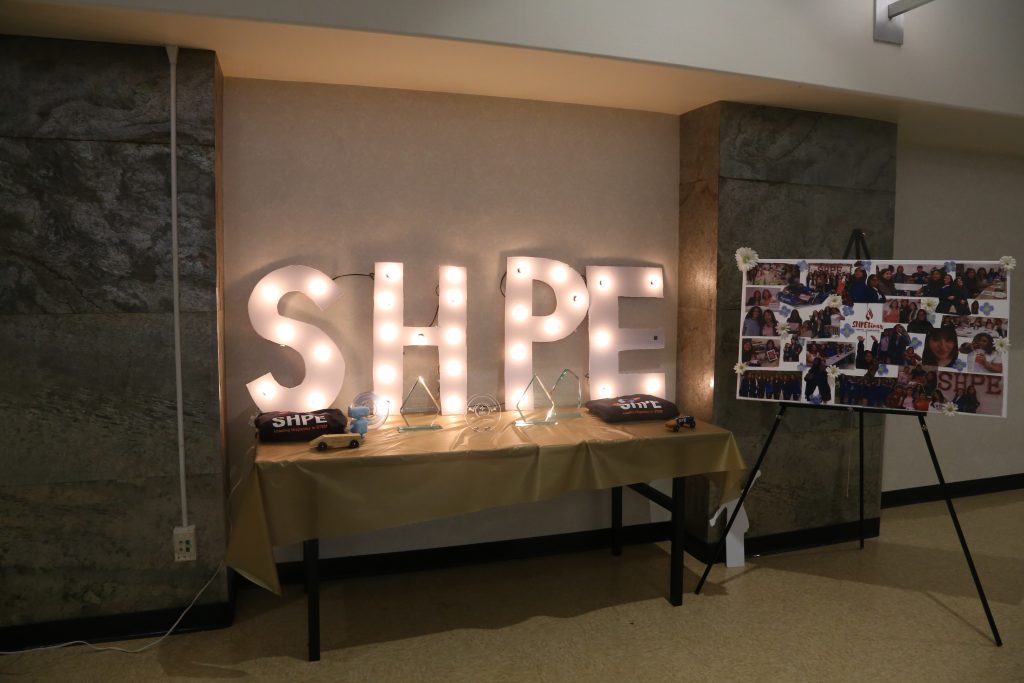
The Binghamton University Society of Hispanic Professional Engineer Latinas hosted its fourth-annual Female Leadership and Mentorship in Engineering and Science panel.
Held on Monday, the FLAMES event featured a discussion with six panelists led by Janelle Mosquera, the events chair of SHPE and a junior majoring in environmental science. The University’s chapter of SHPE became a nationally recognized organization in 2002 and SHPEtinas, one of its sectors, was founded in 2019 to empower Latinas interested in engineering.
The six speakers were Eliza Grames, assistant professor of biological sciences; Kaiyan Yu, associate professor of mechanical engineering; Ashley Ramos ‘23 MS ‘24, a public health engineer trainee for the government of Orange County and former president of SHPE; Kimberly Harry, assistant professor of the school of systems science and industrial engineering; Brianna Gillfillian, a Ph.D. candidate at Syracuse University and founder of STEAMfluence, an initiative focused on making STEM education accessible and engaging for underserved communities; and Mikayla Chandler, a graduate computer science student at Syracuse University.
The event opened with a keynote address by Stacey Brown, an assistant director of Watson Career and Alumni Connections at the University. Brown’s address reflected on her experiences of striving to work in criminal justice during her undergraduate studies, feeling replaceable in her role, experiencing burnout in her career and finally landing a career she enjoyed at the University. She highlighted her passion of mentorship and working with students despite not initially wanting to pursue that career, advising the audience that the path to one’s career is not always linear.
“You don’t need a perfect path to have a meaningful one,” Brown said. “You don’t have to feel confident to be capable. And you don’t have to do it alone, because sometimes the most powerful thing you can do is just keep going and bring others with you along the way.”
Ramos, Gillfillian and Chandler addressed their experiences with imposter syndrome as women in STEM. Imposter syndrome is defined by the National Library of Medicine as the feeling of self-doubt of one’s intellect, skills or accomplishments — despite their own evident success and achievements — and is most common among women and marginalized groups.
Ramos discussed her experience with imposter syndrome in her current place of work, where she is one of two women engineers among 12 other male engineers.
“I just have to keep going, push forward and not let that bother me and just put my foot down and explain why I’m here to help them,” Ramos said.
Gillfillian said that when she landed her dream internship at IBM, she initially felt that she didn’t belong there, which led her to think that she wasn’t good enough as a researcher or as a STEM student. She emphasized the importance of having people in her circle to help her through these situations and remind her to “remember where you’re coming from and do not lose light on where you’re going.”
Panelists spoke about being assigned tasks typically believed to be a “woman’s job.” Ramos mentioned that there were times when she and her other female coworker were asked to do secretarial work on top of the work they already had to do.
“If they needed help with mailing or taking notes, they would rather not learn how to do it and have us do it instead,” she said. “It’s been a battle telling them ‘we have our own work and we can’t pick up your slack and that you can learn how to mail things too.’ It’s not just a ‘woman’s job.’”
Harry discussed the challenges she faced in finding financial aid while being an immigrant student in the United States, seeking out programs that would provide her with food and textbook assistance. For students facing similar challenges, Harry encouraged them to apply to scholarships and fellowships that align with their background and qualifications.
Ramos also discussed maintaining a work-life balance, saying that it is important to “work to live instead of live to work.” She says that one should love what they’re doing in their day-to-day career, but also make time for things that are not work-related.
After the intermission, Mosquera fielded questions from the audience. One person asked about how the panelists continue to show up despite the challenges they face in the workplace. Grames replied that her passion for the people she helps with her work motivates her to keep pursuing her career. Gillfillian explained she is the first in her family to graduate high school and college and she wants to serve as an example for her community.
Mosquera said that she hoped the FLAMES panel would be an opportunity for students to ask questions and get insight into being a woman in STEM from professionals.
“I hope that the students are able to get insights as to any questions that they had or things that they were contemplating about the workforce, or even academia,” Mosquera said.