





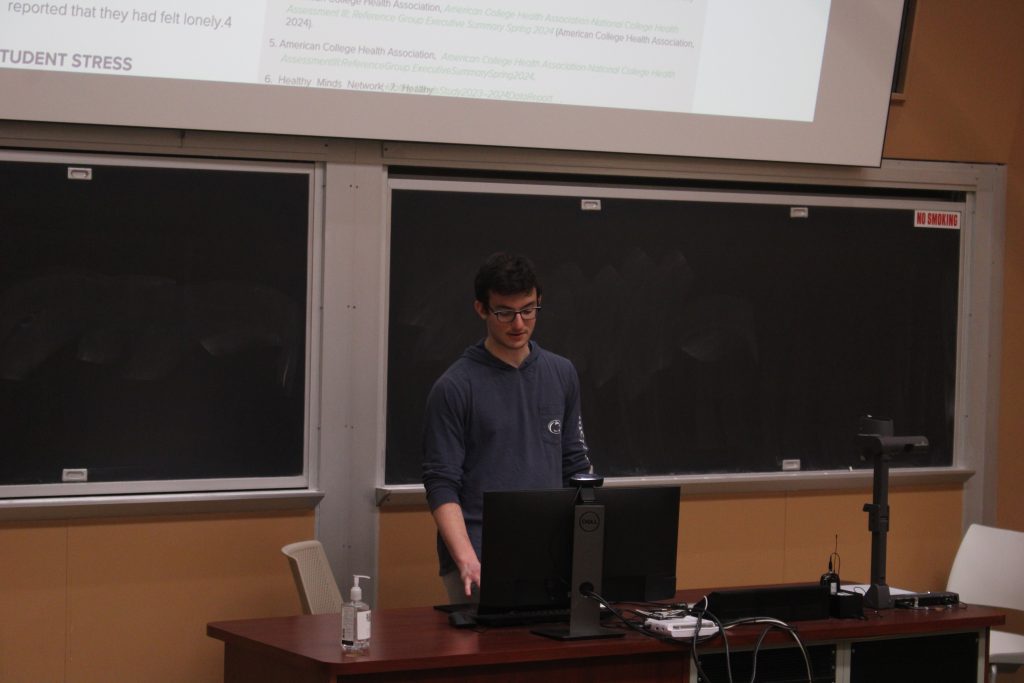
The Student Association’s Student Life and Academics Committee hosted a mental health town hall for students to share their difficulties with accessing and utilizing mental health resources at Binghamton University.
Organizers opened the town hall by citing statistics about college student mental health from the American Council on Education. According to a 2024 study, 47 percent of students reported having symptoms of anxiety or depression and less than half of those students received therapy or counseling in the same year.
“Our committee is hosting this Town Hall as a direct response to the barriers students have shared with us, from the difficulty of booking appointments to the need for a counseling staff that reflects our lived experiences, and the stigma many face in their communities when seeking help,” Emily Landis, chair of the SLA and a sophomore majoring in political science, wrote in a statement to Pipe Dream.
The committee recently launched its Connection Project to promote mental health resources on campus. Initially created in honor of Noah, a University student who passed away in the spring of 2025, the SLA committee has since expanded the project to more broadly identify the mental health needs of students through tabling and engaging in outreach with campus organizations like the Black Student Union, Asian Student Union and the Omega Phi Alpha fraternity.
Jeremy Marcus, the vice chair of the SLA committee and a junior double-majoring in political science and economics, moderated the town hall and asked the audience how they were feeling about their mental health on campus. Marcus argued that students and the SA have to advocate for themselves regarding mental health resources.
“The University has a lot to step up on in regards to mental health services and listening to what students express that they need,” Marcus said in an interview with Pipe Dream. “We’ve seen far too many students lost either their lives or they transferred out because they couldn’t handle the stressors of both college or specifically Binghamton.”
Some students expressed appreciation for February’s Rejuvenation Day and urged for more mental health days sanctioned by the University. They also discussed the impact of seasonal depression on students and suggested the University purchase lamps specifically designed to address “seasonal affective disorder,” which the Diagnostic and Statistical Manual of Mental Disorders Fifth Edition now terms major depressive disorder with a seasonal pattern. If the University purchased these, it would follow in the footsteps of other schools trying to combat this issue, such as the University of Rochester, which offers special lamps for short-term lending at the university’s campus information center.
Christopher Downey, the University’s director of health and counseling, told Pipe Dream in a statement that the University Counseling Center offers free light therapy boxes for students to use.
The conversation shifted to discussing the UCC. Students shared that while some of their experiences with UCC staff were positive, many of them have also had a hard time booking an appointment due to limited availability and not enough staff members.
Myles Dansby, a Dickinson Community representative and a sophomore double-majoring in political science and history, told Pipe Dream in a statement that he found his counseling experience at the University to be positive.
“As a person who is conscious of my mental health, there have been difficult points in my journey where I didn’t have guidance and direction and felt isolated,” wrote Dansby. “What helped me navigate through it was seeking guidance from counseling and by expressing myself. Seeking out campus resources, such as the University Counseling Center, was personally helpful.”
Downey told Pipe Dream that UCC offers both same-day urgent appointments and regular consultation appointments for students within two to three days of scheduling. Students can also call the office after hours for counseling support if needed.
Students at the town hall highlighted a lack of diversity within the UCC staff. Landis told Pipe Dream that because the counselors are predominantly white, some students struggle to make appointments with counselors who “have the same lived experiences as them.”
Town hall moderators began brainstorming ways to normalize the discussion of mental health, especially in male-dominated spaces. Students made suggestions for how members of the campus community can anonymously share the challenges they face, which could also serve as a form of processing by having the space and opportunity to put their struggles into words.
“This Mental Health Town Hall is very important to normalize a dialogue about mental health, which breaks down the cultural stigma around it, and to build solidarity through discussing mental health,” wrote Dansby.
According to a report published by the National Alliance on Mental Illness, 64 percent of students who experience mental health problems and withdraw from college do so because of them. Of those students, half do not access mental health resources while they are still on campus.
Downey said in a statement that the Counseling Center recognizes the need to increase diversity of its staff and that “our current recruiting plan places a strong emphasis on diversity.”
By hosting this town hall, the SA hopes to gain further insight into student needs so it can better advocate for mental health-related improvements at the University.
“Normalizing self-advocacy starts with leadership that listens,” Landis wrote. “I view this Town Hall as another step in my committee’s commitment to closing the gap between students and the services they rightfully deserve. Our goal is for every student to leave this event knowing their voice is being used to build a more responsive, inclusive campus.”
Editor’s Note: Jeremy Marcus, the vice chair of the Student Life and Academics Committee, is a former News writer for Pipe Dream. He had no part in writing or editing this article.