





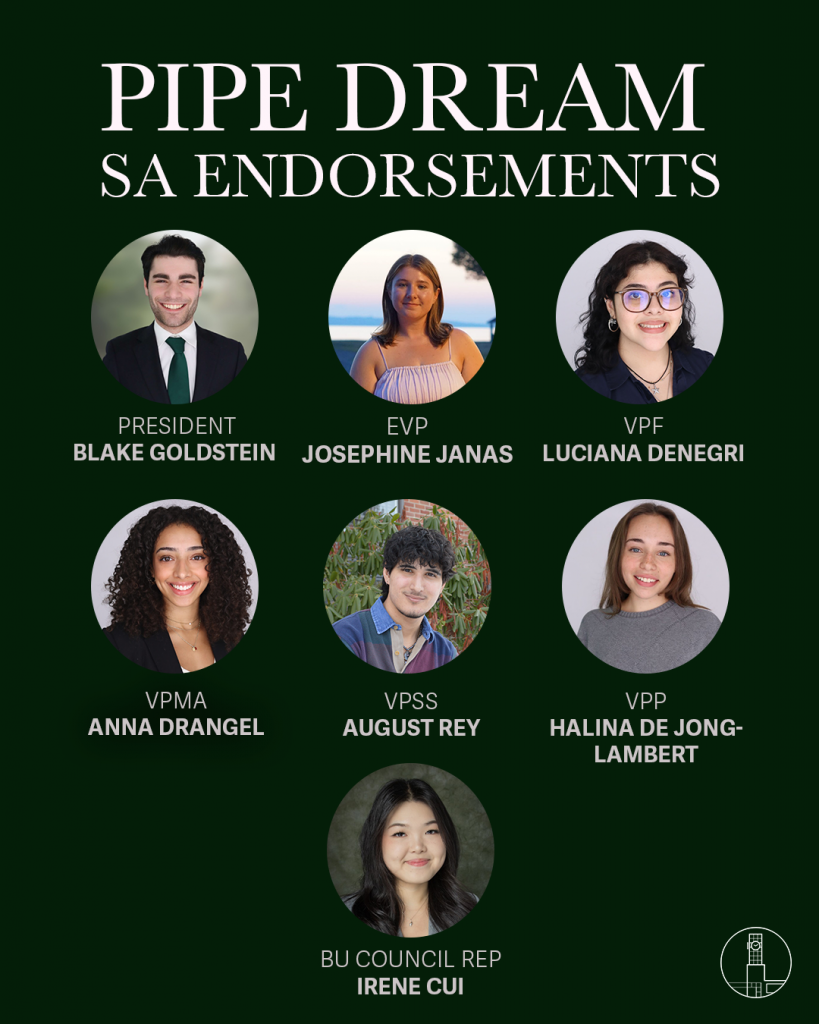
Each year, Pipe Dream’s Executive Board interviews every candidate running for positions on the Student Association’s E-Board and the Binghamton University Council. Each candidate had the opportunity to share their backgrounds, platforms and why they felt deserving of students’ votes.
To keep endorsements objective, E-Board members with personal connections to the candidates had no role in their interview or endorsement process.
After discussion and deliberation, we decided to endorse the following candidates and we hope our endorsements will guide readers in making a decision on March 26. To learn more about each candidate, visit our election page.
President: Blake Goldstein [BOLD]
Deciding on our endorsement for president was particularly difficult this year, as all three candidates had strong ideas. Considering each candidate’s platform and prior experience, we are endorsing Blake Goldstein, a junior majoring in political science, for SA president.
Goldstein’s current role as speaker of the SA Congress has given him the necessary experience in working with the administration and leading SA initiatives. In his capacity as speaker, Goldstein has led the Noah Project, now known as the Connection Project, and worked to improve transparency between the SA and the student body by implementing the student opinion form.
Goldstein outlined several clear initiatives he plans to pursue, like creating a customizable search tool so students can more easily navigate and track Off Campus College Transport buses, expanding the Connection Project to emphasize mental health on campus, improving access to menstrual products on campus and issuing weekly accountability reports detailing SA activity.
He has also been vocal about keeping U.S. Immigration and Customs Enforcement off campus. Goldstein plans to issue SA announcements informing students of their rights and has called for an end to the University’s partnership with Flock Safety, which tracks license plates at all campus entrances. We think he has shown a strong desire to advocate for students, particularly those who may be international or noncitizens, which we find important given increased ICE activity in the past year.
Chinemerem (Mira) Emenogu, a sophomore majoring in philosophy, politics and law, advocates for strong ideas like increased communication between the SA and administration and ensuring the maintenance of the Plan B vending machines located under Glenn G. Bartle Library. However, we found her platform lacked specific ways to implement these ideas.
Meanwhile, Brady Lindsey, chair of the SA Congress’s Internal Affairs committee and a sophomore majoring in physics, has several proposed initiatives that we find commendable. “Bearcats Beyond Campus,” for example, which would connect student organizations with local businesses and develop a database to track partnerships, would provide an important service to students and foster stronger relationships with the Binghamton community.
While we admire Lindsey’s proposed changes and his plans to address campus issues, we found Goldstein’s ideas of implementing his platform more specific. We also believe that Goldstein’s experience as speaker better prepares him for the role of president.
All three candidates noted areas for improvement that we hope will be addressed, regardless of who wins the upcoming election. OCCT reliability came up across all candidates as an area of concern and we hope ideas like Goldstein’s customizable search tool or Emenogu’s increased advertising for feedback tools are implemented.
Executive Vice President: Josephine Janas
We believe that Josephine Janas, the current chair of the SA Financial Committee and a sophomore majoring in global public health, is the best choice for executive vice president.
The EVP office oversees all nonfinancial administrative matters for chartered organizations and is the primary liaison for student organization use of the B-Engaged platform. We believe that Janas’s experience as the financial committee chair and extensive involvement with the SA have prepared her for success in the position.
Janas’s platform focuses on three main initiatives: taking the office beyond its physical walls, expanding transparency and communication efforts and strengthening support for organizations. To make the EVP’s office more open and friendly, Janas hopes to adopt the model used by the President’s Office of sending a representative to weekly general body meetings of student organizations.
The other EVP candidate, Shlok Dharia, a sophomore double-majoring in mathematics and computer science, also has strong ideas, including creating YouTube modules to help with student questions and leadership training. We hope to see this idea implemented by next year’s EVP.
However, Janas’s extensive experience in the SA makes her better prepared to take on this role. Janas plans to work closely with the director of the Union to remedy continued storage issues for campus organizations and improve on the current rubric that is used for space allocation and follow it closely. She wants to advertise and expand the storage grant for organizations. Janas also expressed support for the newly proposed amendments to the chartering process.
Janas also plans to increase communication and transparency in the EVP’s office by sending a biweekly newsletter that will include important deadlines, policy updates and upcoming campus events to keep students informed.
For her final initiative, Janas plans to support organizations in both their operations and internal dynamics. She wants to introduce conflict-resolution training at the fall leadership conference and create resources for organizations facing interpersonal problems.
Janas emphasized making the EVP office welcoming and plans to build close relationships with E-Board members from various student organizations. Her current role as chair of FinCo has prepared her to foster these relationships, as she already often meets with the leadership of organizations.
While Janas and Dharia are both strong candidates, we believe Janas has both the experience and initiative to succeed in the EVP Office.
Vice President for Finance: Luciana Denegri
Having experience as the current fundraising assistant for the Vice President for Finance office, we believe that Luciana Denegri has the background to excel in the role of VPF.
The VPF manages the SA’s large budget and allocates resources accordingly — an important task we believe is best handled by someone who already works in the office and has intimate knowledge of the subject matter. Denegri, a junior majoring in business administration, emphasizes her experience with data visualization and the analysis of spending spreadsheets and we believe these skills will be crucial to leading the VPF office.
That being said, candidate Nina Thomas — a sophomore double-majoring in political science and economics — also has relevant experience through SA’s finance committee and we believe she would likely also do well in the role. However, Denegri and Thomas have different missions and we find Denegri’s focus on the internal affairs of the VPF office to be more pressing, given the SA’s current $150,000 financial deficit.
Denegri plans to prioritize cutting the SA’s current deficit without cutting any business or club funding, instead reducing unnecessary operational spending, including office supplies and travel. Additionally, both Denegri and Thomas think the current plan to raise the student activities fee will help cover the deficit.
Thomas’s campaign seems more focused on improving communication between the SA and VPF office, such as creating how-to guides for club leaders and holding office hours. On the other hand, Denegri wants to prioritize addressing the internal issues within the office, focusing on analyzing current spending to identify where changes can be made.
Both Denegri and Thomas’s platforms address the current concerns about student organization voucher rejection rates, with each offering a different approach to tackling the issue. For instance, Thomas expressed a proactive approach of educating organizations and we think her idea of creating video instructions on how to do so is a strong solution to the problem, while Denegri emphasizes communicating directly with organizations about why these rejections occur.
We think Denegri’s plan to establish clear communication about what information organizations like OCCT can share with students is a positive start toward addressing student concerns about transparency. However, we hope this can be taken further to reduce information barriers shared with students. Over the next year, the VPF office should focus on fixing its current financial situation and addressing structural issues, rather than just communication issues.
Although both Thomas and Denegri are strong candidates, we believe Denegri’s platform is better suited for fixing this financial deficit, focusing primarily on the internal operations of the VPF office.
Vice President for Multicultural Affairs: Anna Drangel
We believe that Anna Drangel, a junior double-majoring in sociology and philosophy, politics and law, is the better choice for vice president for multicultural affairs. While it was a tough decision to choose between two highly qualified candidates, Drangel’s leadership as secretary of Powerful United Ladies Striving to Elevate, along with her role as director of outreach and advocacy for the BU Council Representative Committee, demonstrates her preparation to take on the role.
Drangel’s platform is centered around five aspects — Visibility, Outreach, Inclusion, Community and Empowerment — under the acronym VOICE. Through this, she hopes to “honor the importance of the multicultural space,” according to the SA campaign website.
This includes raising awareness for on-campus resources, such as the Multicultural Resource Center and Support Empathy Empowerment Kindness, through visits to introductory courses and during orientation and hosting a Multicultural Art Gallery. She also plans to expand previous events like the Multicultural Networking Night and Multicultural Extravaganza, an annual fair for multicultural organizations.
For Drangel, one of the most pressing issues around diversity and inclusion is that students are often uncomfortable voicing their opinions. This includes discussing topics like ICE, which she expressed is not just a political issue, but one that affects communities both on and off campus. We believe that her plan to introduce monthly “Town Halls” in the MRC, in addition to Off Campus College Council meetings, would allow students to voice their concerns with administrators consistently.
Another part of her platform is having Binghamton University Dining Services partner with local food businesses to provide cultural catering for events. While Drangel acknowledged that the plan is ambitious, she wants to organize discussions with administrators about broadening dining contracts for students and organizations. This is a necessary change that we hope Drangel will work to implement, as it could allow multicultural groups to serve food that authentically reflects their respective backgrounds.
That being said, candidate Farhat Naimey, a junior majoring in environmental studies, also has compelling ideas in her platform. We believe that they should also be considered moving forward into next year.
Naimey’s platform includes important aspects, especially those regarding amplifying students’ voices through listening sessions and biweekly workshops. Additionally, we believe that her plan to distribute Know Your Rights pamphlets around campus should be implemented regardless of who is elected as VPMA.
Ultimately, Drangel has the most concrete ideas, with tangible ways to put them into effect. Her leadership experience in PULSE sets her apart, as many initiatives were inspired by firsthand experience with funding and catering issues. Because of her clear goals and time in a large multicultural organization on campus, we are confident that Drangel will strengthen the multicultural community’s voice at the University in the 2026-2027 academic year as VPMA.
Vice President for Student Success: August Rey
We believe August Rey, a sophomore majoring in political science, is the strongest choice for the position of vice president for student success. Emily Landis, a sophomore majoring in political science, is also a strong candidate with ample experience in the SA and a strong pool of plans. However, we feel that Rey’s initiatives were clearly driven by a desire to expand the population of students served by the VPSS office and would have a broader impact on student success.
Rey’s platform includes three primary focus areas — accessibility, affordability and accountability. These proposed initiatives, which include expanded bus service during finals and midterm weeks and aligning Rejuvenation Days with major multicultural holidays, are clearly driven by conversations with a diverse population of the University’s student body.
Additionally, we felt that many of Rey’s proposed plans were bold but implementable. Their proposed VPSS grant to reduce the costs of summer and winter courses mirrors existing grants offered by the Fleishman Center for paid internships. Rey also stated that their Narcan training program would utilize strategies employed by the University’s 20:1 Interpersonal Violence Prevention Program.
However, we believe that several aspects of Landis’s platform are feasible, support students and should be pursued no matter the outcome of the election.
Landis’s platform highlighted a plan to develop an online appointment-booking system for the University Counseling Center. Landis proposed utilizing Decker Student Health Services’ online booking system to avoid potential costs associated with launching an independent HIPAA-compliant booking portal for the UCC.
Although OCCT expansion has been a common theme throughout our VPSS interviews over the years, we felt that Rey’s experience as an organizer with the University’s chapter of the Young Democratic Socialists of America effectively supports their approach to ensuring successful implementation. We also felt that Rey’s plan to work alongside other departments in the SA to maximize the number of voices calling for OCCT reform could make expansion feasible.
Overall, we felt that Rey’s proposed approach to managing student success was driven by a desire to expand the definition of student success to encompass all of the University’s student body and that their plans would be both implementable and aligned with their broader policy goals.
Vice President for Programming: Halina de Jong-Lambert
Although running unopposed, Pipe Dream confidently endorses Halina de Jong-Lambert for vice president for programming. Serving multiple positions across the SA since her sophomore year, de Jong-Lambert, a junior majoring in economics, is more than qualified to take on the role as VPP.
Currently, de Jong-Lambert serves as chair of student fleas, managing the communicational and organizational aspects of hosting student vendors at University-wide events like UFest and Spring Fling. This semester, de Jong-Lambert organized for a student flea to be included at SAPB’s Battle of the Bands. The decision to incorporate a student flea this year was designed in collaboration with Binghamton Underground Music Presents to effectively manage crowd control at the event. Ultimately, this role has enabled her to strengthen her collaborative skills through her management of vendors and event planning with branches in the SA and campus organizations to ensure that all needs are met and spaces are well organized.
As VPP, de Jong-Lambert hopes to expand entertainment around the University’s multifaceted student body by involving student fleas, tabling opportunities and pre-concert performances from multicultural dance and performance organizations in campus-wide events put on by the SAPB.
De Jong-Lambert plans on strengthening partnerships with a wide range of student organizations, rather than the select few that are regularly involved by utilizing the listserv and SA-Line to facilitate better communication in coordinating their involvement in future events.
De Jong-Lambert hopes to tackle the issue of events scheduled later in the semester which leads to reduced student attendance. She plans on communicating with these contacts in the summer to have performances lined up earlier in the semester, getting ahead of inevitable delays and complications. In streamlining the timeline for scheduled programming throughout the academic year, de Jong-Lambert hopes to better inform students about events planned by posting a comprehensive calendar on the SA website, with possible dates for events updated month to month.
With over a year of experience and multiple roles in the SA, we are confident that de Jong-Lambert has the skill set to follow through on her platform. De Jong-Lambert’s communication-driven platform, centered around adapting to the needs of the student body and being a proactive leader, sets her up for a fruitful term.
BU Council Representative: Irene Cui
This year, current BU council representative and a junior majoring in economics, Irene Cui is running unopposed for reelection. Although she is the only candidate, we are confident in our endorsement of Cui, based on her achievements during her 2025-26 term and her realistic, student-focused platform for the upcoming year.
Throughout her term, Cui has aimed to ensure students feel included and safe on campus and has been working with the University’s chapter of the YDSA to create an anti-ICE campaign in response to fears expressed by international students. She is also working to start a Student Veterans of America chapter on campus, which she has helped establish an E-Board for and hopes to charter next year.
Cui has focused on creating an extended orientation program for international students to be implemented next semester, for which she raised $10,000 through crowdfunding. After having conversations with international students who expressed feelings of loneliness, Cui decided to create the program to foster a sense of community and inclusion, which we believe is important during a time of increased threats to DEI.
Building on her previous achievements, Cui’s platform also highlights future plans that align with student needs. With the change to Chartwells Higher Education for dining services, she aims to work with the administration and Sodexo to understand current student critiques of dining services and implement the changes students want to see, including expanding dining hall hours and increasing culturally diverse options.
Cui also wants to connect the BU community with the broader local Binghamton area by increasing awareness of local events, incentivizing attendance through raffles and offering internship opportunities for students at local establishments that would be mutually beneficial. For instance, Cui describes an internship opportunity where economics students could perform data analytics for local businesses.
Overall, the strongest point of Cui’s term as BU Council Representative has been her communication and outreach to students. Cui has met with over 30 student organizations to inform her priorities and decisions as BU Council Representative and we believe extending this focus into her next term will enable further progress on key issues.
Although not all aspects of Cui’s previous platform were achieved this year — regarding structural changes to campus to make it more accessible to disabled students — her future plans seem feasible and student-centered. Cui hopes to continue her monthly meetings with organizations, establish a peer mentorship program for upperclassmen and incoming freshmen, increase transparency and strengthen campus connections to the local community.
We believe that Cui’s previous experience and commitment to communicating with students will lead to another successful term as BU Council Representative.