





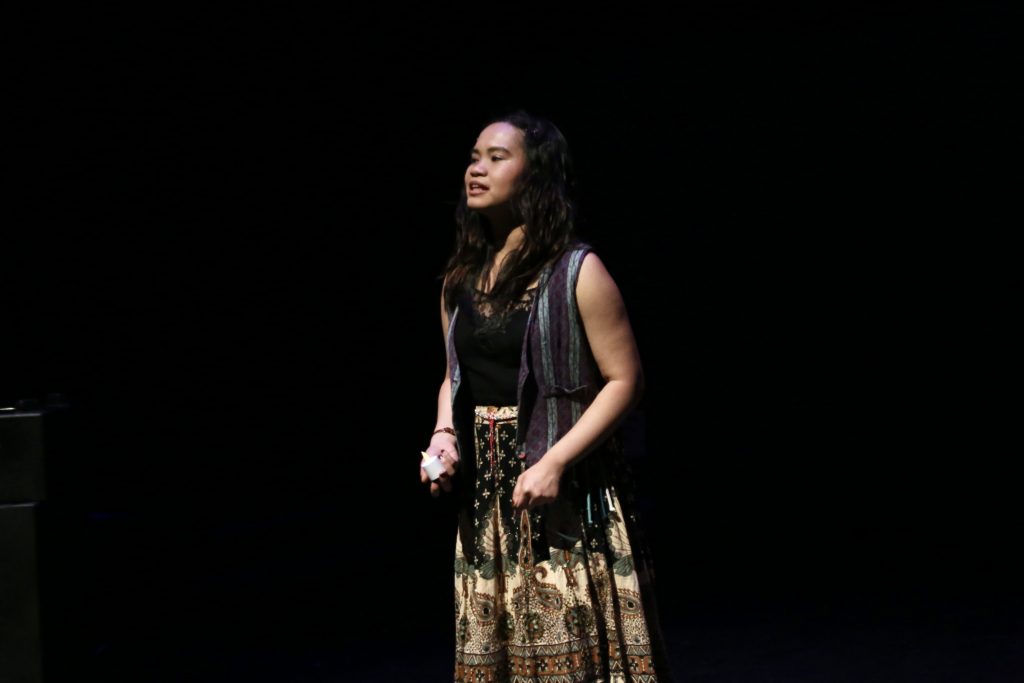
Jamie Eliana Papa, a second-year graduate student studying theatre, produced an acting thesis titled “Yuridisi” — an adaptation of Orpheus and Eurydice, featuring the Greek myth through a cultural lens while centralizing personal experience, passion and Filipino history.
As a graduate student with an acting concentration, Papa is a Filipina theatre artist who has appeared in numerous productions. A graduate from the University of the Philippines Diliman, she specialized in Anglo-American literature and had diverse experiences in content creation, writing and marketing. Along with her work at Binghamton University, Papa has built a growing resume as a performer and creator, working with many independent productions. Her thesis production, “Yuridisi,” ran last weekend, from March 14 to 15, in Studio A of the Fine Arts building.
Pipe Dream interviewed Papa about her graduate thesis, her creative process and the cultural legacy that her acting thesis spotlights. Her responses have been lightly edited for clarity.
What was the hardest part of reimagining such a well-known myth through a Filipino perspective?
“I will be honest: it wasn’t ‘hard’ to reimagine the myth under a Filipino perspective. Much of Philippine history, culture, and art are already part of my psyche and artistry, and my research of the Orpheus and Eurydice myth allowed me to make parallels in narratives. Eurydice in the musical ‘Hadestown’ has also been played by some Filipinos, and it made me immediately wonder: could this Eurydice be Filipino? The typical challenges of a thesis were overpowered by my love for the craft, the myth, and my motherland.”
Were there particular scenes that you had a strong emotional response to or connection with while performing?
“Toward the latter part of my show, I read through letters addressed to Eurydice, but she couldn’t make out its handwriting properly and remember who it was from. These letters are actually Orpheus monologues from Sarah Ruhl’s ‘Eurydice,’ and my way of decoding and remembering my life as Yuring. Ruhl’s Eurydice has a famous monologue where she tries to remember her husband’s name; I translated this to Filipino because my journey as an acting major here in Binghamton has led to a very personal connection with the actions and emotions that the language brings me.
It is strongest to me not only because I feel it deeply, but it also brings forth my way of publicly sharing these while privatizing this vulnerability and having only Filipinos who understand Tagalog know what I am saying. I think there is something necessary and powerful in encouraging everyone to be allowed to express themselves in languages that amplify them.”
Looking back at the entire process, what part of creating and performing this thesis production are you most proud of? What do you also hope audiences take away about Filipino history, culture or identity?
“I am most happy about how this production reflects so much about myself. My friends who have seen this production told me that everything about this show exudes me. The choice of pieces. The costumes. The details. And a lot much about the show. I played most roles in the production — director, producer, stage manager, designer, playwright, dramaturg — only to name a few. I even made my poster from scratch, and I had a friend in the Philippines tell me that it reflects so much of my art style.
Despite the challenge of playing all these roles, I love the fact I can recognize myself in this work. Even the way I worked with my wonderful actors is how I know I love to approach theatre in present time.
What I mainly hope for people to take away would be how it is important to listen to others and open one’s worldviews. It is not possible to let a non-Filipino audience learn everything about the Philippines, but I do want to make them feel how these narratives have been a part of America’s own. In order to not forget, it is important to either remind or inform.”
Did creating and performing this play change the way you personally connect to Filipino identity or history?
“I would say it became deeper. My worldviews have also grown as I moved here to study in Binghamton, and seeing realities of representation and heritage has only brought me the aspiration to have these intertwined with my craft.”
Do you see “Yuridisi” continuing beyond this thesis production, and what would you hope its legacy to be?
“It is actually my goal. I see this thesis as an early version of this work, as doing my research on adaptations of Orpheus and Eurydice have led me to a multi-faceted and historical perspective on Eurydice as a character. I wish to expand this through a piece I will write fully, and I hope it continues both the depiction of the woman — Eurydice and the Filipino — in motion.”