





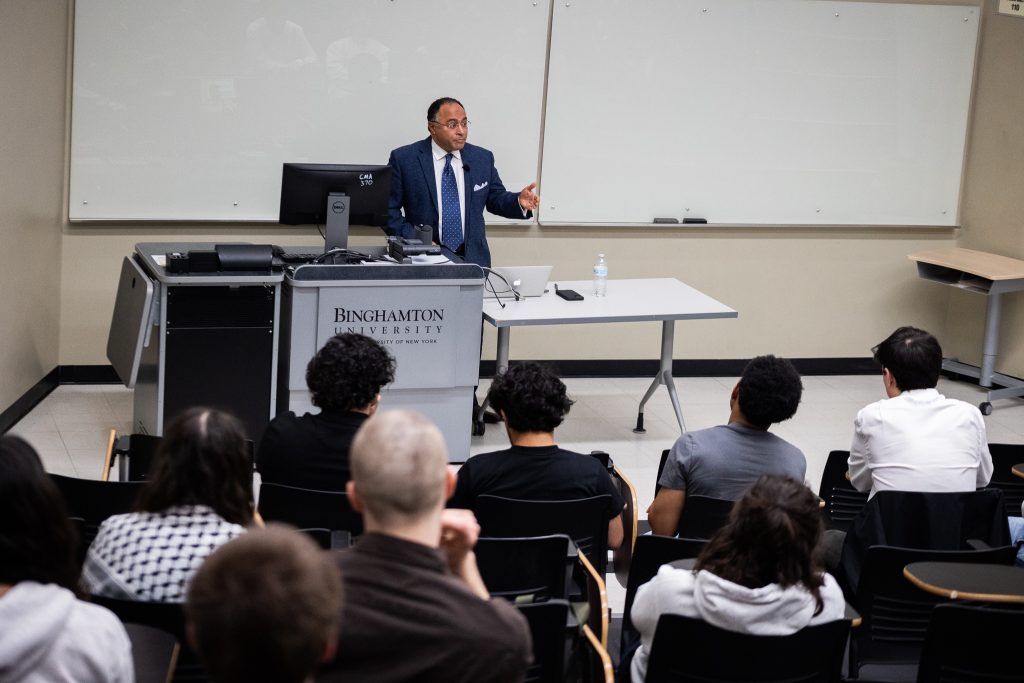
Dr. Mohamed Elfar, a board-certified plastic and reconstructive surgeon, shared his firsthand account of the humanitarian crisis in Gaza with students last week. The talk was hosted by the Arab Student Association in collaboration with Students for Justice in Palestine, the Global Public Health Student Association, the Muslim Student Association and the Center for Middle East and North Africa Studies and was held to “raise awareness and foster informed dialogue around the critical public health and humanitarian challenges currently facing Gaza,” per an email to Pipe Dream.
ASA said Elfar’s presence “has helped provide students on campus with facts regarding the state of the Palestinian people, on an issue which is increasingly clouded with misinformation and propaganda,” as much of the content he presented was not sourced from external organizations or partisan news channels but through firsthand accounts from him and his team.
“It remains crucial that we continue to speak on the ongoing crisis and bring attention to the everyday experience of Palestinians,” the ASA E-Board wrote. “Our voices will remain loud for as long as this genocide continues. As many have stopped to advocate, we believe our identity as not just Arabs, but also human beings, should be called into question if we fail to speak up for those who can’t.”
“We as an organization, will continue to advocate for those who are oppressed, regardless of cultural background,” they continued. “Here and abroad, our culture and traditions are always questioned, yet if we continue to celebrate our traditions, speak our language, and share the unheard stories, we are resisting the forces that seek to erase us. Our culture and representation is our resistance.”
In February 2024, Elfar led a group of 20 physicians and health workers from the United States, Jordan and France on a 12-day mission to Gaza that was organized by two groups: Rahma Worldwide, founded in 2014 to assist humanitarian efforts in regions across the world, and Palestinian American Bridge, a volunteer-led organization created in 2008 focused on “empowering Gazans through healthcare and education,” according to its website.
In an interview before the event, Elfar said that he has given this talk over 10 times across several states, adding he felt compelled out of a sense of duty “to be the voice for those people who’ve been silenced.” He shared the impact of witnessing the destruction and suffering in Gaza during the mission.
“We all came back emotional,” Elfar said. “We all came back feeling that there has to be a solution to this situation because, and I said that before, we were practicing medicine by the 18th-century measurements and that shouldn’t be acceptable.”
“No child, man or woman should be treated like this, regardless of any ethnic background, age, education, citizenship, religion,” he continued. “We all have to be treated equal.”
Before he began, Elfar told the audience that he is a “completely independent practitioner” and warned of the graphic pictures and videos he would share, which were taken during his time in Gaza. He shared pictures of patients while discussing his experience treating those in Gaza, most of whom were children. In total, he performed about 35 reconstructive surgeries during the mission.
He told the story of one teenage boy who was left out on the street for five days because it was unsafe to rescue him. When he was finally rescued, both of his legs had gangrene and needed to be amputated. He died two days after surgery. Another story was of a patient who he said was arrested, blindfolded and beaten by settlers until he lost consciousness. The patient was then taken to an Israeli hospital, where he was stabilized and underwent amputations on his arm and leg before being returned to Gaza.
Elfar said his team was blocked from leaving without explanation and forced to return to the hospital for shelter. He played a video of himself the next morning, briefly describing his experience as bombs went off in the background.
“I’m in Gaza, and we’re going to be leaving today after we tried to leave yesterday,” Elfar said in the video. “You can hear the bombing ongoing, and that’s basically the life here, every night, every morning, nonstop.”
He also shared pictures of the hospital he worked in, which showed outdated machinery and a lack of materials like gloves or gowns. Elfar said he operated on patients with instruments contaminated with previous patients’ blood because they could not be adequately cleaned.
“You just do the best you can,” Elfar said. “And you have to keep thinking about the question, ‘Why?’ What is the problem of having an extra piece of cloth? What’s the problem of letting some supplies go in?”
When discussing the humanitarian crisis, Elfar said, “in these hospitals, there’s no food,” and that only the medical team was able to access it. Sheltering families also live in these hospitals, with many lacking access to electricity and water.
“Some people don’t or can’t afford to have a tent, so they just grab a blanket and strip themselves on the hallway and sleep there,” Elfar said. “These are regular people: engineers, teachers, captains, lawyers, you name it. Outside the hospital, it’s not different. You look out, same thing. People are camping around the hospital, thinking that this is a safe haven.”
Elfar left attendees with a final question before moving into a Q&A session.
“How would you label this?” Elfar asked. “Is that a war, is it a state defense, is it a state offense? Is it a genocide, an ethnic cleansing? What is it exactly? I’m not going to volunteer an answer for you — but this is what I saw with my own eyes. I have my answer, but you need to get your answer.”
Elfar plans to head to Ukraine soon before returning to Gaza or the West Bank in the fall. In an interview with Pipe Dream, he said there were two things he hoped students and faculty would take away from this event.
“First is to understand the difference between facts and fiction, and find the reality and the truth behind what’s going on there,” Elfar said. “And second, never stop talking about Gaza.”