





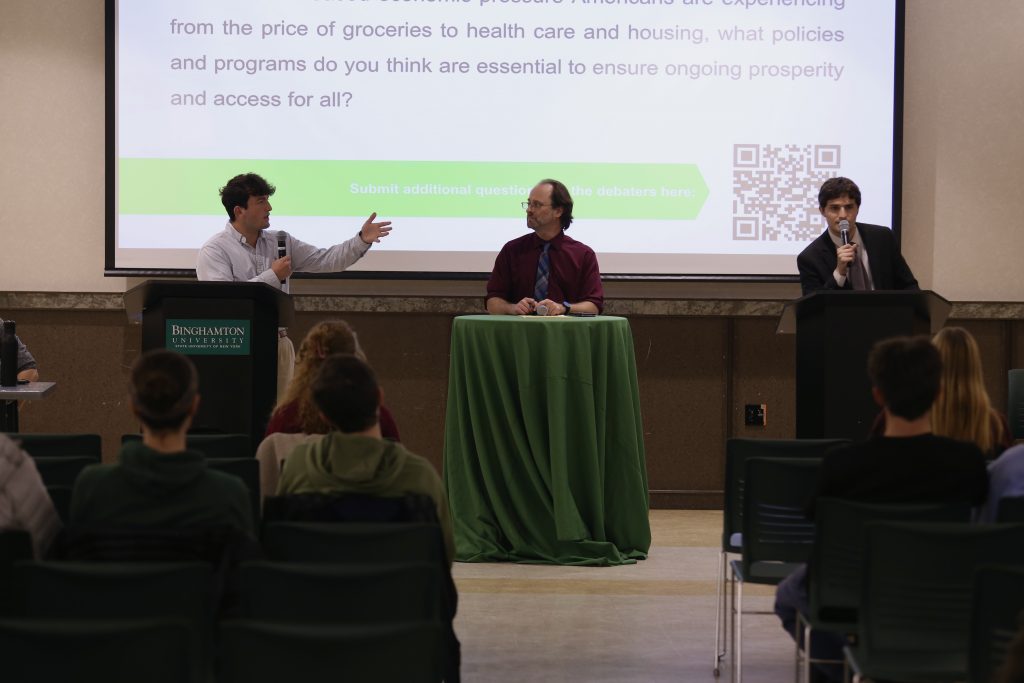
Students gathered in Old Union Hall on Monday for the fourth-annual Great Debate between the College Democrats and College Republicans. Hosted by Binghamton University’s Summit on Student Political Participation, debate participants clashed over policy issues and current events shaping discourse in the United States.
The debate aimed to promote student voting and political participation ahead of Election Day, which fell on Tuesday, Nov. 4. Some of the issues discussed included recent U.S. Immigration and Customs Enforcement raids and immigration policy, U.S. foreign policy and the federal government’s powers under the Trump administration.
The first Great Debate was hosted in 2022, with speakers from the College Democrats, Republicans and Libertarians.
“The Great Debate aims to bring together students from across the political spectrum to have constructive conversations,” Emily Mains, the civic engagement coordinator at the Center for Civic Engagement, wrote in an email to Pipe Dream. “We hope the event sparks these conversations and engages students on political topics as we head into this year’s general election.”
The debate began with both sides discussing how the federal government should address the rising living costs nationwide, from the price of health insurance to housing and food. Shane Rossi, president of College Republicans and a senior majoring in political science, praised the “One Big Beautiful Bill,” which congressional Republicans passed over the summer, for “building back America.”
Rossi then criticized Democrats for the current government shutdown, claiming they want to “give healthcare to illegal immigrants.”
Undocumented immigrants, individuals with temporary protected status and Deferred Action for Childhood Arrivals recipients are largely ineligible for Medicaid.
“Why is this the Democrat shutdown when Republicans are actively fighting against affordable food for children?” Atticus Fauci, a senior majoring in economics, said in response.
Fauci argued that the government should act to expand childcare access, guarantee free school lunches and work to decentralize grocery chains to address affordability concerns.
The government shutdown, which began on Oct. 1 after Congress failed to agree on a federal spending plan, entered its 39th day as of Nov. 8, now the longest in American history. Republicans in the U.S. Senate are short of the 60 votes needed to pass the spending bill. Democrats are pushing to extend tax credits provided through the Affordable Care Act, set to expire at the end of the year, which could leave millions of Americans without health insurance. Republicans have stated they are open to talks on the subsidies, but only after the shutdown ends.
Immigration was a major recurring topic throughout Monday’s debate.
“Illegal immigration, in particular for Americans, takes away the value of American citizens,” said Marcus Caniano, club advisor of College Republicans and a sophomore majoring in political science. “Our government puts foreigners over our native population.”
Ryan Gaire, president of College Democrats and a junior majoring in political science, said ICE agents have targeted U.S. citizens and that recent deportations were not intended to maintain law and order, but instead serve to create “fear, division and the illusion of control.”
The debate moved to the expanded role of federal power under the Trump administration. Gaire explained what he believes to be a contradiction in the Republican Party, which he claimed has historically defended free speech but has recently silenced it. He gave examples like the Trump administration’s deployment of the national guard in cities like Chicago to end protests and the six-day cancellation of “Jimmy Kimmel Live!” at the end of September for comments the comedian made about Charlie Kirk’s death.
Rossi responded by saying the question was “nonsensical” because he thinks that both parties believe in an expanded federal government. He claimed that Democrats want to “enforce abortion nationwide even though many states opposed it” and that it was an example of prioritizing federal decision making over state interests. Kimmel’s temporary suspension was ABC’s decision, not the Republican Party’s, Rossi added.
Shifting to foreign policy, College Republican speakers argued for an “America first” policy that centers national interests rather than other goals like foreign aid through the U.S. Agency for International Development, which provided “humanitarian assistance during global conflicts and other emergencies” abroad. The Trump administration closed the agency on July 1 and moved its remaining functions to the State Department.
College Democrats responded by arguing the administration’s “America first” policy has isolated the United States from the world stage and divided the country’s global allies.
Joseph Leeson-Schatz ‘01, MA ‘03, Ph.D. ‘09, the debate moderator and director of debate at the University, closed out the evening by thanking audience members for attending and encouraging students to participate in local elections.
“The goals of these debates are not necessarily to pick winners and losers, but to help be able to create a better understanding of the different divisions and the different sides that exist on the different topics,” Leeson-Schatz said.