





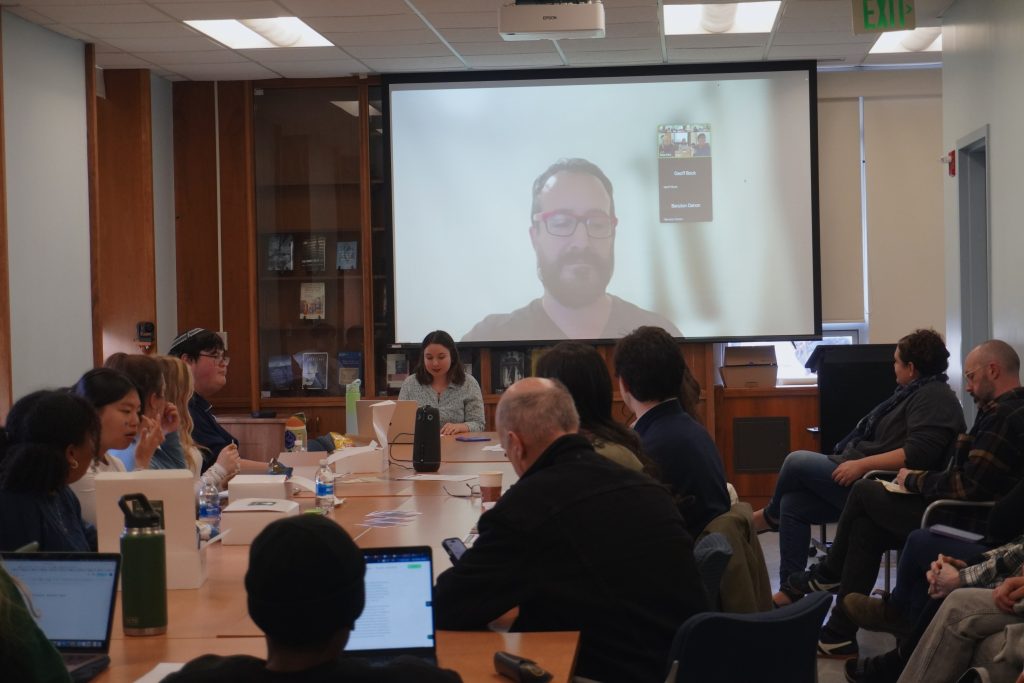
Binghamton University’s Center for Israel Studies held the second installation of its planned three-part roundtable series on the humanitarian crisis in Gaza.
The talk, titled “Roundtable Series on Gaza: On Humanitarian Aid,” focused on the work of nongovernmental organizations and other groups providing aid to Gaza. The roundtable featured Yoni Bock, an adjunct professor at Florida International University’s Academy for International Disaster Preparedness. Bock has been in the region since March 2024 and has worked as deputy head of mission for Médecins Sans Frontières Belgium, more commonly known as Doctors Without Borders.
Bock previously worked as the regional team lead for Project HOPE in Israel, an organization that works internationally to coordinate with local healthcare systems and provide humanitarian relief. He was also the humanitarian assistance advisor for the U.S. Agency for International Development. While at USAID, he was part of the response team for the 2010, 2011 and 2015 earthquakes in Haiti, Japan and Nepal; the 2014 ISIS invasion of Iraq and Syria; and the 2014 Ebola outbreak in West Africa, among others.
Talia Katz, assistant professor of Israeli studies, conducted the discussion through an ethnographic interview, a discussion format that aims to understand another’s perspective. Bock began the discussion by defining humanitarian aid and explaining how he began his career in the field.
“Broadly speaking, when we talk about humanitarian aid, we’re talking about a range of disciplines, a range of activities,” Bock said. “As I said in the beginning, whose focus is to deliver life-saving, life-sustaining aid. So what that means is that at its core, it’s looking at the challenge through the lens of needs — what is the need on the ground based on what the impact of the emergency is.”
Bock also discussed the difference between humanitarian and social justice work, noting that humanitarian work is meant to “alleviate suffering of people impacted by conflict.” The core principles of providing humanitarian aid, he said, are humanity, neutrality, impartiality and independence.
“The job of a humanitarian is to diagnose appropriately what the gap is and to move the specific needed entity into that, and it doesn’t only have to be commodities, right?” said Bock. “MSF — Doctors Without Borders — focuses almost exclusively on medical and health needs. So we move a lot of doctors, we move a lot of medicine and medical supplies, we move field hospitals, we work within existing structures and existing hospitals. That’s our lens.”
Founded in 1971, Doctors Without Borders has operated in Gaza for decades. The organization provides critical medical care, operates field hospitals and clinics, aids in water sanitation and procures medical supplies for the region. The MSF has also advocated for a ceasefire and said Israel’s military actions in Gaza constituted genocide. An independent United Nations commission released a report in August that concluded Israel committed “four genocidal acts” in the Gaza Strip since Oct. 7, 2023.
In September, Doctors Without Borders was forced to temporarily cease operations amid increased attacks and danger presented to its personnel. Since the beginning of the crisis, 15 staff members have died, as of Oct. 5, 2025. On Oct. 15, MSF resumed its wound care clinic in Gaza City following the announcement of a ceasefire deal earlier in the month.
Lior Libman, an associate professor of Israeli studies and director of the Center for Israel Studies, explained the center’s desire to establish the series discussion.
“It was a response to a crisis, to the escalation in the situation,” Libman wrote in a statement to Pipe Dream. “And it is something that I think that a center of Israel Studies should address. We do scholarship about Israel. We don’t do advocacy, we study Israel from every angle and every dimension.”
In September, the Center hosted Dotan Halevy, a senior lecturer and assistant professor at Tel Aviv University’s Department of Middle Eastern and African History, for a talk about the history of the Gaza Strip from pre-1948 Mandatory Palestine to the present.
The third and final part of the series is expected to feature a journalist and writer who was displaced from Gaza.
“Our job as a center is to bring these voices and to contribute to the conversation on campus on these issues,” Libman said.