





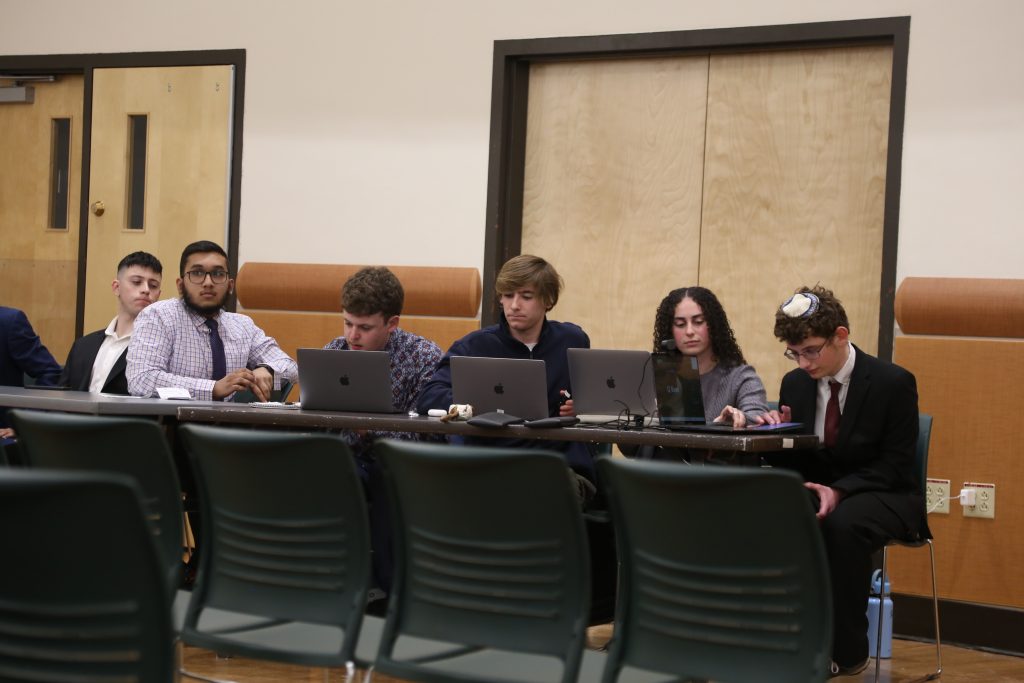
This year’s Student Association Executive Board candidates took to the stage to debate their platforms.
The 13 candidates are running for seven positions, including student representative on the Binghamton University Council and the SA’s six Executive Board positions: president, executive vice president, vice president for finance, vice president for student success, vice president for multicultural affairs and vice president for programming. The debate was moderated by members of the SA Congress’s Elections and Judiciary committee and candidates spoke about their goals for their potential position and took questions from the audience.
Irene Cui, the current BU Council representative and a junior majoring in economics, spoke first. She seeks reelection for her position unopposed. Cui spoke about her involvement this year in speaking with University administration about changes to the dining halls, creating the International Immersion program and chartering a Student Veterans of America chapter while also meeting with 30 student organizations.
Next year, she hopes to continue working on the mentorship program her team is currently building, which matches incoming freshmen and sophomores with junior and senior mentors to help them adjust to the University environment.
Halina de Jong-Lambert, the unopposed candidate for vice president for programming and a junior majoring in economics, was up next. She discussed her previous experience as a Mountainview College representative and a member of the Elections and Judiciary and Finance committees before entering her current role as co-chair of partnerships and collaborations and chair of student fleas.
Next year, she plans to create a monthly calendar for the SA’s website to display the entertainment options available to students. She also hopes to create stronger partnerships between campus organizations.
Farhat Naimey, a junior majoring in environmental studies, and Anna Drangel, a junior double-majoring in philosophy, politics and law and sociology, then presented their platforms running for vice president for multicultural affairs.
Drangel’s platform is based on her six principles of VOICE — “visibility, outreach, inclusion, community and empowerment.” If elected, she said she plans to lead town hall meetings at the Multicultural Resource Center to foster open communication between students and the VPMA office and host multicultural art galleries so creative students from a variety of backgrounds can share their work. She also hopes to partner with local businesses to cater multicultural events on campus to bring more authentic foods to events.
Naimey began by outlining three ideas guiding her campaign: “communication, advocacy and community.” Naimey aims to open dialogue between individual students and student groups and the MRC by hosting monthly dialogue sessions for students and implementing feedback sessions so the VPMA office can directly hear concerns from student organizations.
She also plans to issue a multicultural newsletter and host biweekly cultural workshops, ranging from movie screenings to dance classes.
August Rey, a sophomore majoring in political science, and Emily Landis, the current chair of student life and academics and a sophomore majoring in political science, are the candidates for vice president for student success. Rey spoke first, detailing their platform’s three pillars: “accessibility, affordability and accountability.” They explained that they hope to create a VPSS grant to make summer and winter courses more affordable for students and implement Narcan and alcohol poisoning education on campus.
Landis then spoke about her platform, which also consists of three pillars: prioritizing student well-being, protecting renting students and increasing access to resources for noncitizens. She plans to expand mental health resources on camps by implementing an online booking system at the University Counseling Center and pushing for more diversity in counseling. She also explained that she wants to create more resources for students when they are looking for off-campus housing and dealing with landlords.
Luciana Denegri, a junior majoring in business administration, and Nina Thomas, a sophomore double-majoring in economics and political science, then stepped up to discuss their candidacies for vice president for finance.
Denegri spoke about her experience in the VPF’s office as a fundraising assistant and the five pillars of her campaign: accessibility, communication, reformation, transparency and support. She explained that she hopes to collaborate with the VPSS office to host virtual office hours, reform the training process for treasurers, restructure Off Campus College Transport policies and support increases in funding for both Harpur’s Ferry and OCCT.
Thomas spoke about her experience on the financial committee and as director of public relations. She explained how establishing the new department of public relations within Congress [HYPERLINK: https://www.bupipedream.com/news/sa-congress-to-create-department-of-public-relations/176353/] prepared her to improve communication and accessibility within the VPF office. If elected, Thomas hopes to implement weekly office hours, budgeting workshops for club leaders and increase transparency within the office.
Josephine Janas, a sophomore majoring in global public health, and Shlok Dharia, a sophomore double-majoring in mathematics and computer science, are in the race for executive vice president.
Janas is the current chair of the financial committee. Her primary goal if elected as EVP is to make her office “the most friendly, welcoming place on campus” and to make students feel like their voices are heard. She aims to promote clear lines of communication between students and the EVP office and stay in contact with campus dining.
Dharia plans to improve communication between students and the EVP office through several initiatives, including publishing modules on YouTube for students to reference and posting conference recordings. He would also allocate storage space to organizations based on need, rather than seniority, working with the VPF to track equipment to calculate what organizations need it most.
Three candidates are running for SA president this year: Blake Goldstein, a junior majoring in political science; Brady Lindsey, a sophomore majoring in physics; and Chinemerem (Mira) Emenogu, a junior majoring in philosophy, politics and law.
Goldstein outlined some of the initiatives he pursued as speaker of the SA Congress, including expanding mental health resources on campus, increasing transparency within the SA, creating a position to ensure accountability with dining services and ensuring menstrual products are available on campus. Goldstein also advocated for awareness and student protections against U.S. Immigration and Customs Enforcement.
“If ICE wants to get to one of us, they’re going to have to get through all of us,” he said. “I will defend sanctuary values, communicate their presence on campus and be a leader with enough courage to say ICE has no place on this campus.”
Lindsey discussed his experience as chair of SA Congress’s Internal Affairs committee before speaking about his platform, which includes a “Bearcats Beyond Campus” initiative to connect students with the community and increase support for OCCT workers. He plans to promote transparency through biweekly “Ask Me Anything” sessions and provide updates about the University’s transition to Chartwells Higher Education [HYPERLINK: https://www.bupipedream.com/news/auto-draft-1726/175883/] as the University’s dining provider.
Emenogu discussed her platform next, which emphasized accessibility, fixing the OCCT bus schedule and increasing administrative collaboration. She touched on her work as a fellow for the New York Birth Control Access Project and advocated for the continued access to the Plan B vending machines under the Glenn G. Bartle Library.
The candidates then took questions from the audience. Lindsey and Goldstein were asked about a resolution last year they both previously supported, which advocated for state legislation prohibiting facial masks to conceal one’s identity during protests. The resolution, passed in October 2024, was vetoed by the SA E-Board.
Both candidates expressed regret for supporting the resolution and said that if similar legislation were passed, they would veto it as president.
The campus-wide elections will take place on March 26 and results will be certified on April 7.