


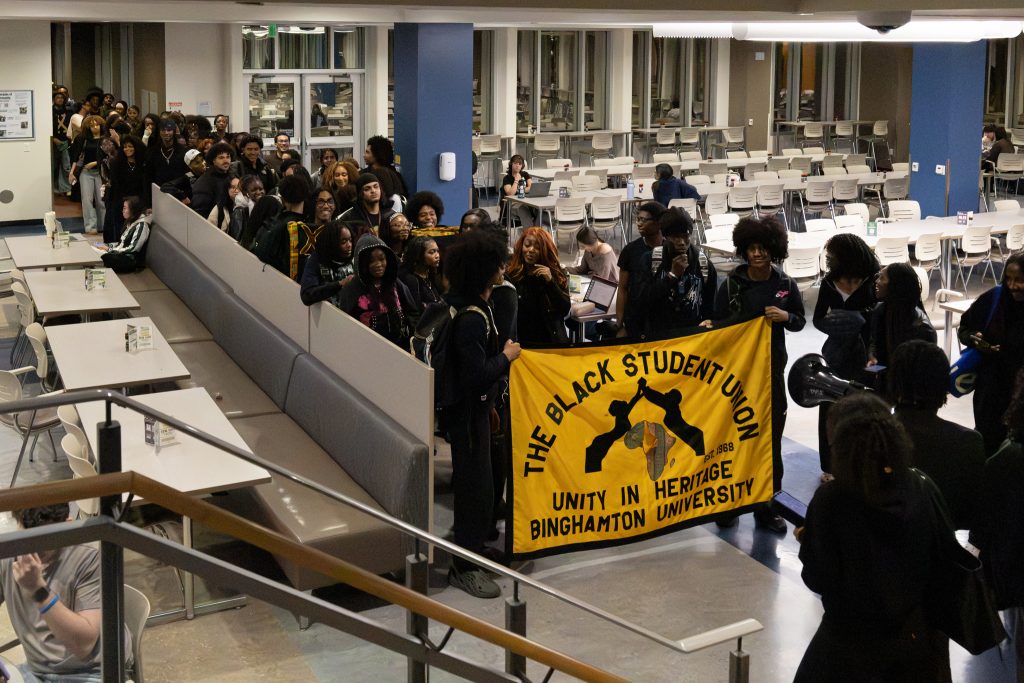
The Black Student Union held a sit-in and march as part of its Black Solidarity Day itinerary, a day celebrating Black accomplishments, identity and unity.
This year’s theme was “Scripting Radical Imagination,” inviting students to recognize Black history and their visions for the future.
“BSD is a day of reflection, learning and solidarity. A day where we choose unity and empowerment over silence or erasure,” said Chidiebere Okoro, a senior majoring in computer science and the president of BSU, during the event. “BSD is a testament to the beauty, strength and resilience that lives within the Black experience.”
Black Solidarity Day was established in 1969 by Afro-Panamanian activist Carlos E. Russell and is observed on the Monday before Election Day. The day recognizes and honors “Black contributions to society by emphasizing our absence from it,” as written on a post shared on the BSU Instagram.
A template shared on the BSU Instagram provided a letter students could send to professors to request an excused absence from class to attend an event.
The full-day agenda began with a kickoff in the BSU Lounge, followed by “Not For Broadcast,” a watch party of the psychological horror film “Get Out” and a discussion titled “Radicalizing Black Minds.” The day concluded with a Solidarity “Sit-In” in UU120.
Black flags with the names of Black individuals were placed along the Spine. The names were of people who died “under systems meant to protect and benefit us,” according to an Instagram post.
Tabling organizations present at the Solidarity “Sit-In” included X-Fact’r Step Team, PULSE, the Juvenile Urban Multicultural Program, SOUL and the University’s chapters of the National Association of Black Accountants and the National Association for the Advancement of Colored People.
The program began with a performance from BSU’s Vanguard Creative Team where a selection of five poems were read.
“This segment is explicitly not poetry nor performance designed for entertainment,” said Samuel Valarezo, a sophomore majoring in mathematics and BSU’s publications coordinator. “This is oral history in its rawest, most urgent form. We are bringing together students to share distinct realities of how their Blackness and intersecting identities impact their daily survival on this campus.”
In the next segment, a member of BSU spoke on the history of Black Greek-letter organizations, also known as the Divine Nine, before representatives from the Alpha Alpha Xi chapter of Phi Beta Sigma talked about how Black representation and community can create a sense of belonging in a predominantly white institution.
The National Pan-Hellenic Council, Inc. is a coalition of the nine largest historically Black fraternities and sororities, and was organized on the campus of Howard University in 1930. Chapters of Alpha Phi Alpha Fraternity, Inc., Kappa Alpha Psi Fraternity, Inc. and Phi Beta Sigma Fraternity, Inc. are present at Binghamton University.
The Black Dance Repertoire, a multiracial and ethnic dance group on campus, performed an artistry showcase next.
“From the blues to the global dominance of hip-hop, rock and roll and contemporary dance, the global entertainment industry is built entirely on the foundation of Black creative genius,” said a spokesperson from BSU during the event. “Yet, all too often, the industry capitalizes on Black culture while discarding Black people.”
The sit-in ended with representatives from tabling organizations speaking about global and local issues that impacted the community. Representatives discussed Immigration and Customs Enforcement raids and the detention center in Broome County.
Last Thursday, BU’s chapter of United University Professionals held a rally in support of the release of two ICE detainees, Dian Zhao Lin and German Machado.
Representatives also discussed the recent death of Javits Frimpong, a 15-year-old who was shot in the Bronx last week in an alleged bully-driven killing.
Frimpong, who immigrated from Ghana in 2025, had complained to school officials several days before the shooting about bullying, resulting in the suspension of two students. The New York Police Department has not identified the shooter.
“We labeled the discussion as a sit-in purely because of the significance of, you know, Black and colored people being able to have a higher education, especially at a [Predominantly White Institution], where it’s like sometimes it feels like our presence is undervalued,” said Okoro.
BSU then led a march that traveled through the Dickinson community, toward the library and along the Spine. Marchers stopped at various points through the walk to read speeches. Students recited chants, such as “Our safety matters” and “No justice, no peace.”
The march ended in the University Union, outside Old Union Hall.
In 2023, BSU, with then-Student Association President Nia Johnson ‘23, led an effort to have the day recognized on the academic calendar.
Black Solidarity Day is not recognized as an official holiday on the 2026-27 academic calendar, but is listed as a heritage and identity day on the University’s Diversity, Equity and Inclusion webpage, where students can request “reasonable and appropriate academic accommodations.”
“I hope that the students who participated in this got their confidence up, understood all of the points that we made during all of our programs throughout the day from 11 a.m. to 9:30 [p.m.], so I generally hope that the experience provided a new perspective,” Okoro said. (7, 1:46)