





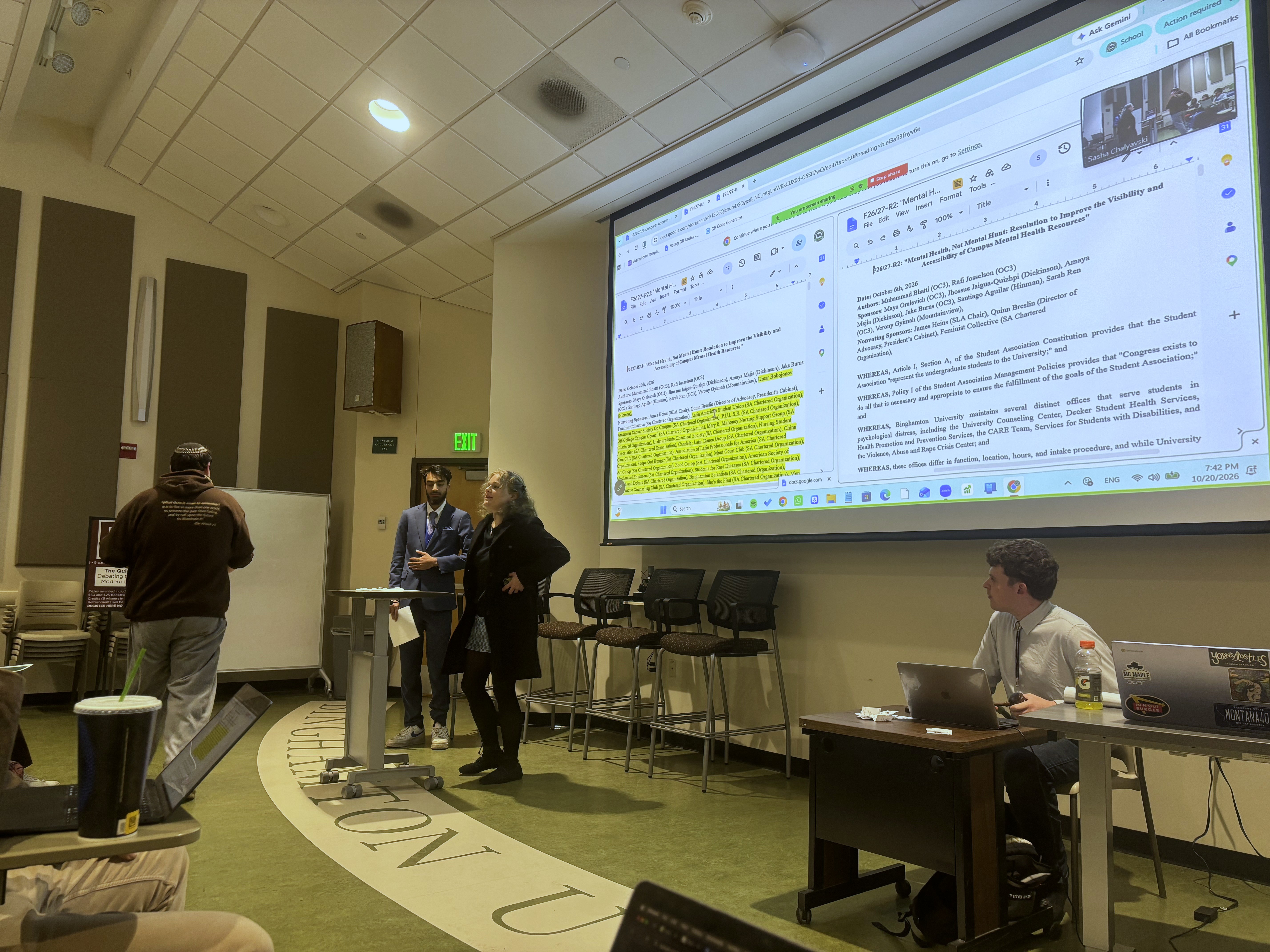
The Binghamton University Student Association Congress failed to pass a resolution to promote access to mental health resources.
“Mental Health, Not Mental Hunt: Resolution to Improve the Visibility and Accessibility of Campus Mental Health Resources” was authored by Muhammad Bhatti, a sophomore majoring in philosophy, politics and law and an off-campus representative. The resolution intended to increase awareness of mental health resources on campus by increasing signage so students know where they can access the appropriate resources for their needs.
The intention of bringing the resolution to Congress in the Oct. 20 meeting was to get feedback on how it can be improved. Rafi Josselson, a sophomore double-majoring in Judaic studies and history, was originally a co-author of the resolution. Josselson explained at the beginning of the discussion regarding the resolution that he and Bhatti did not intend for it to be voted on in that meeting.
“I appreciate everyone’s patience as we continue to make this bill better because mental health impacts each and every one of us, and it’s important that we get advice,” said Josselson in the meeting.
The Feminist Collective was a nonvoting sponsor on the resolution, along with 32 other SA chartered organizations. Esti Klein, a senior majoring in English and the vice president of FemCo, spoke to Congress about the importance of increasing awareness about resources related to sexual violence.
“The reporting process is not built for perpetrator accountability, but to encourage confused victims into silence,” said Klein. “As students and as people living in a community with one another, it is our responsibility to rectify any of the existing external obstructions for a victim attempting to report their crime. Among the most egregious of these obstructions is the fact that currently there are no signs pointing out the Violence and Rape Crisis Center, effectively hiding it from the student body.”
Some Congress members criticized the resolution, calling it a “campaign piece.” Luke Fehily, a sophomore majoring in political science and an off-campus representative, said he was “disgusted” by the resolution. He argued that mental health is a serious topic and “we’re making it into a political game and a spectacle.”
Congress members also had concerns about the number of nonvoting sponsors on the resolution, with some calling into question if each organization had actually read the resolution. August Rey, a junior majoring in political science and the vice president of student success, explained that one of their cabinet members is the political chair of PULSE, which is listed as a nonvoting sponsor. According to Rey, that cabinet member had never seen the resolution.
Fehily said that if these allegations were true, then Bhatti was “manipulating” Congress.
“I’m now outraged, I’ve never been this angry at a bill,” said Fehily.
Other members argued the resolution might need to be split into multiple parts, because the resolution both has wording about increasing signage and about instituting a liaison between Congress and the administration for mental health concerns.
After hearing some of the debate, Josselson decided to remove himself as a co-author of the resolution. He argued that based on the criticism shared by Congress members, they might need to “start over” with working on a mental health resolution.
Following the debate, Congress decided to vote on the bill instead of table it. No Congress member voted to pass the resolution. Nineteen voted against it, including Bhatti, the remaining author on the resolution, and six members abstained. The resolution failed and cannot be brought back to Congress in its current form.
Josselson told Pipe Dream after the meeting that he appreciated the opportunity to learn from everyone.
“What tonight showed is that legislation, especially on mental health, matters,” said Josselson. “It also matters that it’s done on a place of trust.”
Bhatti spoke with Pipe Dream after the meeting about the resolution’s failure. He said that he received feedback in the meeting that he had never heard before.
“I’m happy to work with the VPSS, I’m happy to work with all the Congressional representatives here today, because I think that mental health deserves to have such a high priority in our minds,” said Bhatti. “And so ultimately I don’t take this as a loss. I take this as a next step towards a better resolution, towards representing students better.”