





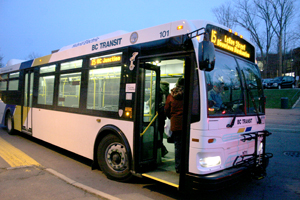
Broome County Transit acquired six hybrid diesel buses that Congressman Maurice Hinchey, D-NY, in conjunction with Broome County officials debuted on April 16. To obtain these buses Hinchey secured more than $3 million in federal funds over the past several years with his seat on the House Appropriations Committee. Binghamton University students are free to ride B.C. Transit buses with a flash of their student ID.
“The bus life is longer, and of course, it is green,” Lori Rolison, B.C. Transit director of operations, said. “Buses are distributed amongst all the bus lines; there is no specific bus line. We are also in the process of getting new ones.”
The vehicles were constructed by Orion Bus Industries, a division of Daimler Buses North America in Oriskany, N.Y. The hybrid diesel-electric systems were manufactured by BAE Systems in Johnson City.
“Having the hybrid technology for these new buses developed right here in Broome County makes this roll-out even more exciting. This is a perfect example of how a smart energy and transportation policy can improve our environment, reduce energy consumption and create local jobs. The United States can and must be a leader in the next generation of transportation technology, and I believe the Southern Tier can continue to play a central role to the end,” Hinchey said.
BAE Systems is the world’s largest hybrid bus manufacturer since 1998. It has delivered more than 2,000 hybrid diesel-electric systems to the United States, Canada and the United Kingdom. This technology is therefore extensively used by transit authorities in New York City, San Francisco, Toronto and London in the form of double-decker buses.
The diesel-electric systems may be expensive to purchase, each bus costing the county $527,000, according to Rolison and Stephanie Diehl, BAE’s communications manager. But the maintenance cost of the bus is lowered in the long term because the high technology uses electricity and thus limits expenditure needed to keep the bus moving and in a well-maintained state.
“The hybrid diesel-electric buses are environmentally friendly. A lot of research has been done on storage devices which include capacitors and batteries in Watson,” said Seshu Desu, dean of the Watson School of Engineering. “The results of various researches conducted on batteries prove that the environment is safe with such buses. This is because with the batteries, the emission of greenhouse gases into the atmosphere is lowered.”
According to BAE Systems, the diesel-electric buses do not emit particulate matter, the black smoke that contains greenhouse gases and other toxic contents.
From 1998 to 2008, 30 percent more greenhouse gases and 90 percent of particulate matter emission that damages lungs and causes serious respiration injury has been prevented. In the hybrid buses, the availability of a smaller engine and a diesel particulate filter ingrained in this engine helps with these preventions. Eight million gallons of fuel, 80,000 tons of carbon dioxide emission and 400 tons of nitrogen oxide have also been saved. All of these savings have been achieved through the accumulation of 50 million miles of revenue service, which is the active carrying of people from one place to the other by the buses.
“B.C. Transit having these new buses is a great idea. Someone has to lead the way, so if B.C. Transit has these buses now, it is definitely a step in the right direction,” said Brian Derry, the maintenance coordinator of Off Campus College Transport, Inc. “The technology is new, but in the long run, if it works out well, it is something we are definitely interested in. This is definitely a step to where the future of America’s transportation is going.”
OCCT is looking into bio-diesel engines that run on vegetable oils, which are also cleaner for the environment, according to public relations director Daren Marrom.
Hinchey is also working with the Obama administration and congressional transportation officials to allow the county to purchase six more buses with $3.65 million in economic recovery money.