





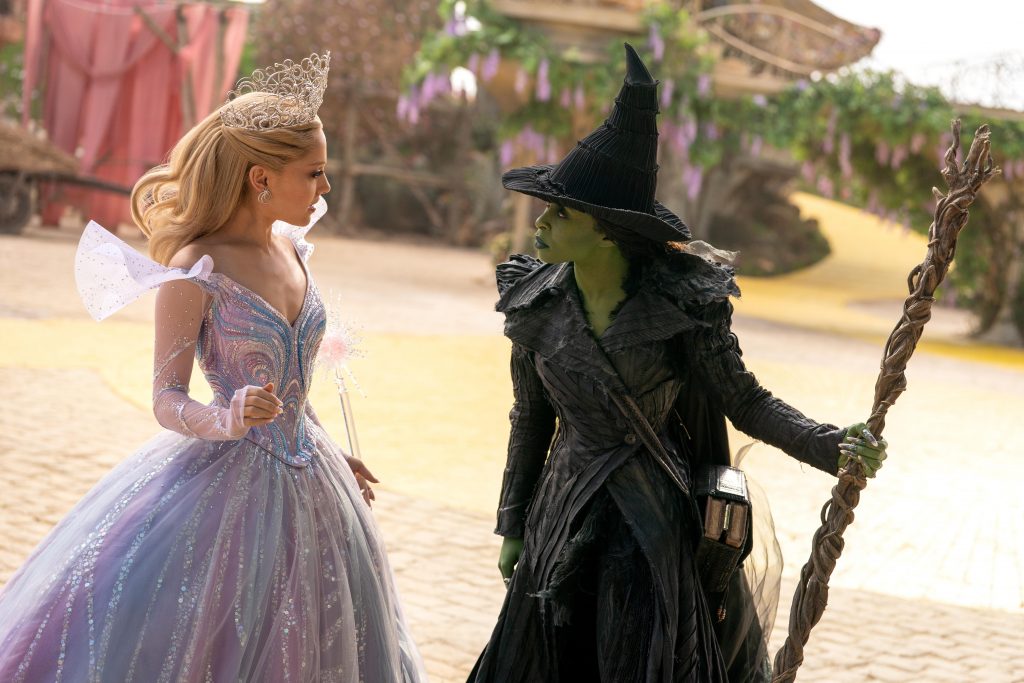
Released on Nov. 21, 2025, the movie-musical adaptation of “Wicked” continues with “Wicked: For Good.” The movie expands on the themes of friendship, love and loss, creating closure for Elphaba and Glinda and intertwining pieces from the classic story “The Wizard of Oz.” Fans had anticipated this second installment since the first movie came out last year as an Oscar- and Golden Globe-winning film that immediately became a cultural phenomenon and set very high expectations for its sequel.
Directed by Jon M. Chu, featuring a screenplay by Winnie Holzman and Dana Fox, “Wicked: For Good” brings the second act of the world-renowned musical to life with top-tier visuals and emotional depth. Notably, the film runs nearly twice as long as Act Two of the Broadway show, as the cast and creative team expand the original storylines and bring the magical world of Oz to life. Picking up right after “Defying Gravity” in the first movie, the sequel pulls viewers directly into the aftermath of Elphaba’s escape from the Wizard, framing her as a “wicked witch” and instilling fear in all of Oz. Cynthia Erivo’s portrayal of Elphaba reflects her loneliness, frustration and determination to free Oz from its leaders, even as everyone turns against her.
Meanwhile, Glinda, played by Ariana Grande, is pushed into the public eye as “The Good Witch,” entrusted with the mission to bring order and hope back to Oz. Her rise to power becomes an internal conflict that deepens throughout the film, as she tries to maintain her role while privately struggling with her loyalty to Elphaba. Grande’s performance effectively portrays Glinda’s inner tug-of-war between her love of popularity and her memories of their friendship, as explored in the first movie — a conflict that grows more painful as Oz becomes more divided.
The tone of this movie is more somber than the first, filled with tears, fights, break-ups and deaths that the characters endure as they navigate the changing landscape of Oz. As the story progresses, the corruption of power by the Wizard and Madame Morrible becomes a crucial obstacle as they increase restrictions on animal rights, including beloved characters like Dulcibear, Elphaba’s childhood nanny, and Professor Dillamond, a goat who was a professor at Shiz University in the first movie.
To add to the growing political tension in Oz, Madame Morrible and the Wizard heavily distribute propaganda and harness fear to manipulate Ozians into turning against Elphaba. Meanwhile, Nessarose, Elphaba’s sister, rises to power as Munchkinland’s governor, restricting animals and munchkins from traveling out of Oz. Elphaba is trapped between her desire to free the animals from these restrictions and her inability to enter Oz without being attacked by the guards of Emerald City.
Like the first film, the visuals stand out with intricate sets, CGI and costumes that transport the audience to the magical land of Oz. Most notable is Glinda’s pink ballgowns adorned with bubbles and sparkles, juxtaposed with Elphaba’s darker and worn-out outfits, highlighting the immense differences between the two characters. The two dress the part as “The Good Witch” and “The Wicked Witch,” emphasizing the disconnect between their public identities and their private friendship.
“Wicked: For Good” features many musical numbers from the Broadway show, including “No Good Deed” and “For Good,” and incorporates original songs like “The Girl in the Bubble” and “Every Day More Wicked.” These songs are delivered through powerful vocals from both Erivo and Grande, and the emotion behind the songs captures the ethos of the audience in both somber and joyful times throughout the story.
The movie also bridges the gap between the first movie and “The Wizard of Oz” by transforming characters like Boq and Fiyero into the Tin Man and Scarecrow from “The Wizard of Oz.” Dorothy’s arrival in Oz, the truth behind the death of “The Wicked Witch of the East,” otherwise known as Nessarose, and their journey to meet the Wizard are all incorporated into the plot. “Wicked: For Good” adds depth to the story we all know and love by creating a background that completely reframes the events of “The Wizard of Oz.”
The central theme of “Wicked: For Good” revolves around Elphaba and Glinda’s friendship, as it did in the first movie. Their journey throughout Oz and their complex relationship — filled with laughter, tears, conflict and forgiveness — is the emotional centerpiece of the film. Their final moments together are arguably the most powerful scene in the movie, where the two are forced to make impossible choices to save Oz. This emotional complexity, along with the writer’s use of humor, creates a rollercoaster of emotions for the audience.
By the time the movie reaches its ending, it leaves viewers with a new perspective on “The Wizard of Oz” — one that centers on the humanity, flaws and strengths of Elphaba and Glinda. With strong and memorable performances amplified by striking landscapes, new music and deeper character arcs, “Wicked: For Good” completes the story in both an emotionally satisfying and visually unforgettable way. Viewers will laugh, cry and leave the theatre with a new appreciation for the world of Oz and the two witches whose bond reshaped it.
Rating: 5/5