





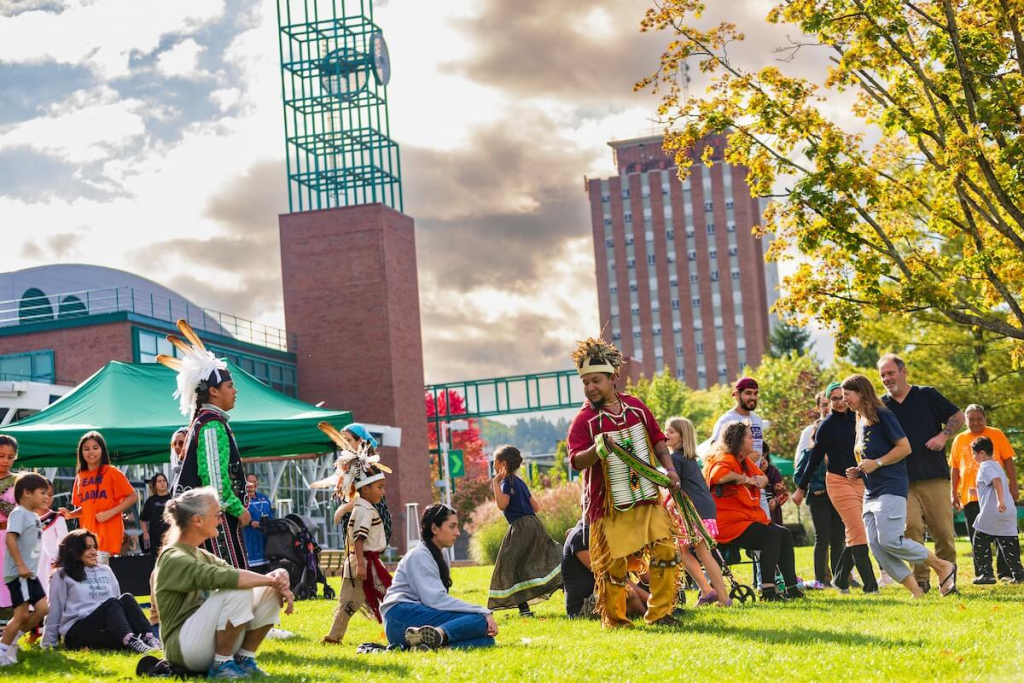
In a vibrant celebration of local and nationwide Indigenous heritage, Binghamton University kicked off its Haudenosaunee Festival last Thursday.
The three-day festival was a collaboration with University faculty, Indigenous peoples and other local community members, highlighting the six clans that make up the Haudenosaunee Confederacy and their culture and history.
“Too often, the distinct history and rich, resilient heritage and knowledge of Indigenous communities are not acknowledged across academic disciplines or represented as living traditions within institutions of higher education,” Tonya Shenandoah of the Oneida Nation and Turtle Clan and the Multicultural Resource Center’s assistant director of Native American and Indigenous Student Initiatives, wrote in an email. “The Haudenosaunee festival is an opportunity to share and honor the distinct history, knowledge and resilient culture that continues to guide many of the Haudenosaunee nation communities.”
The first day of the festival began with the Three Sisters Garden Harvest in the Science 1 courtyard. Attendees learned about traditional harvesting techniques used by the Haudenosaunee peoples and the folktales and history behind what gets planted. The following evening, Suzanne Halbritter, a member of the Onondaga Nation and Eel Clan, shared her experiences documenting protests at the Standing Rock Reservation between 2016 and 2017 in a presentation at the Binghamton University Art Museum.
Halbritter captured her time in the reservation through photos, artifacts and personal recounts with members. Documenting the Indigenous struggle in the United States fighting for water protection on their land, she gave a glimpse into the everyday life of Indigenous peoples today and the demonstrations that took place at Standing Rock.
“It’s to show the power of what the water is for people,” Halbritter said. “It’s not just saving Standing Rock, it’s not just that. It’s setting a precedent for everything — even everything that’s already failed.”
The second day of festivities began with canoeing in Otsiningo Park and a collection of vendors selling artwork, jewelry and books on the Peace Quad. Most of the jewelry was made out of natural objects like horse hair, seashells, crystals and wood, and many of the art pieces centered around people’s connection to nature, highlighting the Haudenosaunee’s reverence and respect toward the Earth.
Other events included a Witness to Injustice event that highlighted the effects of colonization on Indigenous groups through demonstration and storytelling. Many dance groups, comprising Indigenous people and other local community members, performed celebratory and social dances in traditional dress throughout the event. Guests joined the dances and learned more about the history behind the performance and garments.
Every aspect of the festival demonstrated an appreciation for nature, from the artwork to its panelists who discussed the conservation of endangered animal and plant species.
“There’s so much to learn,” Birgit Brander Rasmussen, an associate professor of English and a member of the festival’s organizational committee, wrote. “Many of us don’t know that the Haudenosaunee inspired the U.S. Constitution and the Suffragette Movement. This is a vibrant culture from which we can learn so much more in terms of agricultural and environmental science, philosophy, governance, literature and storytelling, history, land and water management, respect for Elders, etc.”
The final day of the festival commenced with a flag-raising ceremony, where representatives from the Onondaga Nation gave a brief speech, officially starting the day’s festivities. Along with admiring art pieces, attendees also tasted traditional Indigenous foods using ingredients collected from the harvest, like cornmeal made from corn and berries and a complementary strawberry juice.
The events continued with a lacrosse youth clinic held by Hiana Thompson and Jerome Thompson Sr., where they shared the sport’s rich connection to Indigenous history and its importance to communities nationwide. Working with the University’s men’s lacrosse team, the accomplished father and son helped young kids develop their skills and learn life lessons on the field.
Events and displays during the festival highlighted many aspects of the Haudenosaunee’s rich history and celebrated many of the values that the clans still uphold. This included the Two Row Wampum, a belt made of shells that represented a peace treaty made between Dutch settlers and the Haudenosaunee people.
The festival concluded with a final dance from the Haudenosaunee Singers and Dancers, another performance which encouraged audience participation.
“The festival builds bridges of peace and friendship, cultivating a critically needed sense of place for Native American and Indigenous students on campus, creating a sense of respect and belonging,” Shenandoah wrote. “Hosting the festival on the Binghamton University campus will expand these bridges through community partnerships and enrich the educational experiences of all students through the sharing of cultural and intellectual knowledge that continues to guide the distinct way of life of Haudenosaunee communities as separate, sovereign nations.”