





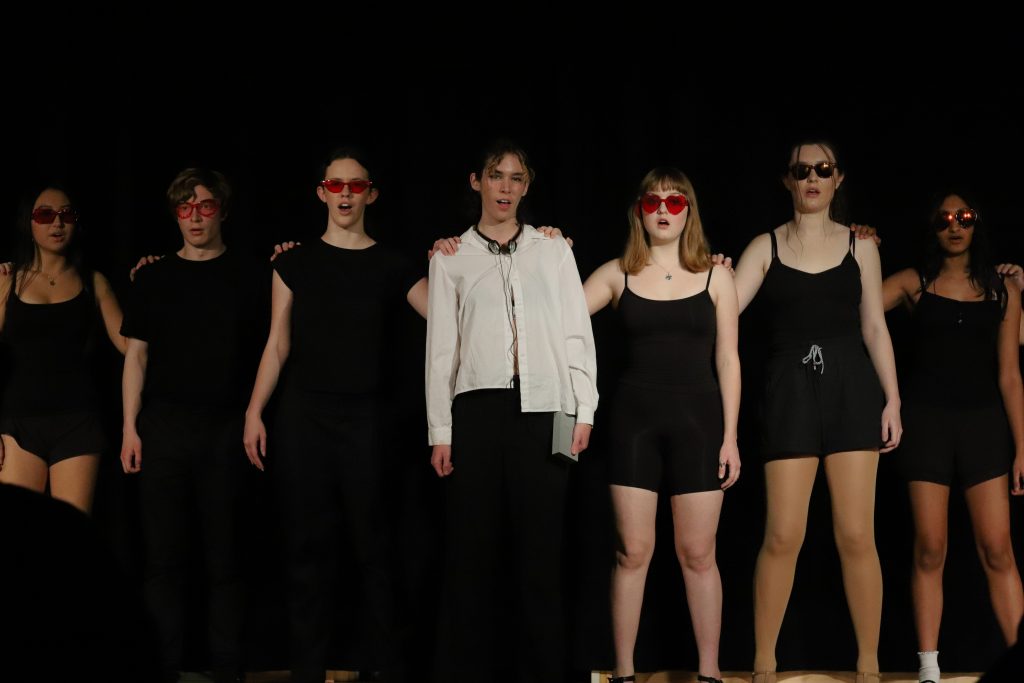
Coined in the early 1980s, “yuppie” describes young, urban professionals with voguish lifestyles fueled by lucrative jobs. Drug and sex-crazed escapades and a superficial obsession with status and wealth are what define Patrick Bateman, the ideal yuppie. At 26 years old, Patrick, a New York City investment banker, lives a double life, plagued by bestial thoughts, all the while ensuring the upkeep of an aesthetically perfect way of living.
Shifting between booking reservations at Dorsia during business meetings to scenes of violence overtaken by red lighting across the stage, Patrick’s unreliable narrative serves as a testament to the psychotic nature that begins to engulf his daily interactions, leaving the audience to question — much like Patrick — if his sociopathic tendencies are truly reality, or if they solely exist within an imaginative state.
The psychological, musical comedy “American Psycho,” performed by the Dickinson Community Players, premiered Friday, Nov. 21. Directed by Rio Pralle, DCP’s president and a senior double-majoring in German and linguistics, the musical was staged in the Chenango Champlain Collegiate Center. Cadi Darling, the assistant director for the musical and a junior double-majoring in French and linguistics, described the portrayal of yuppie culture and the significance the play held to her and her crew.
“It was really interesting to explore how drug addiction can alter how you view things and your relationships with people,” Darling said. “And I also really appreciate that, yes, there were a lot of homophobic things in this production. While that’s not great, I think it is good to bring awareness to it, and I think it was fun to explore that while also trying to be very respectful of it.”
The rapid, conflicting storyline of “American Psycho” forces an analysis of the uncanny. With a cold-colored spotlight on a distraught, bloodied Patrick, he implores the audience to help him rationalize the loss of reality, which he experiences throughout the play. From scenes of derealization in the Hamptons with the musical number “At the End of an Island / Hardbody Hamptons,” to Donald Kimball brushing off Patrick’s distressed murder confession of Paul Owen as a joke, Patrick desperately pleads for some form of notoriety before the musical concludes with him adopting a mindset of existential nihilism.
“I really enjoyed adding elements of unreality into the production,” Pralle said. “There were parts where it got a little bit meta, so I had the detective played by Paul to up the hallucination. I added lighting cues and choreo, like distortion, to make it very unclear what was happening and what wasn’t. That was the same thing with Patrick being covered in blood and no one noticing for pretty much all of Act II.”
To ensure a genuine, on-stage portrayal of the characters featured in “American Psycho,” Pralle’s cast explored authentic representations of their roles with creative liberty. However, they also stuck to the original text provided by the creators, Duncan Sheik and Roberto Aguirre-Sacasa.
Lyd Wyble ‘25, a first-year graduate student studying data analytics, stars as Patrick. She shared some of the strategies she used when conceptualizing her portrayal of the main character.
“Usually, when I act, something I really focus on is humanizing the character and really just being ‘me’ on the stage, connecting with them,” Wyble said. “For this role, I really didn’t want to do that. I wanted it to be a severe disconnect from who we are as people, and who this person is.”
Beyond the psychological turmoil that Patrick experiences throughout the musical, the audience and cast heavily played into the comedic aspect of the musical. One scene featured Paul Owen – played by Abigail Kelly, a senior double-majoring in environmental studies and political science — running around the audience to hand out subtle, off-white business cards with a watermark. The musical also featured the running gag of fellow investment banker Luis Carruthers’ romantic desire for Patrick. The audience was highly receptive to these comedic elements, with laughs echoing from C4’s Multipurpose Room.
“That just unsettling feeling that you’re left with at the end of the show, where [Patrick] repeats the end of his opening monologue, but now he’s 27 years old,” Pralle said. “It’s just so cathartic.”