





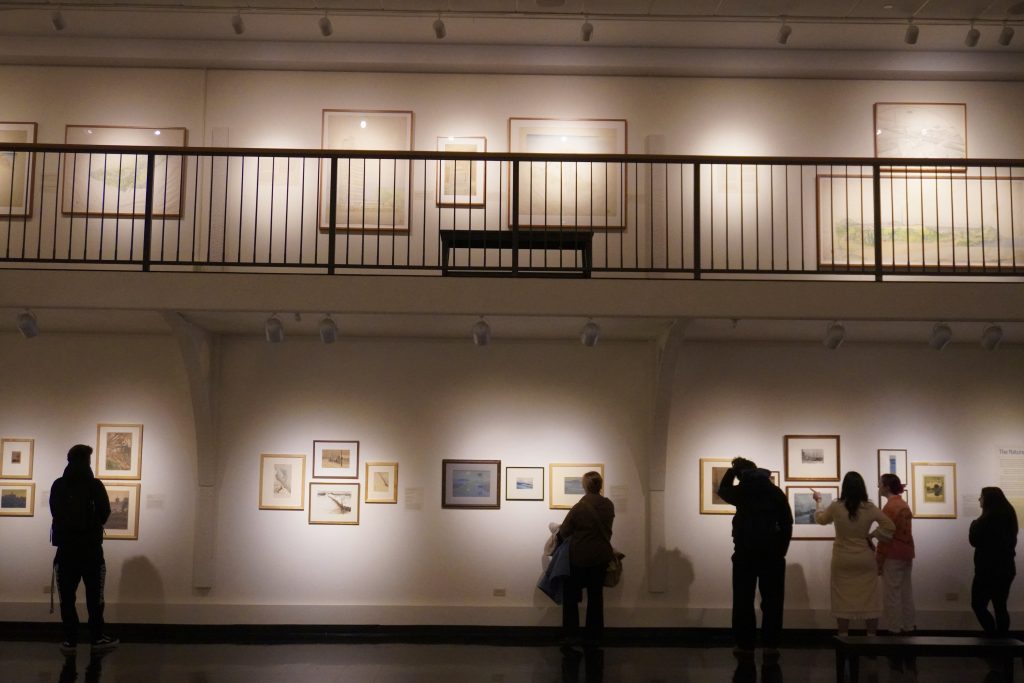
The Binghamton University Art Museum was filled with chattering conversation on Thursday as five new exhibitions debuted for the spring semester. Patrons wandered between the lower galleries, main floor and mezzanine, exploring the impressive range of themes and pieces curated for each exhibit. Students, families and faculty alike perused the galleries as the usual quiet of the museum was replaced with enthusiastic commentary.
The main floor of the museum showcased “Line, Color, Contrast: Japanese Prints and New York Arts and Crafts,” the work of BUAM’s curator of collections and exhibitions, T. Joseph Leach of Endicott, New York. The colorful display of artwork and furniture included prominent themes of nature, soft landscapes and an array of Japanese woodblock prints straight from the museum’s own collection. Leach holds a Ph.D in Asian languages and cultures and spoke on his experience with Japanese prints, especially at the University.
“The collection here has a huge body of Japanese prints, primarily cultivated by alumni donors, and they brought me on so that I could work with that collection specifically,” Leach said. “So I spent the last year and a half digging and really getting to know it.”
A central figure in the New York arts and crafts movement was Arthur Wesley Dow, who Leach attributes to training a generation of American artists in Japanese print and design. He is featured frequently within the exhibit and Leach spoke of his ties with artists in the Woodstock Byrdcliffe Art Colony, another influential entity in the arts and crafts movement.
Dow’s ties extended even further, providing a connection between the two main exhibits in the opening.
“The thing that has been the most exciting, I think, has just been the serendipity of the fact that we have this exhibition happening at the same time as the Frank Lloyd Wright loan upstairs,” Leach said. “The two work so well together. Arthur Wesley Dow and Frank Lloyd Wright overlapped — they were potentially in the same room for an exhibition of Japanese prints.”
Ascending the twin staircases to the museum’s mezzanine led patrons to explore an entirely different exhibit. “Drawing Connections: Frank Lloyd Wright” was curated by Julia Walker, an associate professor of art history and students in “Rewriting Wright,” an upper-level art history course. Walker described the class as examining the career and legacy of Wright, the United States’ most famous architect.
The Guggenheim Museum in New York City is one of Wright’s most famous works, and original sketches for the design can be seen in the exhibit. Collaboration was a theme in both curatorial efforts and in the exhibit itself.
“In particular, one of the things we focused on in both the seminar and the exhibition was just how deeply collaborative Wright’s practice was,” Walker wrote in an email. “He was someone who really wanted to be at the center of things and who didn’t like to share credit with anyone, preferring instead to paint himself as a heroic genius-artist working in the face of adversity. In fact, his family motto was ‘Truth Against the World.’ But in fact, his practice was deeply collaborative.”
“Through the exhibition, we learn about some of his most interesting clients, as well as his employees and apprentices, all of whom have their own specific stories and who brought their own creativity to bear on the works that are displayed in the show,” she continued.
Walker is a scholar of Wright, and her research and teaching at the University focus on modern and contemporary architecture and urbanism. She has both personal and educational ties to the work of Wright, as her father is an architect and she visited some of Wright’s buildings as a child. Wright was the subject of Walker’s undergraduate art history thesis, and her current research project focuses on some of his apprentices.
Alongside the two main exhibits, the museum’s oft-overlooked lower galleries can be found directly below the BUAM. Curatorial interns for the museum spent the fall semester building their exhibits, each with different eras, styles and regions involved. Paxton “PJ” Wells, a senior majoring in history, curated “Japanese Card Games and the Significance of Flora” with intricate Japanese cards adorned on wall labels. Nicole Quintanilla, a senior majoring in psychology, curated “Figures and Fragments: Collage and the Human Form,” which featured a Keith Haring original print of “Into 84.”
Sarah Lin, a junior double-majoring in English and art history, curated “Why So Blue? The Influence of Chinese Blue-and-White Porcelain” based on her cultural heritage, solely using pieces from the BUAM’s collections.
“I wanted to represent my culture in some way, and at this time, I also really was interested in the idea of globalization and how that has really resonated throughout physical mediums,” Lin said. “And I was looking through the database, and I found a lot of pieces that I thought would work really well.”
The exhibitions will be open for the rest of the spring semester and are sure to draw crowds. The five exhibits hold something for every patron, with brilliant collections on display at every level.