





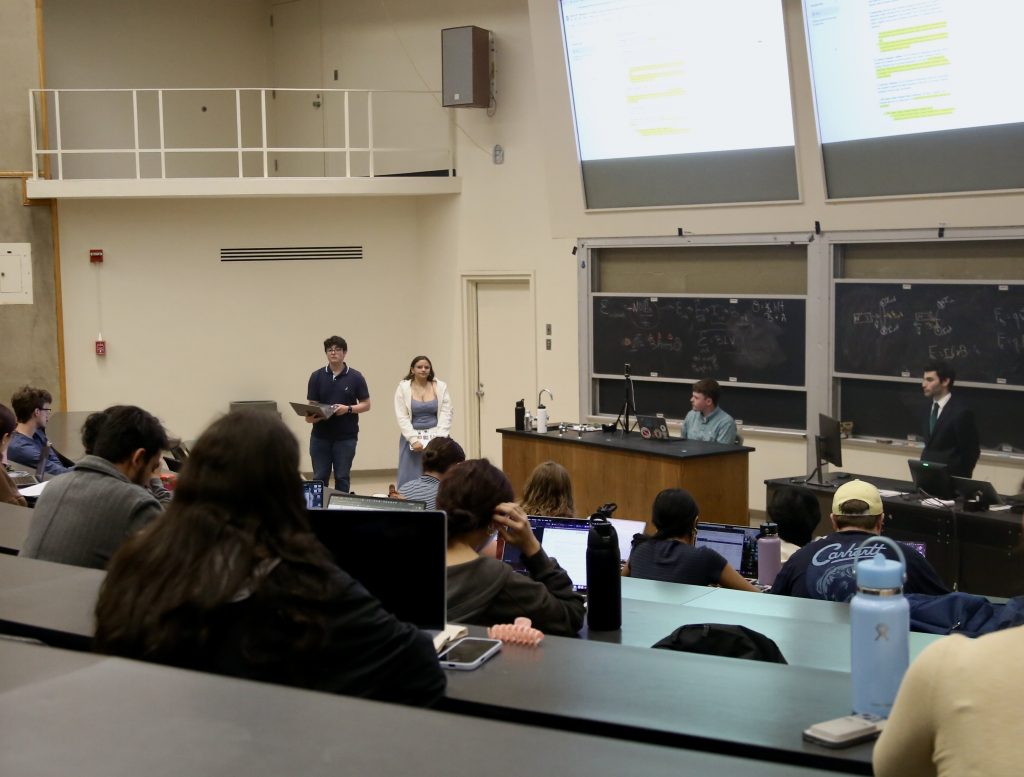
A resolution passed by the Binghamton University Student Association Congress allowing the SA to join the U.S. Student Association’s Interim Governance Council was vetoed for a second time by the SA Executive Board.
First passed on Nov. 4, 2025, the resolution would have paved the way for the SA to join the governance council, a national student-run organization that advocates for student issues. The SA E-Board first vetoed the legislation on Nov. 18 and the bill was revised and passed again on Feb. 24, 2026. The E-Board then vetoed the bill again two days later and announced the decision at Tuesday’s SA Congress meeting.
“In the end, this decision was not made lightly, nor was it made out of disregard for the intentions behind the resolution,” McKenzie Skrastins, the president of the SA and a senior majoring in mathematics and Atticus Fauci, the vice president for programming and a senior majoring in economics, wrote in a joint statement to Pipe Dream. “The Executive Board carefully considered Congress’s perspective, the potential long-term implications of affiliation, and the responsibilities we have to the undergraduate student body.”
“While we respect that others may have reached a different conclusion, we believed it was more responsible to pause rather than commit the Student Association to an external organization without greater clarity on its obligations, benefits, and expectations,” they continued.
The legislation was authored by Lotus Taylor, congressional chair of the diversity, equity and inclusion committee and a first-year graduate student studying higher education and student affairs. The original resolution would have appointed Taylor to represent the University in the USSA and allowed all University students to be involved within that organization.
The resolution also stated that as the legislation pertains to membership in the IGC, upon the organization’s dissolution, the SA’s membership would also end. To rejoin the official charter, new legislation would have to be passed by the SA Congress.
In an interview with Pipe Dream, Taylor explained that while the SA Congress passed this version of the legislation, it was vetoed by the E-Board, which cited concerns about Taylor serving as the representative to the USSA.
Taylor said that following the veto, she amended the resolution to make Hatim Husainy, a sophomore majoring in political science and an SA Hillside representative, the representative for the USSA. She explained that she asked him to fill this position because of his previous engagement with the USSA at its Grassroots Organizing Weekend.
Taylor said she met with Skrastins and Fauci before presenting the new resolution and said the E-Board members informed her that under the SA Constitution, only the E-Board can appoint outside representatives on behalf of the organization. The E-Board then changed the representative to Fauci.
“Throughout this process, the Executive Board remained insistent that Atticus Fauci, Vice President of [Programming], serve as the representative, even though Executive Board members are invited to attend Congress meetings and [Fauci] attended very few, and never advocated on his own behalf for this bill in our chamber,” Husainy wrote in a statement to Pipe Dream.
According to the E-Board’s joint statement, after this change, the E-Board voted to join the USSA. However, a representative from the USSA informed the E-Board that their membership would only be recognized if the updated resolution passed in Congress. Even though the E-Board explained that external representation falls under its purview, the USSA still would not grant membership.
Taylor then chose to reintroduce the resolution to Congress, meeting with both Skrastins and Fauci to “come to a consensus on its general direction.” The revised resolution was then passed by Congress on Feb. 24.
At the following E-Board meeting, the legislation was vetoed again. The vote was not unanimous and Skrastins said many on the E-Board had differing opinions.
At the March 10 Congress meeting, Taylor said she would no longer “continue contesting the veto or debating the merits of joining USSA.” Skrastins also gave a statement regarding the veto decision.
Skrastins explained that there were three reasons for the veto: potential financial obligations, unclear benefits and engagement expectations.
While there are no current fees associated with joining the organization, Skrastins argued that a future SA Congress may have to deal with the costs if implemented. She explained that this would mean taking money away from other clubs and student-led initiatives.
However, Taylor told Pipe Dream that there is no anticipated fee structure currently for the USSA and any future Congress that may have to address such fees would need to pass new legislation to officially join the USSA.
Further, Taylor explained that the fee structures that have been discussed are similar to the structure of the FAFSA in that “it would be a pay what you can or if you can’t pay anything, an option to not pay anything into the organization.”
“The fee structure does not exist as it stands,” Taylor said. “And there’s a way for nonpayment, right? But remember, the last time it was vetoed, it was the representation. Now we’re concerned about student fees.”
While Skrastins explained the E-Board recognizes the importance of student collaboration, it was “unable to identify clear, direct benefits” of joining the USSA for BU students.
Taylor said the benefits include a direct connection to Washington, D.C., opportunities to participate in federal lobbying, a connection to a large alumni network and student collaboration.
The E-Board finally cited concerns about engagement expectations, namely how “deeply or consistently” involved it could be given its primary responsibilities to the student body.
Taylor said part of the reason she suggested that Husainy be the representative was that she understood that the E-Board had many other responsibilities. She also explained that membership in the USSA “never took up an extraneous amount of my time” as the standard for membership is hour-long meetings once every two weeks.
Following the final veto, Taylor announced that she would not continue to pass this legislation because she believed that the E-Board would veto it again.
“But also, given my track record with this executive board, it feels like they’re also making this opinion, because, quite frankly, they don’t particularly care for me or respect me and the work that I do,” Taylor said.
Husainy shared his disappointment at the decision, highlighting the potential benefits that joining a national network of students would have had for the University and expressed concern over the legislative process surrounding the resolution.
“After multiple revisions made specifically to address the Executive Board’s stated concerns, this outcome suggests that the issue was never truly about representation or procedure,” Husainy wrote. “Instead of working collaboratively with Congress to strengthen our connections with students nationwide, the Executive Board ultimately blocked the effort entirely.”
“I hope that next year’s Executive Board candidates take note of this incident — where personal and procedural disputes ultimately outweighed the potential benefits to the student body — and that a future Student Association will again pursue joining the USSA Interim Governance Council,” Husainy finished.
Editor’s Note (3/23): This article was updated to correct the year and major of Atticus Fauci, SAPB’s president of programming.