





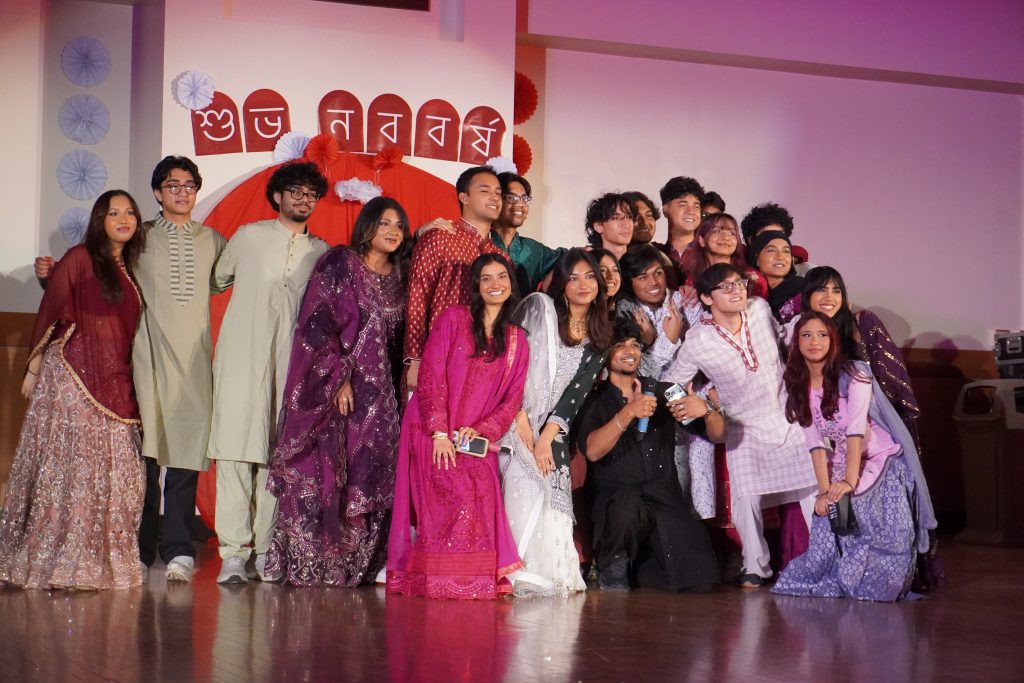
The Bangali Student Association welcomed students to celebrate Pohela Boishakh, a traditional New Year’s celebration, in the Mandela Room on Friday. With fun booths, performances and traditional street food, attendees enjoyed an exciting and lively night that honored Bangali culture.
Pohela Boishakh roughly translates to the first month of the calendar year and dates back to the Mughal Empire. During the Mughal Empire, taxes were often collected before the first harvest, according to some historians. To remedy this, a new calendar was created by combining the lunar Islamic calendar and the solar Hindu into the Fasholi shan or harvest calendar.
BSA strived to bring forth these traditions with its annual celebration of Poehla Boishakh. Tasnim Hossain, the president of BSA and a sophomore majoring in biochemistry, reflected on the inspiration behind the festivities and how the holiday is traditionally celebrated.
“The inspiration is a typical carnival-type thing that we do back home in [Bangladesh] called a Mela,” Hossain said. “It’s basically booths with games, street food, jewelry. People have stands, people are selling stuff. Usually there are carnival rides too, music, performances, dancing. It’s just a very big, bright, colorful celebration to welcome the new year.”
Baisakhi Melas are incredibly popular celebrations and the BSA embodied many of these intricate traditions with its event. The night opened with time for guests to go from booth to booth, playing games like mini golf or shoot the duck. Along with games, attendees could receive henna designs and purchase jhumkas, traditional desi earrings.
Hosts Jeba Karim, senior advisor and a senior majoring in political science, and Krish Patel, co-event coordinator and a junior majoring in biology, welcomed guests onto the floor for a game of musical chairs, passing the parcel and finally the cup game. These games are often played at Bangali picnics, as explained by Karim.
In pass the parcel, as guests sit in a circle and hope not to be the last person holding the parcel when the music stops. The cup game was split into two parts, with guests fighting to see who first grabbed the cup in a head-to-head game. After the games, the remaining contestants began an interactive scavenger hunt around the room.
The winners of the games were given a Polaroid camera, a bubble gun and a Sony headset provided by the night’s sponsors, The Printing House.
In between the games, traditional Bangali street food was served, including jhalmuri and fuchka. These nostalgic foods were accompanied by catering from Royal Indian to close out the first half of the evening. Following the games and food, Hossain was excited to share the dances that would soon unfold.
“I think I’m most looking forward to the last dance that we’re doing, which is a Bangali dance and it’s with a song that a performer actually performed here, I think two years ago,” Hossain said.
At the end of the night, in traditional attire, members of the BSA E-Board began their dances. Featuring Bangali songs like “Boisahker Bikel Belay” by Akassh and “Bom Diggy Diggy,” the audience excitedly enjoyed the dances and cheered along. The lively display showcased the vibrant and colorful Bangali culture that the organization worked to showcase throughout the night.
Coming together to share Bangali culture has fueled much of the BSA’s endeavors and continues to inspire its members.
“[BSA] made my time so much better, finding people from my own culture, being able to celebrate things away from home that I didn’t think I’d be able to celebrate at college,” Hossain said.