





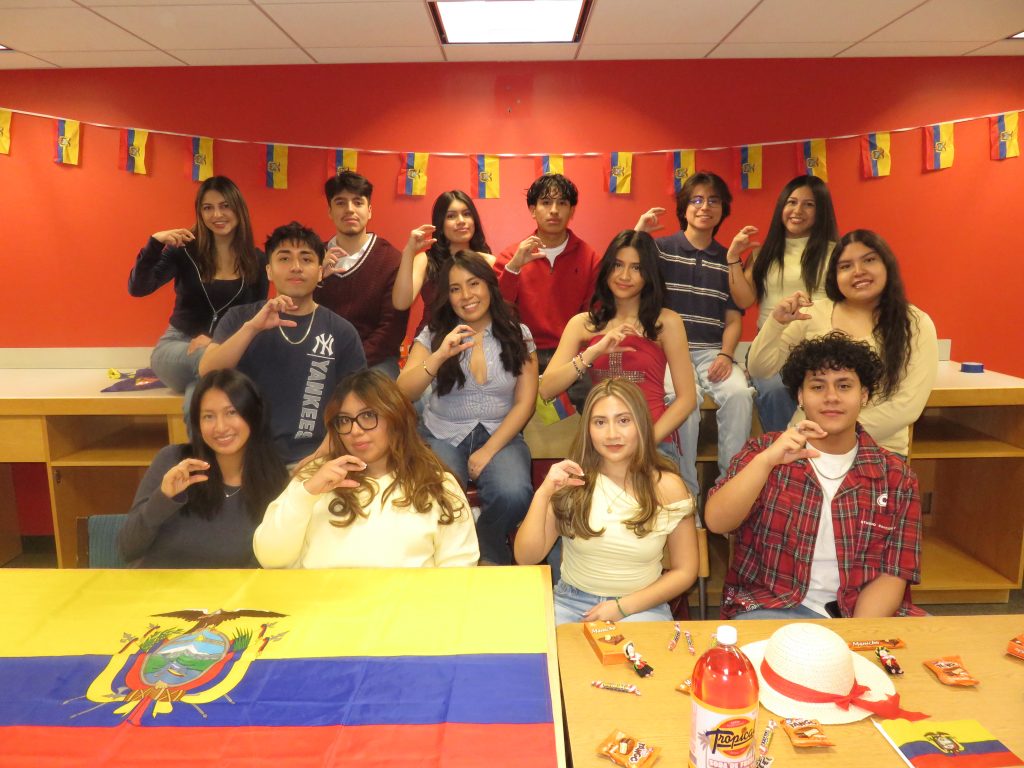
Among the newest additions to the Binghamton University student organization scene this year is the Ecuadorian Student Association. Founded last fall, the ESA provides a dedicated space for students to learn about and connect on what being Ecuadorian stands for, including warmth, generosity and unity.
ESA’s founders Lesly Cabrera, co-president and a junior majoring in biology, Sofia Lupercio, co-president and a junior majoring in integrative neuroscience and Jennifer Vivar, vice president and a junior majoring in business administration, came together to form the organization after witnessing the growth in the Ecuadorian student population at the University, taking initiative and following the lead of other recently-established organizations. Despite its new status on campus, ESA has quickly found success.
“Seeing new clubs rise on campus, like the Mexican Student Association (MASA), was very inspiring and eye-opening to the idea that there is a space on campus for other cultures to shine through,” Cabrera, Lupercio and Vivar wrote in an email. “The growing populations of Ecuadorians and Latinos on campus encouraged us to create a space where our traditions and culture were able to be expressed and embraced.”
While ESA’s E-Board has familial roots all around the country, from the high-altitude city of Cuenca in the Andes Mountains to the riverside town of Tena at the gateway of the Amazon Rainforest, they enjoy many of the same pastimes that make up core moments of their childhood.
“Our favorite tradition would be spending our days at las canchas, which can translate throughout different countries across Latin America,” Cabrera, Lupercio and Vivar wrote. “Las canchas allow family members of all ages to come together to play volleyball and soccer tournaments, while enjoying the beautiful Ecuadorian atmosphere through the food stands, the music, and indulging in conversations that remind us to live in the moment.”
That same emphasis on the value of togetherness is evident in the events, meetings and fundraisers ESA has hosted thus far. Its first official event included an entertaining, casual soccer watch party where the national team La Tri Ecuador squared off against the United States. “Salchipapa,” a comforting South American street food combining a base of French fries and sliced sausages, was served to dozens of attendees.
Since then, ESA has continued to expand its presence across campus and collaborated with several multicultural clubs at the University, including the Puerto Rican Student Association and the Caribbean Student Association.
Erick Mendez, ESA’s treasurer and a junior majoring in business administration, described the kind of relationships he’s been able to foster — something that only joining ESA could have offered.
“My favorite part about being involved with ESA is seeing the organization grow over time,” Mendez wrote in an email. “We started halfway through the fall semester, and we have only gone up since then. Our turnout at general body meetings is incredible, and we have gained so much support from the Binghamton community.”
“ESA stands out to me because of the cultural connection I share with the organization,” he added. “I have found a family of Ecuadorians on campus and made friendships that will last a lifetime. This was only possible through ESA, and I am forever grateful for that.”
ESA has even bigger aspirations for the future, looking to eventually host a large-scale “Carnaval”-style event inspired by the four-day national holiday in February. In Ecuador, streets come alive with elaborate parade floats and water fights, swarmed by crowds of people dancing, singing and celebrating to unwind before Lent. The organization is also planning a soccer tournament, inspired by “Canchas Ecuatorianas.” Held on April 11, the event will feature Ecuadorian cuisine and a lively atmosphere.
Although Cabrera, Lupercio and Vivar are all upperclassmen, they hope the foundation they’ve started to build for Ecuadorian students at Binghamton will remain strong in the years after they graduate.
“As juniors, we have limited time on campus, but we have seen how strong and prideful the Ecuadorian community is here on campus,” they wrote. “We truly believe ESA will not only continue growing in numbers but will continue to embrace culture and unity within the greater Latino community. We can only hope and work towards a bright and united future for ESA, all of its future members, and all its future endeavors.”