





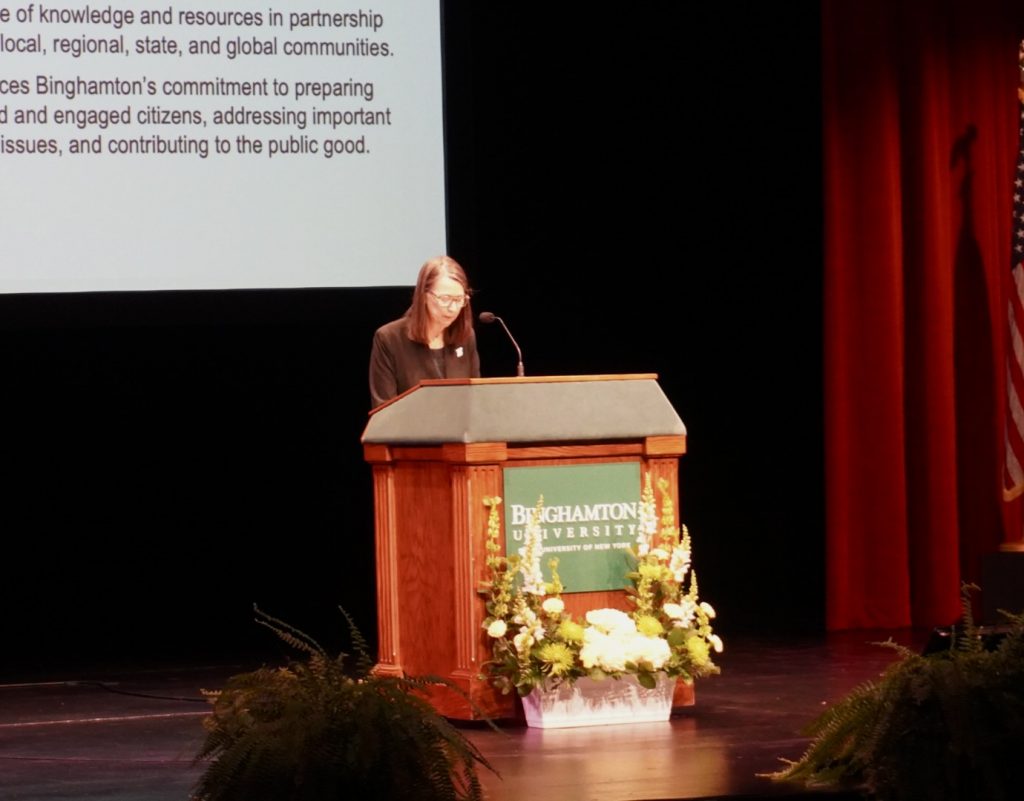
Binghamton University President Anne D’Alleva delivered her inaugural State of the University address on Friday, sharing insights from her “Listening to Lead” tour and plans for the upcoming year.
D’Alleva began the address by thanking former President Harvey Stenger for his role during the leadership transition, along with the BU Council, Foundation Board and SUNY Chancellor John B. King Jr. She then pointed to the University’s upcoming eightieth anniversary and its history and status among public higher education institutions.
“For 80 years, this place has been driven by the core mission of giving talented students the opportunities and resources they need to make our world a better place,” D’Alleva said. “And our commitment is to continue to grow and amplify that mission into the next 80 years.”
Next, D’Alleva announced the development of the Center for AI Responsibility and Research, funded by a $30 million donation from Tom Secunda ‘76, MA ‘79, who co-founded Bloomberg L.P. and a $25 million investment from New York state. She said that the center will “focus on responsible AI and advancing it for the public good.” The center is a part of the Empire AI project, a consortium of research institutions to innovate AI and address both its potential benefits and harms.
D’Alleva then discussed her Listening to Lead tour, where she made 38 stops throughout November and December to meet with student leadership and organizations, faculty, staff and alumni to evaluate the University’s strengths and areas to improve. Throughout the tour, she posted updates on the University’s website. She plans to continue sharing weekly news and updates in her “From Anne’s Desk” blog.
Addressing “several themes” that emerged during the listening tour, D’Alleva shared her takeaways and how she plans to implement the feedback she received. She started with the “widespread consensus” that the University is in a “position of strength” in academia, pointing to its “Public Ivy” designation, its $87.3 million investment in research and rising applications, which reached 61,200 for last year’s incoming undergraduate class.
“At the core, we’ve created a caring and compassionate community, marked not only by extraordinary student success and faculty excellence, but also by staff who are recognized across SUNY and even nationally as leaders in their fields,” D’Alleva said.
D’Alleva then discussed research, which she said has made significant advancements but still has room to expand. She added that the University needs to develop more research space, work with industry partners and grow the number of graduate students. To improve the graduate student experience, she plans to address student concerns with housing, sense of community and career development.
Several expansions and construction projects are underway at the University, which D’Alleva said will address demand for new spaces. The new lecture hall across from the Academic Complex will open in 2027. Additionally, the former Columbian Financial Group building on Vestal Parkway, which the University purchased in December for $5.5 million, will be used for “back of house” staff, allowing more campus space for research and student support.
Grace Hall, a 350-bed residence hall located between College-in-the-Woods and Mountainview College, will open in summer 2027, according to D’Alleva. The residence hall will grow the University’s capacity to over 8,000 beds. Other projects in the Chenango Room, East Gym, the Events Center and Science 3 are also underway or set to begin shortly.
D’Alleva shared quotes from the listening tour, where research staff, parents of students, faculty and a member of the Student Association’s E-Board discussed the University’s “culture of caring” and campus experience. She then said that when asked how she will measure her success as president, it will be when the University is on the list of exemplary public institutions alongside schools like the University of California, Berkeley, the University of Michigan and the University of Virginia.
“Binghamton deserves to be on that list, top of mind, because of the great people in this community,” D’Alleva said. “The listening tour was an excellent opportunity for me to reaffirm my belief that this is possible. And that we have the people, the resources and the vision to make it happen.”
To make this possible, D’Alleva unveiled her strategic planning process, which will build upon Stenger’s Road Map initiative to create a five-year plan for the University. Co-chaired by Donald Hall, provost and executive vice president for academic affairs and Distinguished Professor Mohammad Khasawneh, the planning process will “put students first” and create a “tangible and realistic pathway” to cement the University as a premier public institution, according to D’Alleva.
The process is set to conclude in May. In March, the strategic planning committee will build on the listening tour by continuing to collect feedback from the campus community to examine the University’s “strategic priorities.” Afterward, the committee will use this feedback to develop five-year actions and metrics to measure success. D’Alleva said the strategic plan will start being implemented in the summer and the fall 2026 semester.
D’Alleva finished the address with what she called the “Binghamton Bond,” or the University’s culture of research, collaboration and community. She said the University’s values have persisted since its founding and can be seen in its national recognition and partnerships.
“As a newcomer to this community, I’ve felt the ‘Binghamton Bond,’” D’Alleva said. “I heard about it throughout the listening tour. How much everyone in this community cares about one another. How collaborative we are in our work and how Binghamton and its people make a difference.”