





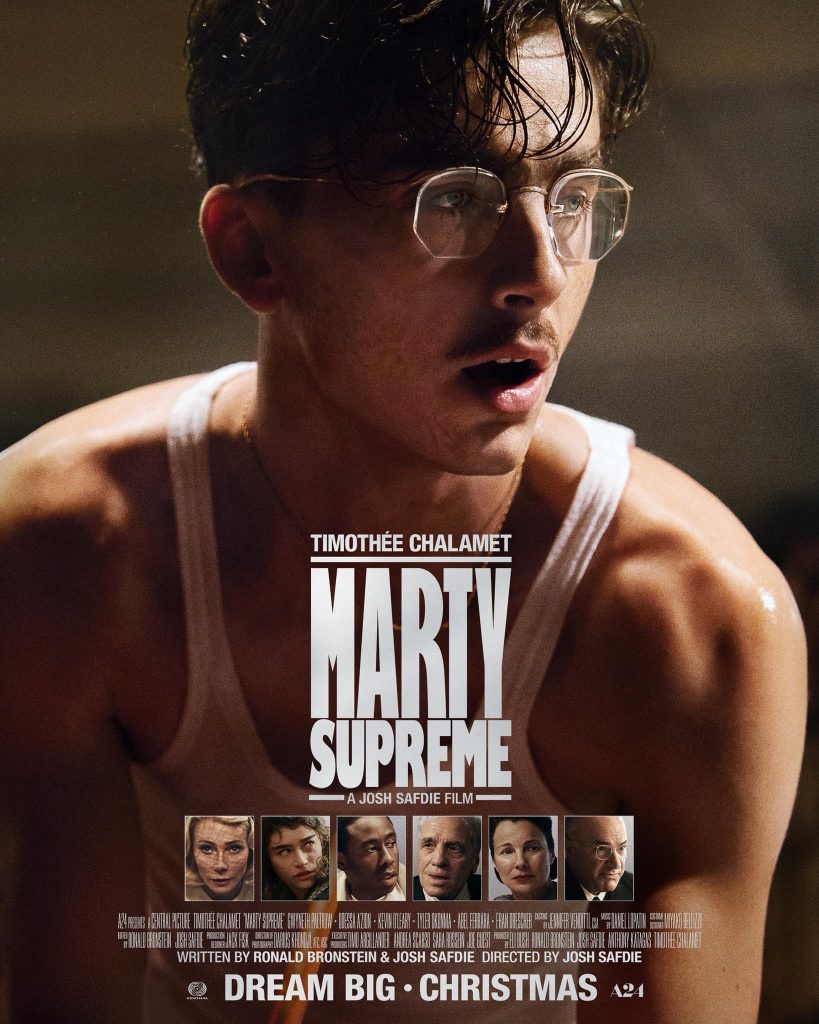
“Marty Supreme,” released on Christmas Day, quickly caught the public’s attention, becoming the fourth A24 movie to surpass $100 million globally. The success was well-deserved, with Timothée Chalamet’s performance in the film winning him his first Golden Globe award.
The movie takes place in New York City in the 1950s, following Marty Mauser (Chalamet), a shoe salesman and professional table tennis player struggling to make ends meet (3). He dreams of defeating the defending champion of the British Open, Béla Kletzki (Géza Röhrig), believing that it would not only demonstrate his talent but also bring American attention to the lesser-known sport.
Marty faces the opposition of people closest to him who show disdain for his passion, unable to take it seriously. Nonetheless, Marty is not only driven but blinded by pure ambition. He acts selfishly, without hesitation, so long as it serves him well. This is demonstrated right at the beginning of the film as he holds his coworker at gunpoint to gain enough money to get to London for the British Open.
Once he arrives in London, his entitlement and stubbornness land him with much more comfortable accommodations, granting him the opportunity to start an affair with Kay Stone (Gwyneth Paltrow), a wealthy former actress. Despite his cockiness, Marty fails to beat a deaf Japanese opponent, Koto Endo (Koto Kawaguchi), in the final rounds of the competition.
Despite his loss, Marty’s ambition and drive to succeed, without allowing any other outcome to enter his consciousness, are shown through his personal affairs. Back home, Marty only continues to cause trouble. He avoids getting arrested for stealing the money from his job. He refuses acknowledge that his childhood friend, Rachel Mizler (Odessa A’zion), with whom he had an affair, is pregnant with his child.
Even with the challenges he poses to others, Marty can’t help but think only of himself as he goes to great lengths to scrounge up enough money for a trip to Tokyo so he can beat his newfound rival, Endo.
After wrapping his closest friends up in his drama as he gets on the wrong side of some ping-pong players and a gangster, chaos continues as he abandons Rachel and uses Kay and her husband, Milton Rockwell (Kevin O’Leary), to find a way into Tokyo. His match in Tokyo marks a pivotal point as he veers away from the script of letting Endo win for Rockwell’s marketing strategy and, with a burning persistence, convinces Endo to compete against him in a real match. Despite the wreck he leaves in his path to victory, he finally defeats his nemesis.
The movie is a fiery back-and-forth, with the intensity of the fast-paced ping-pong matches highlighting the intensity Marty felt to create a worthy legacy for himself. The unhealthy and selfish actions often had the audience questioning Marty’s moral compass.
The director of the film, Josh Safdie, explained that he “wanted to use Marty to explore the urgency of dreaming big.” This goal was not only met, but its limits were tested. Marty often made questionable and hurtful choices for his own benefit, yet in the end, he still got what he wanted. He was never forced to come to terms with how selfishly he had acted, or how his tunnel vision was hurting those around him.
In a world where fame, fortune and success leave a stronger legacy than humble morality, how far is too far while clawing one’s way to the top? Marty shows some emotional growth, as the ending scene highlights him crying while holding his baby back in New York City. However, it is up for debate whether he will actually resist giving in to his future ulterior desires without any consideration for what it takes to satisfy them.