





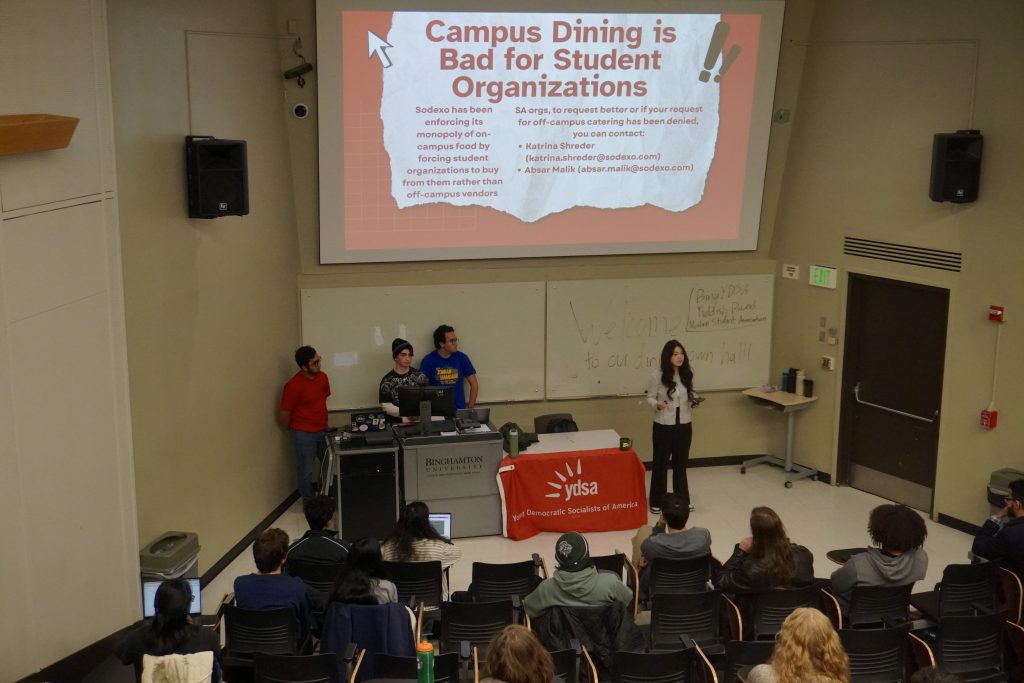
Binghamton University’s chapter of Young Democratic Socialists of America held a town hall on Thursday to discuss student complaints about campus dining services and progress made on their dining campaign.
The town hall outlined some of the demands that YDSA listed in a dining petition created last semester. The petition has garnered over 1,700 student signatures, according to Tyler Brechner, YDSA’s co-chair and a junior majoring in computer science.
“We’re running this campaign because we know that the only way if you want to improve dining is through collective action,” Brechner said. “Sodexo or the University — they’re not going to work to improve dining if you don’t make them do it. Sodexo is a multibillion dollar, multinational corporation that only cares about its profits, and the University is not really going to do anything about that because they are fine with the status quo.”
The town hall came two days after the Student Association Congress unanimously voted to pass a resolution recommending improvements to campus dining. The bill, titled “Resolution to Modernize On-Campus Dining,” called for greater access to kosher and halal dining options, transparency around allergen and dietary information, use of compostable utensils rather than single-use plastics and union protections for dining hall workers.
The University’s contract with Sodexo is set to expire this year. A University spokesperson told Pipe Dream that the University received four proposals so far from different vendors for the next contract. Last semester, a third-party consultant conducted a student survey and collected feedback and suggestions from about 1,800 students for the request for proposals from vendors.
A YDSA-led survey found most students have refilled their meal plan, Brechner said. Most students living on campus are required to purchase a resident dining meal plan and can choose between six different funding options, with a base membership fee of $2,110 per semester, which Brechner said was nearly $1,000 more than other SUNY schools and universities partnered with Sodexo.
Irene Cui, the BU Council Representative and a junior majoring in economics, attended the town hall and spoke about a lack of healthy meal options and the challenges many students face under the dining dollars system.
“Students shouldn’t have to trade their health for affordability or make impossible choices between accessible food options and essentials,” said Cui. “When the cost of eating well becomes out of reach, it sends a very clear message about whose needs are being met and whose are not.”
Bushra Mussarat, co-president of the Muslim Student Association and a senior majoring in integrative neuroscience, said the University’s catering policies make it difficult for the organization to use outside catering vendors.
According to the University Dining Services website, outside catering with costs over $300 must be approved by Auxiliary Services and BUDS through an online Food Policy Portal. (8) Mussarat said the MSA faced difficulties with a lack of communication on changes in the portal and a decline in requests for off-campus catering.
The MSA also said the University lacks sufficient halal options, with only three stations on campus. Chenango Champlain Collegiate Center offers halal food from 11 a.m. to 5 p.m. on weekdays, with no service on weekends. Chick-N-Bap and Royal Indian also offer halal options, but both are located in the MarketPlace, where food prices are typically higher than in the dining halls.
“The MSA serves one of the largest populations of Muslim students on campus, and Sodexo’s recent changes to off-campus catering approvals directly affect our community during Ramadan,” MSA wrote to Pipe Dream. “Muslim students are already impacted by inconsistent dining hall hours and limited halal options, these factors place Muslim students especially those living on campus at a significant disadvantage and is a burden that will increase during a holy month when reliable access to appropriate meals is essential.”
A representative from the Yiddish Bund also discussed poor accessibility of kosher food at dining halls. The Kosher Corner at C4 is open six days a week but closed for breakfast and all of Saturday.
Another complaint listed on the YDSA petition included lack of sanitation and quality of food, according to Stephen DiFilippo, YDSA’s public relations coordinator and a sophomore double-majoring in philosophy, politics and law and economics.
Data published by the Press & Sun-Bulletin found numerous health code violations [HYPERLINK: https://www.bupipedream.com/news/auto-draft-1673/172425/] in campus dining halls last month, including food storage at insufficient temperatures, improper cleaning and storage of utensils and the presence of insects and rodents. C4 has failed seven out of eight health inspections conducted since Oct. 23, 2020. Over the past five years, all four campus dining halls were found to have critical and noncritical violations.
Sodexo did not return Pipe Dream’s requests for comment.
“We are pleased that Binghamton Auxiliary Services Corporation has agreed to many of our health and safety demands: financial penalties for dining providers who fail health inspections and additional third-party inspections,” YDSA wrote in a statement to Pipe Dream. “We are disappointed that they, along with President D’Alleva, refused our request to attend our town hall and hear concerns directly from students and multicultural organizations.”
Editor’s Note: Tyler Brechner is a News writer for Pipe Dream. He had no part in the writing or editing of this article.