





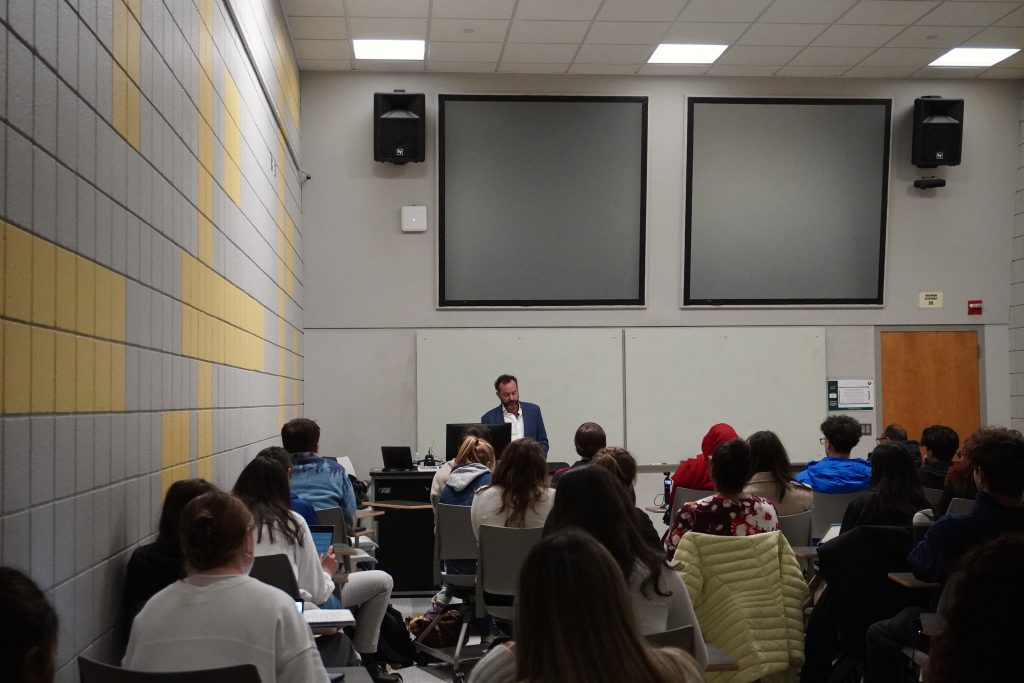
The Institute for Genocide and Mass Atrocity Prevention hosted a former U.S. State Department deputy ambassador for a lecture earlier this month as part of this semester’s visiting practitioner program.
The talk, titled “Re-Homing Atrocity Prevention: Imagining a Future for U.S. Foreign Policy,” focused on the United States at a time when the country appears to be taking a less active role in international atrocity prevention efforts. David Mandel-Anthony is the former deputy to the Ambassador-at-large for Global Criminal Justice in the state department’s Office of Global Criminal Justice, where he oversaw U.S. policy on preventing and responding to mass atrocities. In this role, Mandel-Anthony operated in Burundi, Uganda, the Democratic Republic of Congo, Sierra Leone, Liberia, Guatemala, Ukraine and other nations.
Throughout his career, he also led policy portfolios on matters like international hybrid courts, atrocity prevention and human rights law.
Earlier this year, the Office of Global Criminal Justice was eliminated as part of a major overhaul by the Trump administration.
Mandel-Anthony began by explaining the history of U.S. policy toward atrocity prevention, starting in 2007 with the creation of the Genocide Prevention Task Force. The task force then published a report detailing why atrocity prevention should be incorporated into U.S. foreign policy, arguing that ongoing atrocities undermined American interests by creating regional instability, refugee crises and a rise in terrorism.
The Office for Global Criminal Justice was established in 1997 as the Secretary’s Office on War Crimes Issues.
“Rehoming atrocity prevention is not just about policy,” Mandel-Anthony said during the talk. “It is about identity, it is about recognizing that American power when paired with American responsibility can serve humanity rather than simply our own self-interest and convenience.”
“It is about identifying with pluralism and the strengths that come with pluralism, and it’s about transforming our lessons, failures and aspirations into a strategy that is about as much as who we are at home as about what we do,” he continued. “And if we do this, if we truly integrate reflection, accountability and imagination into the machinery of U.S. power, then we can offer the world not just our might but our credibility, not just our rhetoric, but our example and that’s the promise of rehoming atrocity prevention and it’s a promise worth striving for.”
While Secretary of State Marco Rubio claimed the GCJ’s legally authorized functions would be reassigned to a different office in May, Democratic lawmakers said few details have been revealed about “whether the rest of GCJ’s broader responsibilities will continue or be reassigned within the new organizational structure.”
Jenna Norosky, a postdoctoral associate at I-GMAP, said the talk helped students understand the importance of U.S. influence in the field and connect with those working to prevent future atrocities.
“l was pleasantly surprised to get, I think, a really self-reflective — in the sense of the broader U.S. — take on what our stance or position in the world has been, and what that might look like going forward,” said Norosky. “But as an educator myself, l really value opportunities like this where students can ask questions to folks whose jobs might seem very much removed from their own day-to-day lives.”
The I-GMAP’s visiting practitioner program allows students to engage with those actively working in the field of atrocity prevention. Atrocity prevention practitioners visit the Greater Binghamton area for one week and engage with students, faculty and the local community.
In an interview with Pipe Dream, Kerry Whigham, founding co-director of I-GMAP and an associate professor of public administration, said he hoped students would learn the importance of the United States’ role in atrocity prevention.
“I’m hoping that they see, one, the complicated role that the U.S. has played, both for good and for bad when it comes to foreign policy and its relationship to preventing atrocity crimes,“ Whigham said. “But also, I hope that they’ll think about what our responsibility is now living in a country that is experiencing democratic backsliding, what it means when the U.S. is stepping back from its role of being a defender of human rights and a promoter of atrocity prevention globally and the negative consequences that’s going to have for many, many societies around the world.”