





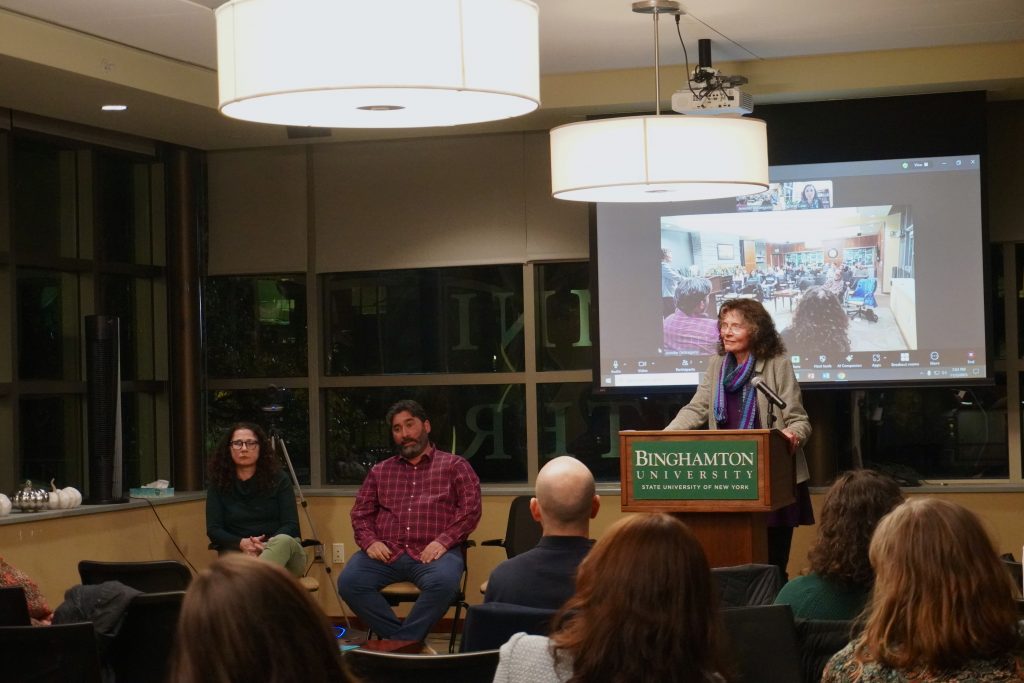
Three Binghamton University creative writing alumni shared their work last Wednesday, continuing the cycle of artistic inspiration that the University has fostered since its founding. Novelist Aggeliki Pelekidis MA ‘08, Ph.D ‘12, creative nonfiction author Jennifer Case Ph.D. ‘14 and poet Dante Di Stefano ’01, MA ’04, MAT ’06, Ph.D ’15 shared and discussed their works following introductions by Jaimee Wriston Colbert, distinguished professor of creative writing.
Colbert has made momentous contributions to the Creative Writing Program throughout her professorship at the University, and two of the alumni speakers were once enrolled in her classes. She described the unique experience of witnessing students return after making profound achievements.
“How special it is to see writers come back, remembering them in your workshop when they were much younger and they were still hopeful to maybe someday publish,” Colbert said. “Then they go off, and you’re not sure of where they are or what they do, and suddenly you get an email or something that so-and-so is getting a book out.”
Having experienced the life of both a BU student and a published writer, each speaker provided crucial insights for current students aspiring to write. Pelekidis, associate director of first-year writing and lecturer of the Writing Institute, read excerpts from her recently published novel “Unlucky Mel.”
Pelekidis shared insights into how one’s mental habits and relationship to their surroundings can impact creativity.
“Just thinking, giving myself the time to daydream and think without phones taking up my time and allowing myself to be bored,” Pelekidis said. “It’s amazing what you can figure out when you’re bored. When you give your brain the opportunity to ponder things.”
Through reading their works, the alumni created a powerful and singular experience for all in attendance, elevating their words with emotional connections to the pieces. Case, who read from her book “We Are Animals: On the Nature and Politics of Motherhood,” observed the effects of this kind of intimate environment.
“Written work has the ability to change the mood of a room and change the energy of a room,” Case said. “And so attending or being part of a reading gives you a much more communal experience than you necessarily would have as a writer, just sending my work out and having someone read it in isolation.”
Di Stefano added to this sentiment, explaining the value of reading poetry to a group through similar events.
“It’s just a wonderful way to experience the tripartite life of a poem,” Di Stefano said. “Because a poem exists on the page as a written thing, as a text, it exists in the poet’s body and it exists in the air as a spoken thing. This is a space where all three of those things come together for an audience and for the poet themselves.”
An event that shares the written word like this is nothing new to the University’s Creative Writing Program. Rather, it continues a tradition that is integral to the community. Jennifer DeGregorio Ph.D ‘21, lecturer and associate director of creative writing, said that the uniqueness of the University’s academic programs stems from its connections with alumni and dedication to sharing their work.
During their time at the University, the alumni received similar opportunities to share spaces with accomplished writers and witness firsthand the power of the written word. Di Stefano read excerpts from his book-length poem, “The Widowing Radiance,” for the audience.
He then described an experience from his time as an undergraduate at the University, witnessing Milton Kessler and Ruth Stone read their work as part of a past creative writing event. Seeing these two renowned poets and professors at the University had a lasting impact on Di Stefano.
“These were the first big poets that I saw read, and they were campus faculty,” Di Stefano said, “And they showed me something about what that life in poetry could be, or what a poem could be when it was spoken in a space with other people.”
Through events like this, the work and perspectives of alumni speakers fuel the next generation of BU writers, not only with powerful inspiration but with living proof that the program and community can be a path toward a life of sharing their voice with the world.
Tina Chang ‘91, professor and director of creative writing, emphasized the significance of the Alumni Reading.
“What makes this alumni reading so special is the sense of homecoming and inspiration it brings,“ Chang wrote. ”Writers who once discovered their voices here are returning to show how far their voices have reached. Celebrating our accomplished alumni, Jennifer Case, Dante Di Stefano, and Aggeliki Pelekidis, in three different genres (poetry, fiction, and nonfiction) reminds us of the breadth and depth of writing the Creative Writing program nurtures. In a time when free expression is being questioned, events like this affirm that storytelling itself is an act of freedom.”