





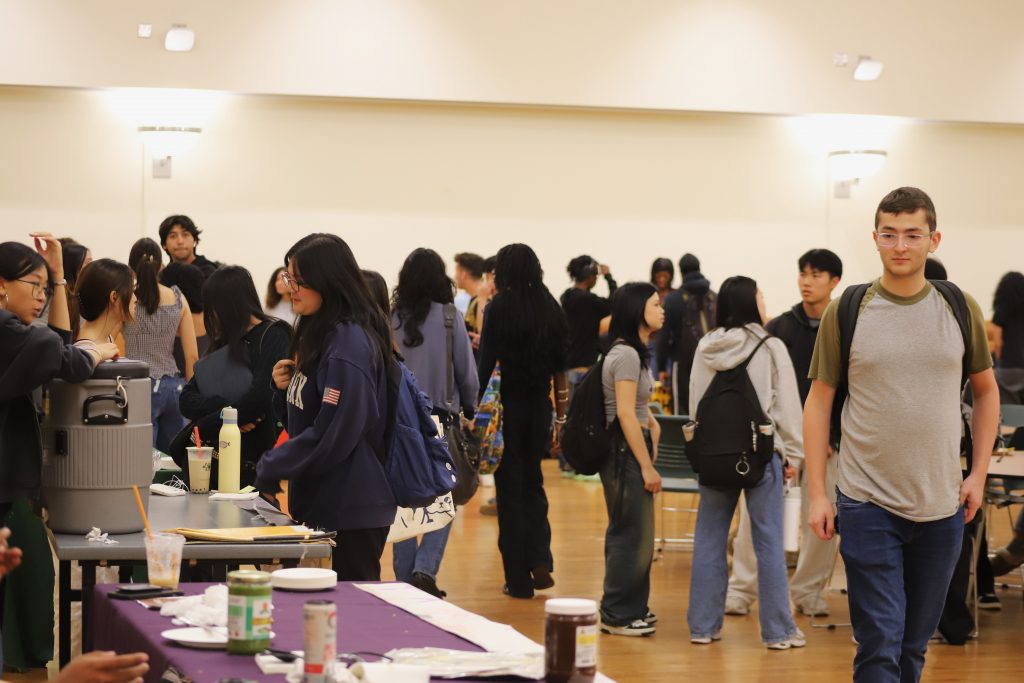
Last Monday, the Vice President for the Student Success Office held its third annual Multicultural Voting Fair to promote political engagement among students.
The fair was organized in collaboration with the Center for Civic Engagement and a variety of student organizations: the Asian Student Union; the Latin American Student Union; the Indian International Student Union; the Hindu Student Council; the Juvenile Urban Multicultural Program; the Caribbean Student Association; the Black Student Union; the African Student Organization; the Binghamton University Association of Mixed Students; the Global Public Health Student Association; the University’s chapter of the NAACP; Undivided; ColorStack BU; and the Society of Hispanic Professional Engineers.
“The third annual Multicultural Voting Fair aimed to promote voting behavior and civic engagement among the student body of Binghamton University, especially in students of color, who are historically underrepresented at the polls,” Kristina Donders, the vice president for student success and a senior double-majoring in mathematics and political science, wrote in a statement to Pipe Dream. “By giving out $1,500+ of cultural food and 300 cans of Celsius, the VPSS Office was able to entice students to learn about civic engagement.”
Students received cards at the fair entrance to get stamped by visiting each of the four voter information tables, which offered information about becoming a poll worker, registering to vote, pledging to vote and requesting an absentee ballot. Once they collected a stamp from each table, attendees went around to the many tables set up by multicultural organizations that offered food, drinks and snacks.
Donders described the event as a “huge success.”
“Even though it’s not a big voting year, we had three students register to vote at the event, 38 students actively go to vote.gov [HYPERLINK: vote.gov] to get registered, and 55 students go to the website to request absentee ballots,” Donders wrote.
Binghamton city’s mayoral election will be held on Nov. 4, with early voting from Oct. 25 to Nov. 2. Voters will decide whether to give incumbent Republican Mayor Jared Kraham a second term or elect his Democratic challenger, Miles Burnett.
Donders wrote that this election will “directly impact” students and showcase the importance of being active in local politics.
According to the Census Bureau’s Population Survey, voter registration among Black, Asian and Latino Americans has been persistently lower than that of white Americans. While Latinos and Asian Americans are among the fastest-growing electorates in the United States, they remain among the lowest in terms of voter registration. This is due to a myriad of factors, including historical and economic barriers to poll access and voter ID requirements.
“Voting in communities that are historically underrepresented, especially, is a really good way to start the conversation about how oppression begins and how we can fight to stop it,” said Hatim Husainy, an SA Congress representative for Hillside and a sophomore majoring in political science. “That conversation shouldn’t end at voting, but it’s a good place for it to start.”
Jestina Tam, vice president of multicultural affairs and a senior majoring in biology, volunteered at a table that provided absentee ballot request forms. Tam told Pipe Dream in a statement that it was “incredible” to engage with attendees and answer their questions about voting eligibility.
Students representing the NAACP described the importance of racially and culturally informed voter education.
“The NAACP has a huge history in promoting the right to vote for people of color, so it’s very important that, as an organization on campus, we also show up for events like this,” said Damel Stewart, the press and publicity chair for BU’s NAACP chapter and a sophomore majoring in biomedical engineering.
In early November, the VPSS office will host a “Chalk the Vote” event, where students can write non-partisan quotes and slogans on the Spine to encourage their peers to vote in the general election.
“Over the past two years, the Multicultural Voting Fair has helped dozens of students get registered to vote, become poll workers, request absentee ballots, and pledge to vote,” wrote Donders. “By putting students in a place where they can have support to become more civically engaged, while also getting free food, we’re able to get students genuinely excited about voting.”